
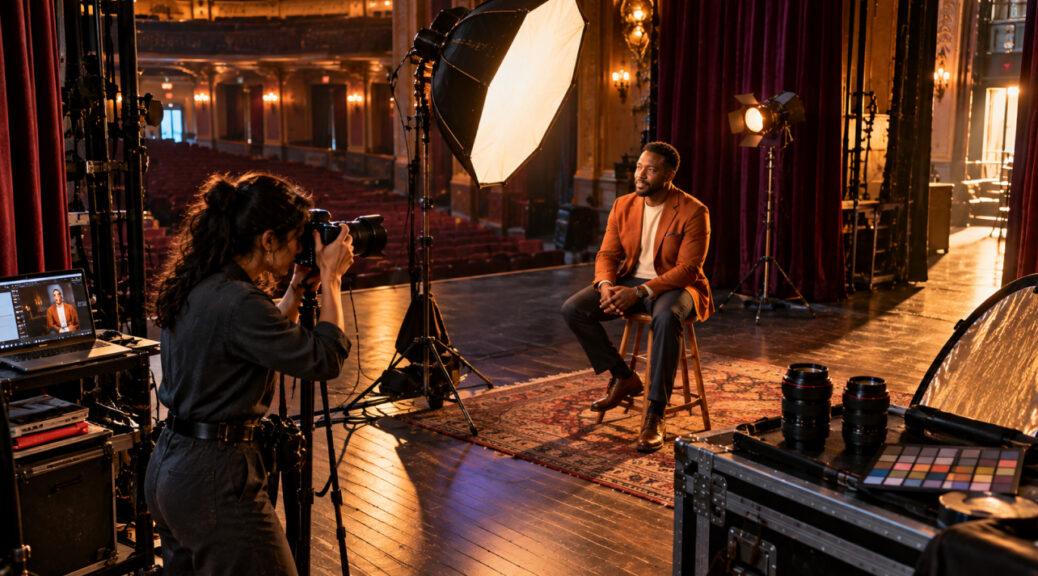
A professional portrait can change dramatically without changing the person being photographed. Move a light source, adjust the camera’s distance, or introduce a different background color, and the same subject can appear in an entirely different photographic setting.
But which decision matters most: lighting or lens choice?
On October 13, 2026, the Dallas Professional Photographers Association (Dallas PPA) scheduled a presentation by Joe Baker, a portrait photographer based in Lubbock, Texas, exploring three elements of his creative approach: lighting, color, and lens choice.
The program, titled What Makes Joe Baker Photography? Three Methods I Use to Create Dynamic Images and Stand Out Amongst the Crowd, was listed for 7:00–9:30 p.m. at Slate Venues at II Creeks in Richardson, Texas.
According to the official Dallas PPA event announcement, Baker specializes in high school and college graduation portraits, professional headshots, modeling portfolios, and family photography. He also teaches workshops and mentors other photographers.
His presentation description identifies off-camera flash as an important part of his creative process.
The event offers a useful starting point for examining a question that affects both photographers and their clients.
Lighting controls how a subject is illuminated and how the image feels. Lens choice influences framing, working distance, and how much of the surrounding environment appears. Neither works independently of the other.
Understanding that relationship can help people recognize the difference between a technically acceptable portrait and one that successfully communicates their personality or professional identity.
What Joe Baker’s October 13 Photography Program Set Out to Explore
Dallas PPA organized Baker’s October presentation around the idea that distinctive photography involves more than owning expensive equipment, producing elaborate edits, or winning awards.
The event description specifically identifies three creative decisions: lighting, color, and lens choice.
Baker’s professional background makes those subjects relevant to several types of portrait photography.
Graduation portraits often involve outdoor locations, changing sunlight, and personal styling choices.
Professional headshots typically require clear facial detail, controlled composition, and images suitable for websites or business profiles.
Modeling portfolios may call for more expressive lighting, varied camera angles, and different visual moods.
Family photography introduces additional challenges involving multiple subjects, natural expressions, and changing environments.
Baker’s official photography portfolio presents these specialties separately, including graduation photography, family portraits, professional headshots, and modeling work.
That variety illustrates why photographers need to understand how technical decisions serve different assignments.
A lighting arrangement suitable for a dramatic graduation portrait may be unnecessarily theatrical for a corporate directory.
Likewise, a lens that captures an entire family within a scenic environment may not be the most practical choice for a tightly framed headshot.
The publicly available event listing describes the intended subjects of Baker’s presentation. It does not provide a detailed post-event transcript or establish the specific demonstrations delivered during the meeting.
The technical comparisons below therefore draw on established photographic principles and published educational resources rather than attributing undocumented instructions to Baker.
Does Lighting or Lens Choice Matter More for a Professional Portrait?
The answer depends on what the photograph needs to accomplish.
If the subject’s face is poorly illuminated, improving the lighting may make the greatest immediate difference.
If the camera is positioned too close to the subject, changing the working distance and lens combination may be more important.
If the portrait looks technically correct but visually disconnected from the person’s professional identity, color, background, expression, and styling may deserve greater attention.
Lighting determines how brightness and shadow reveal the subject’s features.
A large, diffused light source can produce gradual transitions between illuminated and shaded areas.
A smaller, more directional source can create stronger contrast and more defined shadows.
Neither approach is automatically superior.
A softly illuminated corporate headshot and a dramatically lit editorial portrait may both be successful when their visual treatment matches their intended purpose.
Lens choice influences a different set of decisions.
A wider lens can include more of the environment, while a longer focal length allows tighter framing from a greater distance.
That difference affects the relationship between the person and the background.
For a conventional professional headshot, controlled lighting and a comfortable camera distance are usually more important than choosing the most expensive lens.
For a creative environmental portrait, showing the surrounding space may be essential to the story.
Baker’s emphasis on three separate photographic elements is useful because it encourages photographers to consider the entire image rather than search for one universally correct technical setting.
Why Lighting Changes the Mood of a Portrait
Lighting is one of the most immediately noticeable differences between an ordinary photograph and a carefully constructed professional portrait.
The position of a light source influences where shadows fall.
Its apparent size relative to the subject affects whether those shadows have soft or sharply defined edges.
Its intensity determines how strongly the subject is illuminated, while its color influences the appearance of skin, clothing, and the surrounding environment.
Consider a professional headshot taken beside a large window.
If the subject faces the window, the light may illuminate the face relatively evenly.
Turning the subject slightly can create more dimensional lighting, with one side of the face receiving stronger illumination.
Moving the subject farther from the window or introducing a reflector changes the balance again.
These adjustments can produce different photographs without changing the camera or lens.
Nikon’s professional portrait photography guidance emphasizes appropriate exposure, controlled lighting, accurate focus, and awareness of distracting shadows.
The guidance also discusses using flash and reflected light when existing illumination is insufficient.
For clients, this helps explain why two photographs taken with similar cameras can look different.
The result depends partly on whether the photographer understands the available light and can modify it intentionally.
A good photographer should also recognize when additional lighting is unnecessary.
Soft natural light may already provide the appearance required for a particular portrait.
Professional quality comes from controlling the result, not from using the largest possible lighting setup.
How Off-Camera Flash Gives Photographers Greater Creative Control
Joe Baker identifies off-camera flash as an important technique in his photographic practice.
Unlike a flash mounted directly above the camera lens, an off-camera light can be positioned independently.
This allows the photographer to control the direction of illumination and create a more deliberate relationship between the subject and background.
For example, a photographer working outdoors near sunset may expose the background to preserve the color of the sky while using a separate flash to illuminate the subject.
Without additional light, the person might appear too dark against the brighter environment.
A carefully positioned flash can help maintain detail in both areas.
The photographer can also modify the light using a softbox, umbrella, reflector, or other appropriate accessory.
These tools influence how light spreads and how shadows appear.
In Nikon’s off-camera flash photography guide, the photographer explains how independently positioned flash can supplement existing light without overwhelming the atmosphere of a scene.
That distinction matters.
Artificial lighting does not have to look artificial.
A photographer may use flash simply to brighten the subject’s eyes, reduce an unwanted shadow, or balance the difference between the foreground and background.
Other assignments call for a more noticeable treatment.
A graduation portrait might use directional lighting to emphasize the subject against an evening sky.
A modeling portfolio might explore stronger contrast to create a specific editorial mood.
A business headshot may benefit from softer, more consistent illumination.
The technique should follow the purpose of the photograph.
Why Lens Choice Changes How a Face Appears in Photographs
Lens choice matters, but there is an important technical distinction that is frequently misunderstood.
Camera-to-subject distance determines perspective. Focal length determines how much of the scene is included from that position.
When photographers use a wide-angle lens for a tightly framed headshot, they generally move closer to the subject.
At close distances, features nearest the camera appear relatively larger than features farther away.
The nose, for example, may appear more prominent in relation to the ears.
This is a perspective effect caused by the camera’s position, not simply by the focal-length number printed on the lens.
A longer lens allows the photographer to move farther away while maintaining a similar head-and-shoulders composition.
From that greater distance, differences in the apparent size of facial features become less pronounced.
Researchers Martin S. Banks, Emily A. Cooper, and Elise A. Piazza examined the relationship between focal length, camera position, and image perception in the 2014 paper Camera Focal Length and the Perception of Pictures.
Their discussion illustrates how photographs made at different camera distances can produce different apparent depth relationships.
For professional headshots, this means photographers should think about working distance before treating a particular lens as a guaranteed solution.
An 85mm lens is a popular portrait option, but it does not automatically produce a better image.
The camera position, subject distance, lighting, background, and photographer’s direction still matter.
What Different Portrait Lens Focal Lengths Actually Do
Photographers often use different focal lengths according to the type of portrait they are creating.
The following examples refer to approximate full-frame-equivalent focal lengths. Cameras with smaller sensors may use different physical focal lengths to achieve comparable framing.
| Focal Length | Common Portrait Application | Main Creative Consideration |
|---|---|---|
| 35mm | Environmental portraits, workplace photography, lifestyle images | Includes more surroundings; tight close-ups require care with camera distance |
| 50mm | Half-body portraits, natural workplace images, general portrait sessions | Flexible framing with a moderate working distance |
| 85mm | Professional headshots, individual portraits, studio photography | Supports tight framing from a comfortable distance |
| 135mm | Tight headshots, editorial portraits, outdoor portraits | Narrower field of view and greater working distance for similar framing |
These are practical examples rather than mandatory rules.
Nikon’s portrait lens recommendations include standard and short-telephoto options, with focal lengths such as 60mm, 85mm, and 105mm among its suggested choices.
The appropriate lens also depends on the available space.
A photographer working inside a small office may not have enough room to use a long telephoto lens comfortably.
A photographer creating a portrait in a large outdoor location may have considerably more freedom.
Lens choice also affects the visible background.
A wider field of view can reveal more of an office, studio, workshop, or natural environment.
A narrower field of view can simplify the composition by excluding distracting elements.
The objective is not to eliminate the environment from every photograph.
It is to decide how much of that environment contributes to the subject’s story.
Why Color Is the Third Essential Element of Portrait Photography
Lighting and lens choice receive considerable attention, but color can be equally important to the overall composition.
Joe Baker included color alongside lighting and lens selection in the description of his October 13 program.
That emphasis is relevant because color affects how different parts of a photograph relate visually.
A warm background may create a different atmosphere from a cool gray studio backdrop.
A brightly colored jacket may become a prominent part of a personal-branding portrait.
A neutral wardrobe can allow the viewer’s attention to remain concentrated on facial expression.
However, photographers must distinguish creative color choices from accurate color reproduction.
Skin tones should not be altered unintentionally by incorrect white balance or uncontrolled mixtures of light sources.
For example, daylight entering through a window and warm indoor lighting can produce different color casts in the same room.
Adding flash introduces another light source that may need to be balanced with the existing environment.
Nikon’s guide to color temperature and flash photography explains how photographers use color temperature and ambient-light control to influence the appearance of a scene.
For professional portraits, color should support the subject rather than create unnecessary distractions.
A creative entrepreneur might choose a vivid background that complements an established visual identity.
A healthcare professional may prefer a restrained setting that keeps attention on the individual.
A musician or performer might want a more expressive combination of colored lighting and environmental details.
These are communication choices, not universal judgments about personality or competence.
There is no single background color that makes every person appear more trustworthy or professional.
Why a Dramatic Portrait Is Not Always the Best Professional Headshot
An eye-catching photograph and an effective professional headshot are not necessarily the same thing.
A dramatic portrait may feature strong shadows, colored lighting, an unusual camera angle, or an elaborate environment.
Those choices can be appropriate for creative portfolios, promotional materials, or personal artistic projects.
A professional headshot often has a more specific purpose.
It may need to work as a small image on LinkedIn, appear beside a company biography, or fit into a directory containing portraits of several employees.
In those situations, recognizability, facial clarity, and consistent framing may be more important than dramatic visual effects.
The photographer must understand how the image will be used.
A business owner who needs photographs for multiple marketing channels may benefit from a combination of straightforward headshots and more expressive environmental portraits.
An actor may require different images for different casting contexts.
A graduating student may want both a traditional portrait and photographs that reflect personal interests.
Joe Baker’s portfolio includes these different photography categories, illustrating why portrait work cannot be reduced to one visual formula.
The best technical choices depend on the intended result.
What the Dallas PPA Headshot Marathon Adds to the Discussion
The October 13 Dallas PPA program included another relevant element.
The association advertised a pre-meeting Headshot Marathon, during which participating members offered to photograph fellow Dallas PPA members without charging for the session.
According to the event listing, the opportunity was organized on a first-come, first-served basis.
The announcement encouraged photographers to consider whether their existing headshots were outdated or no longer suitable for their professional presentation.
That detail connects the technical discussion to a practical need.
Even photographers who understand lighting, lenses, and posing may need updated images of themselves.
A professional headshot can become less useful when it no longer resembles the individual or no longer matches how the person presents themselves professionally.
An image may also need updating because its intended use has changed.
A casual portrait suitable for a personal social-media profile might not provide the framing or resolution needed for a business website.
Likewise, a photograph created for a formal company directory may not offer the flexibility required for a more expressive personal-branding campaign.
The Headshot Marathon was a scheduled opportunity rather than evidence that every participant received a particular result.
Its inclusion in the event nevertheless reinforces an important point: professional photographers are also users of portrait photography, and the same principles apply to their own public images.
How to Prepare for a Portrait Session When Lighting and Lens Choice Matter
Clients do not need to understand every camera setting before booking a professional portrait.
However, a few preparation decisions can help the photographer choose the appropriate visual approach.
The first is identifying the intended use of the photographs.
A conventional LinkedIn headshot, a graduation portrait, and an editorial image for a personal website may require different framing and lighting.
The second is discussing the location.
A small office with limited window light presents different challenges from an outdoor setting or a professional studio.
The photographer should be able to explain how the available environment affects the session.
Wardrobe is another consideration.
Clothing colors and textures interact with lighting and background choices.
Highly reflective materials may create bright highlights, while certain patterns can become distracting in tightly cropped photographs.
Clients should choose clothing that represents their preferences and professional context rather than adopting a style that feels unfamiliar.
For people who are uncomfortable posing, discussing that concern in advance can also help.
A photographer can adjust the pace of the session, provide clear direction, and allow time for different expressions.
Technical control is most useful when it supports a comfortable experience for the subject.
Five Questions to Ask a Professional Portrait Photographer
Before booking, consider asking:
- How will you choose the lighting for my session? The answer should reflect the location, intended style, and practical requirements rather than one fixed setup.
- What type of lens and framing will you use? A photographer should be able to explain whether the session will emphasize close headshots, half-body portraits, or environmental images.
- Can we create more than one visual style? Depending on the package and available time, different backgrounds or lighting arrangements may provide useful options.
- How will you handle skin tones and color accuracy? Ask whether the photographer adjusts white balance and reviews the images for unwanted color casts.
- What finished images will I receive? Clarify the number of photographs, editing approach, delivery schedule, file formats, and permitted uses.
These questions help establish whether the photographer’s technical approach matches the client’s expectations.
They also create an opportunity to discuss comfort, accessibility, and the intended appearance of the final images.
What Photographers Can Learn From Baker’s Three-Part Approach
For emerging photographers, the October Dallas PPA program offers a useful framework for creative development.
Lighting, color, and lens choice are separate technical subjects, but they become more powerful when considered together.
A photographer might begin by choosing the desired composition.
That decision influences camera position and focal length.
Next comes the lighting arrangement, which determines how the subject and environment are illuminated.
Color choices then help establish the relationship between clothing, background, and light.
In practice, these decisions often overlap.
Changing the camera position may reveal an unwanted background element.
Moving a light source may create a new reflection or alter the appearance of a colored surface.
Adjusting the background may require a different exposure or white-balance setting.
Experienced photographers recognize these interactions and adapt accordingly.
The lesson is not that every photographer must use off-camera flash or a particular portrait lens.
It is that strong photographs usually result from deliberate decisions.
A photographer who understands why a technique works can adapt it to different people and environments.
Someone who relies only on a familiar camera preset or editing style may find it harder to respond when conditions change.
Technical knowledge creates flexibility, but communication and creative judgment determine how that flexibility is used.
The Best Professional Portrait Balances Technique With Personal Identity
Joe Baker’s October 13, 2026, Dallas PPA program placed lighting, color, and lens choice at the center of a discussion about distinctive photography.
Those three elements help explain why portraits made with similar equipment can look dramatically different.
Lighting shapes the distribution of brightness and shadow.
Lens choice determines framing and influences the working distance needed for a particular composition.
Color establishes visual relationships between the subject, clothing, and environment.
But the strongest professional portraits require another consideration: the person being photographed.
A technically sophisticated image can still be unsuccessful if it does not meet the client’s needs or represent them recognizably.
A simple portrait made with appropriate lighting, comfortable posing, and thoughtful framing may be more useful than an elaborate image created primarily to demonstrate equipment or editing skills.
For clients, that means choosing a photographer who can explain their process and adapt it to the intended purpose.
For photographers, it means treating technical decisions as creative tools rather than fixed formulas.
Lighting and lens choice do not compete for importance. They work together to produce a portrait that is visually effective, technically controlled, and appropriate for the person it represents.