
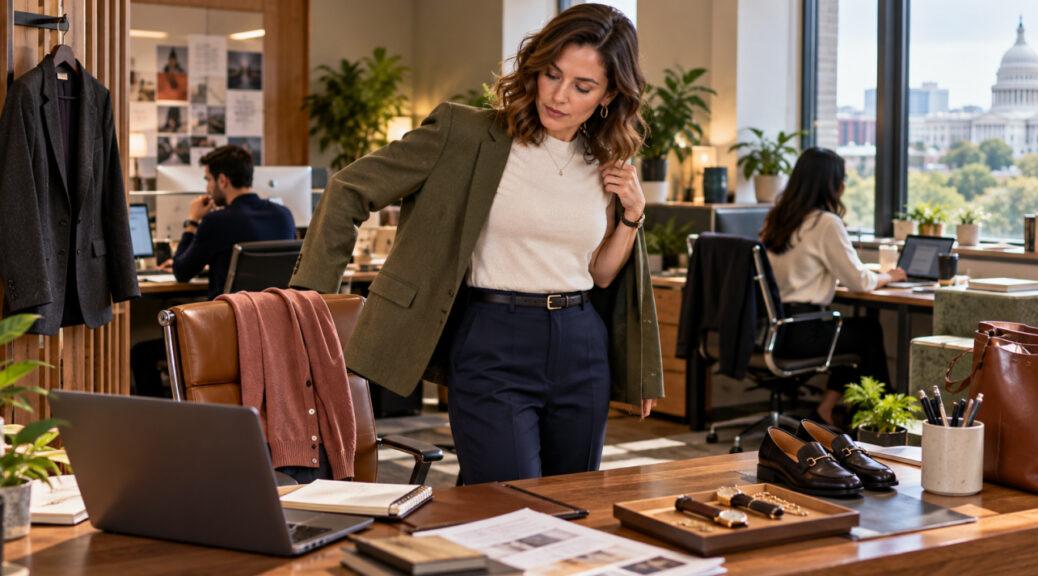
Before a customer asks an employee a question, hears their voice or experiences their service, clothing may already have communicated something.
That does not mean a polo shirt makes someone more competent, or that a particular color guarantees good customer service. It does mean clothing can function as an immediate visual cue: Is this person an employee? Can I approach them? What role might they have? Does their appearance fit the environment I just entered?
That question became particularly relevant in the United States in September 2026.
On September 28, 2026, Progressive Grocer reported that The Kroger Co. had updated its store-employee uniform policy for the first time in a decade. Citing Bloomberg reporting, the publication said nearly 400,000 employees across Kroger banners were moving from their own tops to company-issued shirts. General store employees receive polos or T-shirts in blue, red or black depending on the corporate division, while store leaders have button-down shirts and quarter-zip options. Kroger’s new uniform policy is intended in part to make employees easier for shoppers to identify.
The scale is substantial. Kroger’s latest annual filing reported more than 403,000 full- and part-time employees and 2,697 supermarkets as of January 31, 2026, across 35 states and the District of Columbia.
Kroger is not alone. Target announced updated employee-color guidelines on September 16, explicitly saying that customers need to be able to quickly spot store employees. Its guidelines call for a sleeved red top or vest, blue denim or khaki bottoms and minimal non-Target logos.
Two enormous American retailers making employee appearance part of the customer experience raises a bigger question: can what employees wear actually change a customer’s first impression?
Research suggests clothing can influence some initial perceptions and behaviors. But the interesting part is not simply whether employees look “professional.” It is how clothing communicates identity, role, consistency, approachability and context before an interaction begins.
First Impressions Can Begin Before Anyone Speaks
Imagine walking into an unfamiliar store.
You need help finding something.
There are 15 people in your field of view.
Which one works there?
Before you read a name badge, you are probably looking for visual patterns: a particular shirt color, vest, apron, logo or style of clothing.
In that situation, employee clothing is performing a practical function.
It is visual identification.
A 2020 study published in the Journal of Business Research examined how employee apparel affected shoppers’ intentions to approach workers. Across three studies, including a 360-degree video experiment and a behavioral laboratory study, researchers Christian Barney, Carol L. Esmark Jones and Adam Farmer found that apparel can act as a cue affecting whether customers approach an employee. Perceptions of expertise and service expectations were part of that relationship. employee apparel and shopper approach research
That does not mean a uniform objectively makes someone an expert.
It means customers sometimes have to make a quick decision about whom to approach with limited information. Clothing can become one of the available signals.
That distinction matters.
A first impression is an interpretation, not proof.
Recognition May Matter More Than Formality
When people hear “professional employee appearance,” they may imagine formal clothing.
That is not necessarily what a retailer needs.
A supermarket employee does not need to resemble a banker. A hardware-store employee does not need to dress like an attorney. A hotel concierge, restaurant server, airline employee, sales associate and software-store specialist all operate in different visual environments.
The useful question is therefore not:
Does this outfit look formal?
It is:
Does this outfit make sense for this person’s role?
Research has explored that distinction.
A Journal of Business Research experiment published in 2004 found that what participants considered appropriate employee dress influenced expectations of service quality and purchase intentions in the banking context studied. Importantly, “appropriate” was connected to the professional context rather than simply maximum formality. research on employee dress and service expectations
That limitation is important when applying the finding elsewhere.
A dark suit might fit a particular financial-services interaction while appearing unnecessarily formal in a grocery aisle. A bright branded shirt could work extremely well for retail identification while being inappropriate in another professional setting.
Context changes the meaning of the clothes.
Kroger’s Uniform Change Is Really About Visibility
Kroger’s September uniform story is interesting because the central visual problem was not that employees supposedly looked unfashionable.
It was recognition.
Progressive Grocer reported that the refresh followed customer feedback and employee surveys, and that standardized uniforms are intended to make staff easier for shoppers to identify. The company also modified apron construction, replacing a straight-back design with crossing straps after complaints about neck irritation.
That turns clothing into something closer to environmental design.
Think about other visual signals inside a store.
Aisle signs tell you where products are.
Color coding separates departments.
Floor markings guide movement.
Shelf labels identify prices.
Employee clothing can perform a related function by answering a simple question almost instantly:
Who can help me?
In that sense, a recognizable uniform is not merely fashion or corporate branding.
It is part of the store’s visual navigation system.
Target Is Making A Similar Bet On Recognition
Target provides an interesting comparison because its approach allows more variation while preserving a recognizable visual code.
On September 16, 2026, the Minneapolis-based retailer said its updated Team Colors guidelines were designed to create a more cohesive and recognizable store environment. Target said employees should wear a sleeved red top or vest with blue denim or khaki bottoms and minimal non-Target logos. The company operates more than 2,000 U.S. stores and has more than 350,000 store team members.
The company is also experimenting with how much personal style can exist inside that visual system.
Target’s Collection186, named after the Pantone 186 red associated with the retailer, includes employee apparel ranging from T-shirts and polos to cardigans, track jackets, quilted jackets, blazers and vests.
A limited 16-piece Design Drop launches October 5, 2026, with ideas from Isaac Mizrahi and input from Target employees. Target says the pieces incorporate functional elements including flexible movement, moisture-wicking fabrics and snag resistance. Prices begin at $10. The collection is optional; employees can continue wearing other clothing that meets company policy. Target’s Collection186 employee apparel
That creates an interesting visual compromise.
The company can preserve an instantly recognizable red employee identity without requiring every worker to look exactly the same.
Consistency Does Not Require Identical Outfits
There is a difference between consistency and uniformity.
Imagine a store where employees can choose between polos, T-shirts, cardigans and jackets, but all of them use a recognizable color.
Customers can still identify the pattern.
That can allow employees some control over fit, temperature, personal preference and style while preserving a visual connection to the company.
The same idea works outside retail.
A restaurant might use consistent aprons over individually chosen clothing.
A creative studio might have no uniform but maintain a recognizable level of smart-casual presentation.
A hotel may use more formal coordinated clothing because the environment calls for it.
A salon might allow extensive personal expression because individual style is itself part of the customer experience.
The visual system does not need to be identical everywhere.
It needs to make sense within the environment.
Customers May Read Clothing As Part Of The Brand
An employee is not a logo, but customers can still experience employee appearance as one part of a company’s visual environment.
A 2019 study in the Journal of Retailing and Consumer Services analyzed 437 usable customer responses in the context of full-service restaurants. Researchers found relationships among perceived appropriateness of employee dress, employee-brand congruence, customer-employee interaction and the customer’s relationship with the restaurant brand. service employee dress research
Again, this should not be stretched into the claim that clothing determines whether someone receives good service.
It does show why employee clothing deserves attention as part of a larger visual experience.
Walk into a minimalist luxury store and the employee wardrobe may echo the restrained environment.
Enter a casual outdoor retailer and functional clothing may reinforce the store’s identity.
Visit a playful family restaurant and bright colors may make sense.
The employee is physically present inside the brand environment, so clothing inevitably becomes part of what the customer sees.
Fit And Condition Still Change The Visual Message
Recognition is only one part of employee appearance.
Condition matters too.
Two employees could technically be wearing the same uniform while creating very different visual impressions if one shirt is clean, correctly fitted and in good condition while the other is heavily wrinkled, stretched or visibly worn.
This is where the principles from everyday professional dressing still apply.
Fit affects silhouette.
Wrinkles affect visual neatness.
Fabric condition affects whether a garment appears maintained.
Shoes affect the overall finish.
Layering affects whether the uniform still reads clearly.
For workers who do not wear a prescribed uniform, Finest Image’s guide to what business casual means in 2026 examines how tailored separates, knitwear and polished footwear can communicate workplace readiness without requiring a matching suit.
But employers also need to be careful about what they ask clothing to accomplish.
If the uniform looks polished but is uncomfortable during an eight-hour physical shift, its visual success may come at a practical cost.
Employee Comfort Belongs In The Discussion
A uniform is experienced differently by the person wearing it than by the customer looking at it.
That makes fit, fabric, temperature and movement important.
Kroger’s reported decision to change apron straps after the previous design irritated employees’ necks illustrates the issue clearly. Target’s Collection186 similarly emphasizes movement, moisture management and snag resistance alongside appearance.
Older research has also examined this employee side of uniforms.
A study by Kathy Nelson and John Bowen involving 201 employees at Las Vegas casino-resorts found a significant relationship between uniform design and employee attitudes. The researchers argued that appearance, function, character and comfort can all matter to workers’ experiences of their uniforms. uniform design and employee attitudes
A more recent study published in the Journal of Fashion Marketing and Management surveyed 2,560 uniform wearers in the United Kingdom. It identified factors including positive feelings, suitability and practicality, individual tailoring, visibility and branding among uniform-design priorities. Because that study involved U.K. workers, its population should not be treated as directly representative of American retail employees, but it reinforces why uniform design cannot be evaluated from the customer’s perspective alone.
A uniform has to work on a body, not just in a branding presentation.
Looking Professional Is Not The Same As Looking Formal
Kroger’s new T-shirts provide a useful example.
A T-shirt is normally considered less formal than a button-down shirt.
Yet if hundreds of employees are wearing clearly identifiable company shirts in good condition, the visual result can potentially appear more organized than allowing unlimited variation in personal tops.
Professional appearance is therefore not a straight line from T-shirt to polo to button-down to suit.
Context can matter more than the garment category.
For customer-facing employees, “professional” might mean recognizable, clean, functional and appropriate for the task.
For an attorney, the visual standard could be considerably more formal.
For a designer, it may involve more individuality.
For a grocery employee moving products, retrieving carts or working around food, practical considerations become unavoidable.
The same clothing cannot communicate the same thing in every environment.
Personal Style Can Still Exist Inside A Dress Code
Uniform discussions can become uncomfortable when “professional appearance” is treated as a demand for everyone to look the same.
That is not necessary.
Hair, body type, cultural dress, tattoos, jewelry, religious clothing, disability-related needs and personal identity can all intersect with workplace appearance policies. Employers also have legal obligations that go well beyond aesthetic preferences.
From a visual-design perspective, a company can establish recognition without eliminating individuality.
A consistent color is one option.
A vest is another.
An apron can work.
A name badge can help.
A specific outer layer can identify staff while allowing more freedom underneath.
Target’s current strategy demonstrates one version of that approach: maintain the recognizable red-and-denim-or-khaki system while providing multiple garment styles rather than requiring one identical outfit.
Visual consistency does not have to mean visual sameness.
Clothing Can Change Expectations, Not Reality
This is the most important limitation.
An employee can look knowledgeable and give incorrect information.
Someone can look approachable and provide poor service.
A worker can have an immaculate uniform and be poorly trained.
Another employee can have unconventional personal style and be exceptionally skilled.
Clothing cannot tell a customer whether a person is kind, competent, efficient, knowledgeable or trustworthy with certainty.
Research into employee dress generally measures things such as perceptions, expectations, approach intentions and reported interactions. Those outcomes are meaningful, but they are not the same as objectively measuring job performance.
That distinction protects the discussion from turning into appearance-based stereotyping.
The visual cue can influence the beginning of an interaction.
The employee’s actions determine what happens after it.
First Impressions Are Built From More Than Clothing
Customers rarely see an employee outfit in isolation.
They see it inside an environment.
Lighting matters.
Store cleanliness matters.
Signage matters.
Shelves matter.
Employee posture matters.
Facial expression matters.
Whether someone looks available or overwhelmed matters.
Whether the customer can find help matters.
And, once the conversation begins, behavior quickly becomes more important than clothing.
Target’s September 16 customer-experience announcement makes this broader context unusually clear. Its clothing changes are only one part of a program that also includes additional employee training, store presentation standards, staffing practices and expectations around greeting and helping customers.
Kroger is also making its uniform changes while focusing heavily on store execution. The company reported $34.6 billion in second-quarter 2026 sales, up from $33.9 billion in the comparable 2025 quarter, while identical sales excluding fuel increased only 0.2%. CEO Greg Foran has emphasized customer value, quality, convenience and a shopping experience customers can trust. Kroger’s second-quarter 2026 results
A shirt cannot accomplish those objectives by itself.
The Strongest Uniform May Be The One Customers Barely Notice
Successful employee clothing does not necessarily need to attract attention.
In many situations, its job may be simpler.
The customer should recognize the employee.
The employee should be able to move comfortably.
The clothing should suit the work.
The visual identity should make sense in the environment.
Then the interaction can take over.
That is what makes Kroger’s 2026 change interesting from an image perspective. The retailer is not simply choosing different shirts. It is changing one of the first visual signals that customers encounter across a workforce of roughly 400,000 people.
Target is making a related move while leaving more room for stylistic variation inside its red visual identity.
Neither case proves that standardized clothing will automatically improve customer satisfaction. That would require evidence about the actual outcomes of these programs over time.
What they do demonstrate is that major retailers are treating employee appearance as part of wayfinding, recognition and customer experience, rather than as an isolated dress-code issue.
So, can what employees wear change a customer’s first impression?
The evidence suggests it can influence the cues from which that impression begins—especially whether an employee looks identifiable, appropriate to the setting and approachable.
But clothing only gets the interaction started.
What the employee actually does next is a much stronger test of the impression the customer ultimately takes home.