

Few workplace instructions create more uncertainty with fewer words than “business casual.”
A company says the office is business casual, but what does that actually mean in 2026?
Can you wear jeans?
Are sneakers acceptable?
Does a T-shirt become business casual when you put a blazer over it?
Do you need a collared shirt?
And if everyone else arrives wearing knitwear and relaxed trousers, can dressing too formally make you look almost as out of place as dressing too casually?
The confusing answer is that business casual is not one outfit.
Current U.S. workplace guidance describes it as a middle ground between traditional business clothing and casual dress. Indeed’s updated 2026 guidance defines business casual as professional clothing with a more relaxed approach than traditional business attire, while emphasizing that its meaning varies among companies, industries and career levels. Indeed’s business casual guide
A September 25, 2026 update from DressDex describes the U.S. version even more simply: polished office separates without requiring a matching suit or tie. Its conservative starting point includes tailored trousers or chinos, skirts or structured dresses, collared shirts, blouses or fine knits, and polished footwear. U.S. business casual guidance
The important word is not casual.
It is business.
Business casual gives you more freedom than traditional corporate dressing, but the clothes still need to make sense in the professional environment around you.
Business Casual Sits In The Middle
It helps to stop treating workplace clothing as two categories: formal and casual.
There is a spectrum.
At one end, ordinary casual clothing might include T-shirts, jeans, sneakers and other clothes someone could comfortably wear outside work.
At the other end is business formal: coordinated suits, conservative styling and highly polished footwear.
Business casual occupies the large territory between them.
Indeed’s July 30, 2026 guide to business attire separates workplace dress into several levels, including casual, smart casual, business casual, business professional and business formal. Its business-casual examples include trousers, khakis, blouses, collared shirts, polos, sweaters, sport coats and blazers. Dress Code Law for Professional Branding.
That distinction matters because business casual is sometimes confused with smart casual.
They overlap considerably.
Smart casual generally leaves more room for contemporary styling and fashionable pieces. Business casual tends to begin with recognizable office clothing and then relaxes some of the traditional rules.
Neither requires everyone to look identical.
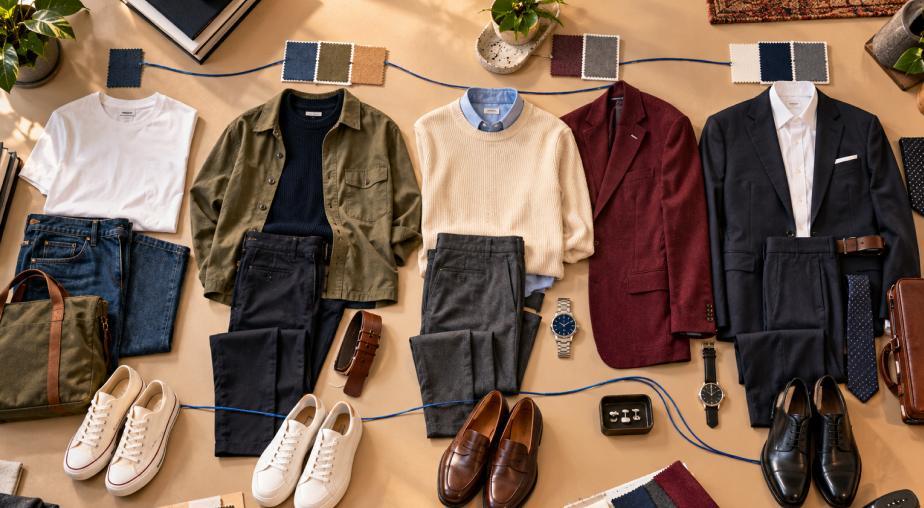
You Probably Do Not Need A Matching Suit
The easiest way to understand business casual may be to identify what it removes from traditional professional clothing.
A matching suit is normally unnecessary.
A tie is normally unnecessary.
A blazer can be useful, but it is optional.
Current U.S. DressDex guidance specifically distinguishes business casual from business professional on this point. Its September 25 business-professional guidance recommends a matching suit, tailored dress or coordinated set with a jacket as the safer choice, while its business-casual guidance centers on polished separates. business professional guidance
That means a pair of tailored navy trousers with a fine-knit sweater can work.
So can chinos with a button-down shirt.
A midi skirt with a blouse can work.
A structured dress can work without a jacket.
A cardigan over a polished shirt may work.
The individual garments matter, but the overall level of finish matters more.
Business Casual Is More About The Combination Than The Garment
This is where many workplace dress guides become too simplistic.
A sneaker is not automatically casual.
A blazer is not automatically professional.
Jeans are not automatically inappropriate.
Context changes how each piece reads.
Consider a plain white T-shirt.
Worn with distressed jeans, running shoes and a baseball cap, it communicates one thing.
Put the same T-shirt beneath a structured jacket with tailored trousers and clean leather sneakers, and the visual impression changes substantially.
The reverse is also true.
An expensive blazer that is wrinkled, oversized in the wrong places and combined with extremely casual pieces does not automatically make an outfit office-ready.
Business casual works through visual balance.
If one element becomes more relaxed, another can introduce structure.
If the trousers are loose, the top might be cleaner and more fitted.
If the footwear is casual, the trousers and shirt can carry more of the professional character.
If the jacket is highly structured, the layer underneath can often be simpler.
The outfit works as a composition.

Jeans Are A Workplace Question, Not A Universal Rule
Jeans may be the most disputed piece of business-casual clothing.
Current guidance demonstrates why there is no universal answer.
Indeed includes dark jeans without holes among possible business-casual pieces in its June 2026 guidance, while DressDex takes a more conservative position and recommends treating jeans as workplace-specific rather than assuming they are acceptable everywhere.
Both approaches can be reasonable because they are describing different office cultures.
Dark, clean, well-fitting denim may look entirely normal in a technology company, design studio or relaxed corporate office.
The same jeans may be too casual for a traditional law, banking or client-facing environment.
If jeans are allowed, visual condition matters.
Heavy distressing, large holes, extreme fading and very casual washes move the garment farther from the business side of business casual.
Dark or clean denim generally travels more easily between casual and professional contexts.
But before debating the wash, find out whether your workplace accepts denim at all.
Sneakers Have Entered Business Casual, But Not Every Sneaker
Footwear has undergone a similar shift.
Indeed’s updated 2026 business-casual guidance includes leather or canvas lifestyle sneakers alongside loafers, Oxfords, mules, boots, flats and heels.
That does not mean every athletic shoe automatically becomes office wear.
A minimal clean sneaker designed as everyday footwear creates a different impression from a brightly colored running shoe built for training.
Condition matters too.
Dirty white sneakers do not suddenly become professional because the silhouette is fashionable.
The easiest way to think about footwear is to ask whether the shoe appears deliberately integrated into the outfit or simply carried over from another activity.
A clean leather sneaker with tailored trousers may look intentional.
A technical running shoe beneath the same trousers may communicate something different.
Again, the company gets the final say.
A Blazer Is Optional, Not Obsolete
Business casual’s growing flexibility does not mean the blazer has disappeared.
It has simply lost its status as the automatic answer.
A blazer remains one of the easiest ways to introduce structure around the shoulders, create a clean silhouette and raise the formality of otherwise relaxed clothing.
But current Fall/Winter 2026 workwear coverage is showing considerably more variety in how tailoring is used. Wardrobe Icons’ September 8 workwear report highlights boxy jackets, oversized cuts and contemporary separates rather than presenting one conventional fitted office suit as the only professional option. 2026 workwear trends
That reflects a broader distinction worth making.
Business casual does not require you to abandon tailoring.
It allows you to separate tailoring from the full suit.
A jacket can be worn with different trousers.
A cardigan can replace it.
A structured overshirt may work in some offices.
A fine knit can provide enough polish on its own.
The appropriate choice depends on the room you are walking into.
Fit Can Matter More Than Formality
Two people can wear almost identical pieces and create completely different impressions.
One reason is fit.
A clean shirt that sits properly around the collar and shoulders can look more polished than a more formal garment that fits poorly.
Trousers that hang cleanly can elevate a simple knit.
A jacket that pulls across the buttons or collapses around the shoulders can do the opposite.
This is particularly important because business casual removes some of the obvious signals of traditional corporate clothing.
Once the matching suit and tie disappear, details carry more visual responsibility.
Fit becomes one of those details.
So does condition.
Wrinkles, stains, lint, damaged shoes, stretched collars and missing buttons are not questions of fashion taste. They affect whether an outfit appears deliberate.
Recent September 2026 coverage of wrinkle-resistant work shirts reflects how much practical office clothing now emphasizes staying polished through commuting, travel and long working days.
The goal is not perfection.
It is evidence that the outfit was chosen for the environment rather than accidentally worn into it.
Color Does Not Have To Mean Navy, Gray And Black
Traditional office wardrobes have long relied on neutral colors because they are easy to coordinate and rarely attract unwanted attention.
They still work.
But business casual gives color considerably more room.
Burgundy, olive, brown, cream, muted blue, forest green and other restrained colors can easily function in professional wardrobes.
Even stronger colors can work when the overall outfit remains coherent.
Fall 2026 workwear coverage is currently incorporating richer shades alongside traditional tailoring, demonstrating that contemporary professional clothing no longer needs to disappear into gray and navy.
The useful distinction is between color and visual chaos.
A burgundy sweater with charcoal trousers can look extremely polished.
A cobalt shirt beneath a neutral jacket can become a controlled focal point.
Several saturated colors, competing prints and multiple statement accessories can create a much busier impression.
Business casual leaves space for personality.
It does not require every piece to demand attention simultaneously.
Patterns Can Work When They Do Not Overwhelm The Outfit
The same principle applies to patterns.
Stripes, checks and restrained prints can fit comfortably into business casual.
A patterned blouse with simple trousers may create balance.
A subtle checked jacket over a solid knit can do the same.
The more visually active one piece becomes, the more useful restraint can become elsewhere.
This is less about an office prohibition against patterns than about hierarchy.
What does the viewer notice first?
Does the outfit look intentional?
Would the clothing make sense while presenting to a client or sitting in a meeting?
Those questions are often more useful than asking whether stripes are officially “business casual.”
Industry Changes The Definition
A major reason business casual remains confusing is that workplaces do not share the same visual culture.
Indeed’s 2026 guidance specifically notes differences by industry.
Finance tends to remain more conservative. Technology companies may have genuinely casual environments. Medical and service professions can involve entirely different practical clothing requirements.
Creative industries frequently tolerate more experimentation.
That means copying a business-casual outfit from social media without considering the wearer’s profession can be misleading.
An outfit appropriate for an advertising agency in Brooklyn may not translate directly to a financial-services office in Manhattan.
A university department may have different norms from either.
Even two companies in the same industry can differ.
Business casual is therefore partly a social dress code.
The people around you help define it.

The Written Dress Code Comes Before Fashion Advice
When a company provides an actual policy, use it.
That sounds obvious, but online styling advice often treats dress codes as though they were universal fashion categories.
They are workplace rules.
One employer may explicitly allow denim.
Another may prohibit it.
One may accept clean sneakers.
Another may require more traditional footwear for client-facing employees.
A company may also impose requirements for safety, hygiene, identification or customer interaction that have nothing to do with fashion trends.
Indeed’s 2026 guidance recommends consulting the company’s official dress code and observing what employees actually wear.
Those two sources are more useful than a generic internet outfit formula.
If the policy and the office culture appear to disagree, follow the policy first.
Your Manager Can Be A Useful Visual Reference
When there is no detailed written policy, look around.
Not at the most fashionable employee.
Not at the most casual employee.
Look at people performing roles similar to yours and at people one level above you.
What do they wear during ordinary office days?
What changes when clients arrive?
What changes for presentations?
What do senior employees wear when no major meeting is scheduled?
This provides a practical range rather than one outfit to imitate.
You are not trying to copy another person’s wardrobe.
You are identifying the office’s visual boundaries.
Client Days And Internal Days May Not Be The Same
Modern business casual can also change within the same week.
An ordinary internal workday may support relaxed trousers, knitwear and clean sneakers.
A presentation to an important client may call for a jacket and more polished footwear.
A company dinner may move the expectation another step upward.
Indeed’s current business-dinner guidance recommends dressing somewhat above normal everyday office clothing, illustrating how professional context can change the appropriate level of formality even within the same organization.
Instead of trying to create one universal work uniform, it may be more useful to build a wardrobe with adjustable levels.
A jacket can be added.
Sneakers can become loafers.
A casual knit can become a collared shirt.
Accessories can become more restrained.
Business casual becomes easier when your wardrobe can move slightly up or down without requiring an entirely different identity.
Interviews Deserve Their Own Judgment
A company’s everyday dress code does not automatically tell you what to wear to its interview.
You are entering the environment before you fully understand its norms.
Indeed’s June 2026 guidance recommends erring somewhat more formal for an interview when uncertain.
That does not necessarily mean everyone needs a traditional suit.
It means the risk calculation changes.
For a job interview, being slightly more polished than the everyday office norm is usually easier to manage than arriving significantly below it.
Once you work there, you can adjust after seeing how the organization actually dresses.
Business Casual And Business Professional Are Not The Same
The distinction becomes easier when you compare them directly.
Business professional is more structured.
Indeed describes it as one of the more formal workplace dress categories and notes its continued use in areas such as banking, accounting, law, government and finance.
A matching or coordinated suit, tailored jacket, polished shoes and more conservative styling make sense there.
Business casual removes some of those requirements.
The jacket becomes optional.
The tie disappears in many environments.
Separates replace the matching suit.
Footwear choices broaden.
Knitwear becomes easier to incorporate.
There is more room for personal color and texture.
But business casual does not remove the expectation that you look prepared to work.
That is the line separating it from ordinary casual clothing.
Smart Casual Is Not Exactly The Same Either
Smart casual can be even harder to distinguish because many of the garments overlap.
Indeed’s current smart-casual guidance describes it as combining fashionable elements with a clean, semi-formal appearance.
That extra emphasis on contemporary personal style is useful.
A smart-casual outfit might be perfectly appropriate for a creative networking event, gallery opening or relaxed workplace while feeling slightly too fashion-forward for a conservative business-casual office.
But these boundaries are not fixed.
Some employers use “smart casual” and “business casual” almost interchangeably.
When terminology becomes ambiguous, actual workplace examples matter more than the label.
Business Casual Should Still Look Like You
The flexibility of modern office clothing has one major advantage.
You do not have to construct an entirely different person every morning.
Someone who prefers color can use color.
Someone who prefers minimal clothing can build around neutral separates.
Someone who dislikes blazers can often find structure through shirts, knitwear, jackets or other layers.
Someone who genuinely enjoys tailoring can continue wearing it without needing a formal dress code as permission.
The objective is not to erase personal style.
It is to translate it into the visual language of the workplace.
That translation is what makes business casual different from simply wearing whatever you like.
When In Doubt, Build From The Most Reliable Pieces
If you are entering a new American office in 2026 and genuinely do not know what “business casual” means there, start conservatively without jumping all the way to a formal suit.
Tailored trousers or chinos are a reliable foundation.
Add a blouse, button-down shirt, polo or fine knit.
Choose clean, polished footwear.
A blazer or structured layer can be added but does not have to be permanent.
Keep the first outfit relatively simple.
Then observe.
If everyone wears dark denim, you now have useful information.
If senior colleagues regularly wear sneakers, that tells you something.
If client-facing employees become noticeably more formal on meeting days, that tells you something else.
Business casual is not a puzzle you solve once.
It is a workplace language you learn.
And in 2026, that may be the clearest definition available.
The modern American office has enough variety that no single combination of chinos, loafers, blazers or button-down shirts can represent every company.
What remains consistent is the intention behind the dress code: look polished enough for the professional setting while allowing more comfort and individuality than traditional business attire.
Once you understand where your particular workplace draws that line, “business casual” becomes considerably less mysterious.