

The modern office has made first-impression dressing harder, not easier.
A candidate can arrive for an interview in a blazer and tailored trousers only to discover that the employees evaluating them are wearing jeans, sneakers, or hoodies. A consultant may show up to a client meeting in formal business wear while the founders on the other side of the table are dressed for a coffee shop. Someone attending a networking event may have no idea whether “casual” means dark denim and loafers or a T-shirt and running shoes.
That uncertainty was at the center of an August 6, 2026 Associated Press report on changing U.S. workplace dress norms.
Dani McEwen, a 20-year-old Baldwin Wallace University student in Berea, Ohio, told the AP that she wore matching blazer-and-trouser separates to an insurance-company interview and immediately questioned the decision after seeing employees in T-shirts and jeans.
Her experience captures the problem perfectly. The old rule of “wear a suit” no longer works everywhere. Dressing exactly like the people who already work there can be risky too.
The most practical middle ground remains surprisingly traditional: dress one level more polished than the environment normally requires.
That does not necessarily mean more expensive, more conservative, or more formal. It means presenting a slightly more intentional version of the visual culture around you.
Why Matching the Office Exactly Can Backfire
The clothing worn by an established employee does not always tell you what is appropriate for someone making a first impression.
That difference matters.
An engineer who has worked at a company for six years may wear an old hoodie on Tuesday because colleagues already know their competence and reputation. A candidate walking into the same office for the first time has no such history.
The candidate’s appearance becomes one of the limited pieces of information available before the conversation develops.
In the recent Associated Press report on changing interview attire, personal stylist Christina Adamo, based at Neiman Marcus in Paramus, New Jersey, described how workplace dress has relaxed alongside remote and hybrid work. The report nevertheless found that recruiters and stylists continue to recommend researching an organization and appearing somewhat more polished than its normal day-to-day standard.
That distinction explains why copying the most casually dressed employee can be a mistake.
Their outfit answers:
“What can I wear here once I already belong?”
Your outfit may need to answer:
“Do I understand this environment, and did I recognize that this interaction matters?”
Those are not the same question.
What “One Level Above” Actually Looks Like
The rule works best when it is interpreted relatively rather than literally.
If employees normally wear T-shirts, jeans, and sneakers, you probably do not need to leap immediately to a three-piece suit. A cleaner smart-casual combination may provide exactly the right amount of elevation.
If the everyday workplace is already business casual, a blazer or more structured separates can move the outfit upward.
If employees regularly wear suits, the interview or major client meeting may require a particularly polished version of the same standard.
A simple framework looks like this:
| Normal Environment | One-Level-More-Polished Option |
|---|---|
| Hoodie, T-shirt, casual jeans | Fine knit or clean shirt, tailored or dark trousers, refined shoes |
| Dark jeans, polos, casual shirts | Chinos or tailored trousers, collared shirt or blouse, optional blazer |
| Business casual | Structured separates, blazer, dress or polished footwear |
| Regular suits | Well-tailored business-professional clothing with restrained accessories |
| Creative casual | Personal style retained, but with cleaner fit, deliberate layering, and one structured element |
The important word is one.
Jumping three levels can make someone appear as though they misunderstood the environment just as clearly as dressing too casually can.
Research the People, Not Just the Dress Code
Many companies no longer publish useful dress codes.
“Business casual” can mean completely different things in different workplaces.
One company may consider clean sneakers and jeans business casual. Another may expect trousers, loafers, and collared shirts. A third may have different standards for employees meeting clients.
The better strategy is visual research.
Look at recent photographs on the company website.
Check recruiting videos.
Look at employee photographs from conferences, office events, panels, or presentations.
Focus on people doing the type of work you want to do.
A software engineer’s wardrobe may tell you little about how a company expects a corporate communications director to appear. A maintenance employee, attorney, salesperson, designer, and executive can work for the same organization while following very different visual expectations.
The Texas A&M Career Center’s current professional-attire guidance recommends researching company culture or asking the person arranging the interview directly. Its guidance similarly advises candidates to dress a little more formally and conservatively than employees ordinarily dress at that organization.
Asking is not a failure of judgment.
It is research.
The Rule Applies Beyond Job Interviews
The “one level above” approach is useful because first impressions happen in many situations where no formal dress code exists.
Consider a professional networking event.
If the event is attached to a technology conference where people typically wear jeans, branded shirts, and sneakers, tailored trousers with a polished knit may be enough. A conservative banking suit might create unnecessary distance.
For a client meeting, the visual equation changes because you are representing not only yourself but potentially your company, service, or expertise.
A photographer meeting a corporate client might wear comfortable dark trousers, a structured overshirt, and clean shoes rather than formal tailoring. The outfit still signals that the meeting is different from an ordinary editing day.
A university presentation may require more polish than a regular classroom while stopping far short of business formal.
Even social situations can operate this way. If a restaurant is relaxed but clearly considered, dressing slightly beyond basic everyday clothing can communicate that the occasion received thought.
The rule is not really about offices.
It is about visual respect for context.
Fit Usually Matters More Than Formality
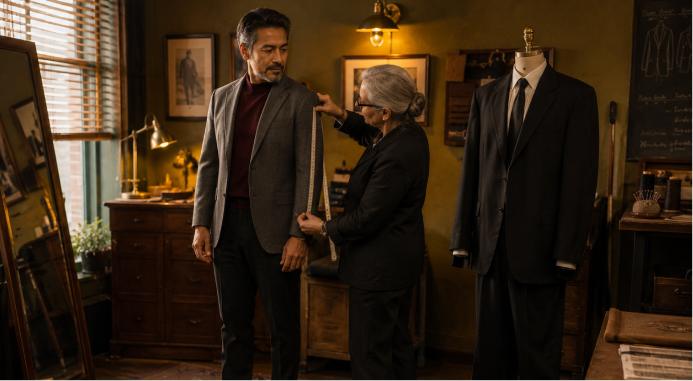
A poorly fitting suit is not necessarily more impressive than excellent business casual.
Formal garments magnify fit problems because their construction creates clear lines at the shoulders, waist, sleeves, and trousers.
If the shoulders collapse, the sleeves cover the hands, or the trousers pull awkwardly when seated, the outfit may look less considered despite technically being more formal.
The same principle applies to casual clothing.
A good knit polo, dark trouser, or clean overshirt can look exceptionally polished when the proportions work.
The University of California, Davis Career Center’s current interview clothing recommendations emphasize comfort, appropriate fit, garment condition, and preparation alongside formality. The center also notes that employers have reported concerns about candidates appearing underdressed more often than about candidates being slightly overdressed.
This helps explain why the one-level rule is relatively safe.
A slight excess of polish is usually interpreted as preparation.
Visible carelessness is more difficult to reinterpret.
Cleanliness and Condition Carry Their Own Message
The difference between casual and underdressed is often condition rather than category.
Dark jeans can look intentional.
Dark jeans with frayed hems, obvious stains, and a stretched waistband create another impression.
Sneakers can work in many offices.
Dirty running shoes with damaged soles send a different signal.
A soft knit can look professional.
A heavily pilled sweater rarely becomes more polished simply because it cost a lot.
Before worrying about whether you should wear a blazer, check the basics:
Does the garment fit?
Is it clean?
Is it wrinkled?
Do the shoes need cleaning?
Is there lint or pet hair on dark fabric?
Does the collar sit correctly?
Is a missing button making the garment look neglected?
Small details often create a stronger first impression than moving from one nominal dress category to another.
Comfort Still Matters Because Discomfort Becomes Visible
“Dress up” should never mean “wear something that makes it impossible to behave normally.”
An uncomfortable outfit can change posture and attention.
Someone who cannot sit comfortably in their trousers may shift constantly.
A restrictive jacket can make arm movement stiff.
Painful shoes can change a person’s walk before they even enter the meeting.
An unstable neckline can require repeated adjustments.
Recruiter Jamie Close, based in Charleston, South Carolina, told the AP that candidates should avoid wearing an entirely new outfit for the first time at an interview. Her reasoning was practical: wear the clothes beforehand so you know how they behave when sitting, standing, and moving.
That is excellent first-impression advice even outside interviews.
Test the complete outfit.
Sit at a desk.
Walk several blocks.
Reach forward.
Put on the coat you will actually wear over it.
Carry the bag you intend to bring.
An outfit should become quieter once it is on your body, not demand your attention for the next three hours.
Seniority Can Change the Visual Expectation
The correct level of polish also depends on the role someone is trying to occupy.
In the AP report, stylist and author Samantha Harman argued that candidates for senior positions may be evaluated partly on whether they appear capable of representing an organization publicly.
That does not mean executives need expensive clothing.
It means external representation can become part of the job.
Could this person meet a major client?
Speak on a conference stage?
Appear before the media?
Represent the organization during a difficult public moment?
Los Angeles publicist Dylan Thomas Cotter, also interviewed by the AP, said he wears a dark blue tailored suit for job interviews or important new-client meetings because visual composure is relevant to public relations.
The exact clothing will differ in design, technology, finance, healthcare, media, law, and other fields.
The broader principle remains useful: the more visible the role, the more likely clothing becomes part of how professional judgment is assessed.
Creative Industries Need Polish Too, Just a Different Kind
Creative workplaces create one of the biggest traps around the word “professional.”
Professional does not necessarily mean conservative.
A stylist, photographer, art director, designer, filmmaker, or creative producer may be expected to demonstrate visual judgment rather than conformity.
Showing up in a generic business suit can sometimes communicate less awareness than a carefully constructed outfit that incorporates texture, color, contemporary proportions, or distinctive footwear.
The one-level rule still works.
If the studio normally operates in jeans and T-shirts, the interview might mean better denim, a structured jacket, and intentional shoes.
If everyone dresses expressively, you do not need to suppress personal style. You need to refine it.
This is where broader personal image and styling guidance becomes useful: the objective is not maximum formality but visual coherence between the person, the setting, and the impression they want to make.
Color Can Raise the Level Without Adding Formality
Dressing more polished does not always require adding another garment.
Color coordination alone can do substantial work.
Consider a casual combination of trousers, knit top, and sneakers.
If all three pieces compete in unrelated colors, the outfit may feel improvised.
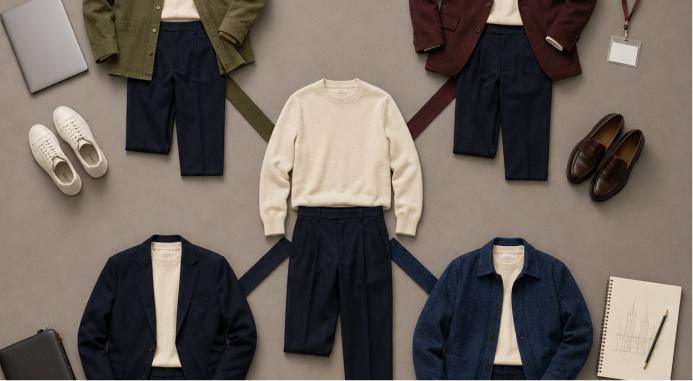
Put the same silhouettes into navy, cream, and burgundy and the appearance becomes more deliberate.
Repeating one color can help as well.
Brown shoes with a related belt or bag create visual continuity.
A blue shirt beneath a navy layer creates depth without introducing noise.
A restrained accent can communicate personality without dominating the interaction.
This is particularly helpful when the environment is too casual for traditional businesswear but the occasion still requires visible effort.
Shoes Often Reveal the Actual Level of the Outfit
Shoes can move an outfit up or down faster than almost any other item.
Wide trousers and a knit shirt with athletic running shoes may look ready for travel.
Change the shoes to clean minimalist sneakers and the result becomes smart casual.
Change them again to loafers and the same base can work in many business-casual environments.
That does not make loafers inherently superior.
The footwear changes context.
For someone who walks or commutes extensively, comfort remains important. It may be better to travel in practical shoes and change before the meeting than spend the entire interaction distracted by pain.
The strongest first impression usually comes from someone who can move naturally in what they are wearing.
Virtual First Impressions Need the Same Strategy
Remote meetings removed the commute but not the visual signal.
A candidate can still appear underprepared on a video call.
The difference is that the camera changes which details matter most.
Solid colors often reproduce more cleanly than tiny patterns.
A dark jacket can disappear against a dark chair.
A white shirt can lose detail against a bright wall.
The camera should be approximately eye level, and the face should receive light from the front rather than from a bright window behind the subject.
The “one level above” rule applies here too.
If the company operates casually, a clean shirt or structured knit may be enough.
If the role is senior or highly client-facing, a jacket may make sense even when the interview is taking place from home.
Dressing fully rather than only above the waist can also help the meeting feel like an actual professional event.
Do Not Let “Polished” Erase Personal Identity
Professional appearance advice becomes weak when it assumes everyone should converge toward the same narrow image.
People bring cultural dress, religious clothing, natural hairstyles, gender expression, disability-related needs, and individual style into professional spaces.
Dressing one level above an environment should work within those identities rather than requiring their removal.
The strongest version of the rule is not:
“Look more conventional.”
It is:
“Make your existing presentation one degree more intentional for this occasion.”
That could mean steaming the garment, choosing the more structured version, polishing the shoes, improving the fit, simplifying the accessories, or coordinating colors more carefully.
The goal is preparation, not disappearance.
Slightly Overdressed Is Usually Easier to Recover From
Imagine arriving at a meeting and realizing everyone is more casual than you expected.
A blazer can often come off.
A tie can be removed.
Sleeves can be rolled slightly.
A jacket can be carried rather than worn.
The outfit can move downward.
The reverse is much harder.
If you arrive in gym clothing and discover a formal client presentation is underway, there may be no practical adjustment available.
That asymmetry is one reason the one-level-above rule continues to survive even as workplaces become less formal.
It builds in a small margin for uncertainty.
First Impressions Work Best When Clothing Stops Being the Story
The purpose of dressing slightly above the normal environment is not to make everyone notice your outfit.
It is almost the opposite.
The best first-impression clothing quickly becomes background information.
It communicates that you recognized the occasion.
The garments fit.
The shoes make sense.
Nothing looks neglected.
You appear comfortable.
Then attention can move to the conversation.
Dani McEwen’s experience in Ohio shows why modern workplace dressing feels confusing: employees may have earned the freedom to dress casually while candidates still feel expected to signal effort.
The solution is not a universal return to suits.
It is calibration.
Study the environment.
Understand the role.
Identify the ordinary level of dress.
Then move one deliberate step above it.
That strategy cannot guarantee a good first impression, because clothing never replaces competence, preparation, or interpersonal skill.
It can prevent your appearance from suggesting that you misunderstood the moment before you have had a chance to show anything else.