
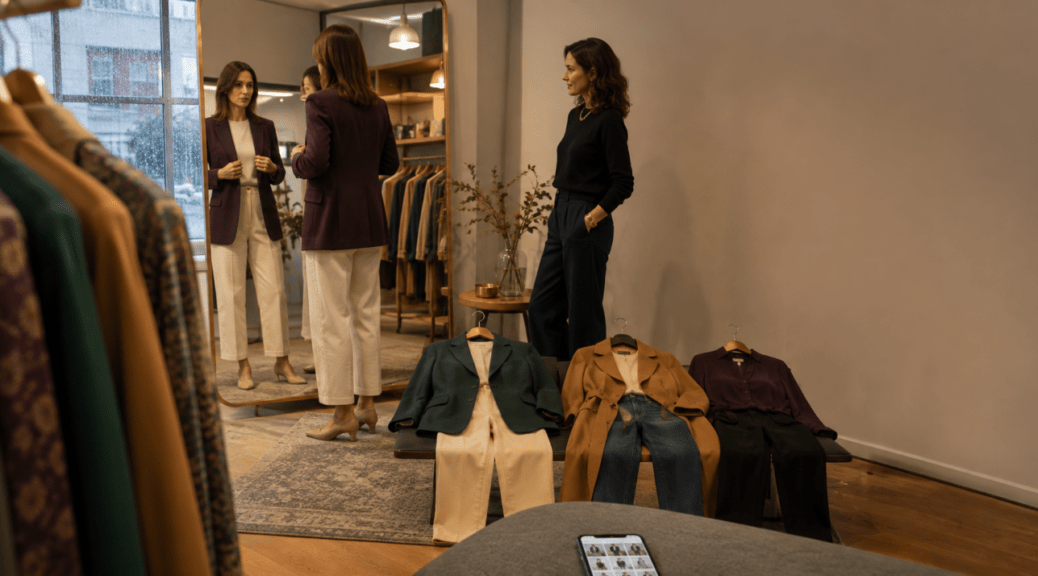
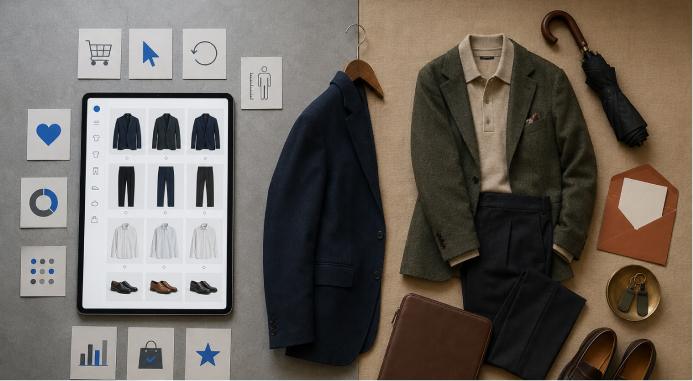
Online shopping was supposed to make buying clothes easier.
In one sense, it unquestionably has. A shopper can compare thousands of garments without leaving home, filter by size and color, read reviews, save favorites, receive personalized recommendations, and have several potential outfits delivered to the front door.
Yet having access to more clothing does not necessarily make it easier to know what to wear.
That tension is helping revive an old-fashioned part of fashion retail: the personal stylist.
A current example is unfolding in Bedminster, New Jersey. On August 13, 2026, Amanda Vittitoe opened New Jersey’s first Monkee’s boutique at 2435 Lamington Road, with personal styling positioned as a central part of the store experience. The opening followed a July 28 announcement from Monkee’s Franchising and included a ribbon cutting with Bedminster Mayor Lawrence F. Jacobs and Committeewoman Gina Lisa-Fernandez. The boutique is built around a curated assortment rather than an enormous inventory, with styling intended to help customers find clothing suited to work, school events, community commitments, dinners, weekends away, and other parts of their actual lives.
That may seem counterintuitive in 2026. Algorithms can recommend products instantly. AI can assemble outfits. Search engines can find almost any garment. Virtual styling can happen without entering a store.
But those technologies may be increasing the value of human judgment rather than eliminating it.
The problem modern shoppers face is increasingly not access.
It is selection.
Online Shopping Solved Availability but Created a New Problem
Traditional shopping imposed limits.
A physical store contained a finite number of garments. The shopper could see them, touch the fabrics, compare colors in the same light, take several sizes into a fitting room, and ask someone nearby for an opinion.
E-commerce removed many of those limits.
That has obvious advantages, especially for shoppers who live far from major retail centers or need sizes, styles, or brands that local stores do not stock.
But abundance creates its own friction.
Search for a black blazer online and the problem quickly becomes apparent. There may be hundreds or thousands of plausible options. Some are cropped. Some oversized. Some sharply tailored. Others intentionally unstructured. Fabric weights, lapel proportions, shoulder construction, lengths, return policies, photographs, and sizing conventions vary.
A recommendation algorithm can narrow the list.
What it cannot necessarily determine is why the shopper wants a blazer in the first place.
Is it for an interview?
A creative workplace?
A professional photograph?
Travel?
Dinner?
Is the shopper trying to make existing trousers more useful?
Does the jacket need to work with sneakers?
Does the person dislike structured shoulders?
Are they replacing a favorite jacket whose proportions they already understand?
Those questions move shopping from product discovery into styling.
Personal Styling Is Really a Filtering Service
The traditional image of a personal stylist can make the profession sound extravagant: someone choosing designer clothing for celebrities or wealthy clients.
For most consumers, the useful function is much less glamorous.
A good stylist filters.
Instead of asking, “Which of these 400 jackets do you like?” the stylist may narrow the decision to three jackets that fit the client’s lifestyle, proportions, existing wardrobe, budget, and intended use.
That reduction has value.
It is one reason Vittitoe’s new Somerset Hills boutique is interesting. Monkee’s says its assortment was selected for the local market and that personal styling and attentive service are central to the experience. Vittitoe described wanting customers to return because they “feel understood,” rather than simply because the store has merchandise. The Monkee’s Somerset Hills opening announcement positions that high-touch service as part of the store’s competitive proposition.
That is effectively the opposite of infinite scroll.
The value is not showing customers everything.
It is deciding what they probably do not need to see.
AI Is Making Personal Styling More Accessible
Human stylists are not the only ones trying to solve the selection problem.
Fashion technology companies increasingly want AI to do it too.
Online styling can now use stated preferences, previous purchases, product catalogs, conversational prompts, and wardrobe information to recommend complete outfits instead of isolated products.
Stitch Fix is one of the clearest U.S. examples of a hybrid model. In announcing generative-AI and styling enhancements in August 2025, CEO Matt Baer argued that both traditional stores and infinite-scroll e-commerce have shortcomings. The company positioned its combination of algorithms, proprietary data, generative AI, and human stylists as the alternative. Its AI and human styling approach deliberately does not treat technology and stylists as mutually exclusive.
That hybrid idea may be more important than asking whether AI will “replace” personal stylists.
AI is exceptionally useful at processing inventory.
A human can be exceptionally useful at interpreting ambiguity.
Together, those abilities address different parts of the shopping problem.
An Algorithm Knows What You Clicked, Not Necessarily Why
Personalization data can reveal a great deal.
If someone repeatedly clicks navy dresses, buys wide-leg trousers, avoids high heels, and returns cropped jackets, a recommendation system can learn patterns.
But behavior and intention are not always the same.
Maybe the shopper clicked 20 navy dresses because none of them was right.
Perhaps the cropped jackets were returned because the sleeves were too short rather than because the shopper dislikes cropped silhouettes.
Maybe someone repeatedly buys black because it feels safe, while what they actually want is help incorporating color.
A stylist can ask why.
That small question can change the recommendation completely.
Human conversation can also reveal contradictions that are difficult to capture through product behavior.
“I want to look more professional, but I hate suits.”
“I want more color, but I don’t want to stand out.”
“I need comfortable shoes that don’t look like athletic shoes.”
“I have plenty of clothes, but I never know what to combine.”
“I want to change my style without looking like a completely different person.”
Those are not product searches.
They are styling problems.
The Fitting Room Still Produces Information a Product Page Cannot
Clothing is unusually difficult to evaluate online because its appearance changes once it interacts with a body.
A photograph can show a jacket beautifully and still tell an individual shopper relatively little about how that jacket will behave on them.
Shoulder width changes the silhouette.
Torso length changes where a jacket ends.
A trouser’s rise changes its relationship with a shirt.
Fabric weight changes movement.
Shoes change the perceived length and formality of trousers.
Even two people who wear the same labeled size can create very different proportions in the same garment.
This is where an experienced stylist standing beside a fitting room can provide information that a product recommendation cannot easily replicate.
The stylist can see that the jacket itself is not the problem—the trousers underneath are creating the awkward proportion.
Or that a garment one size larger hangs better even though the smaller size technically fits.
Or that changing the shoe makes the entire outfit work.
That kind of adjustment is less about fashion rules than visual relationships.
A Stylist Can See the Wardrobe Instead of the Purchase
One of the biggest weaknesses of conventional online shopping is that every product page encourages the shopper to evaluate an item individually.
A stylist can evaluate it as part of a wardrobe.
That distinction can save money.
Imagine someone owns three skirts that are rarely worn because none of their current jackets works with the proportions.
The online-shopping solution may accidentally become three new outfits.
The styling solution might be one shorter jacket.
The same principle applies to shoes.
A shopper may believe they need more work clothes when the real problem is that their current footwear is either extremely casual or extremely formal. One comfortable intermediate shoe could make several existing outfits useful.
Personal styling becomes valuable when it reduces unnecessary purchasing rather than merely encouraging additional purchases.
The Best Stylist May Tell You Not to Buy Something
This is also where consumers should distinguish genuine styling from sales assistance.
A salesperson’s job and a stylist’s job can overlap, but their incentives may not.
A stylist employed by a retailer is usually working within that retailer’s inventory. Recommendations should be understood in that context.
An independent stylist may be able to recommend tailoring, secondhand options, another retailer, or simply continuing to wear something the client already owns.
That independence can be valuable.
The strongest styling advice is sometimes:
You don’t need this.
Maybe the shopper already owns something nearly identical.
Maybe the garment creates only one usable outfit.
Maybe tailoring an existing piece would solve the problem.
Maybe the color is exciting in the fitting room but disconnected from everything at home.
A stylist who can prevent three bad purchases may create more value than one who finds three attractive new ones.
Personal Styling Does Not Have to Mean a Complete Makeover
The word stylist can also imply transformation.
That can intimidate people who do not want a new identity.
Useful personal styling should not require one.
A consultation can be narrow.
Someone might need help finding interview clothes after years of remote work.
Another person may want to understand why their trousers never work with their jackets.
Someone else may need a wardrobe for frequent business travel.
A client could want help choosing clothing that photographs better for speaking engagements.
Another may simply want to stop buying clothes that remain unworn.
The goal should be solving the client’s problem, not turning the client into an advertisement for the stylist’s personal taste.
For a site focused on photography, visual presentation, image quality, and practical appearance decisions, this distinction is especially relevant. FinestImage.com’s profile emphasizes visual presentation and trust rather than deceptive transformations or invented results. That same principle applies to personal styling: improvement should make someone’s presentation more intentional, not manufacture a different person. Read more about online shopping here.
Photography Can Make a Styling Session More Useful
A mirror and a photograph do not show clothing in exactly the same way.
When looking in a mirror, people tend to focus on individual areas.
A photograph compresses the complete outfit into a single visual composition.
That makes photography surprisingly useful during personal styling.
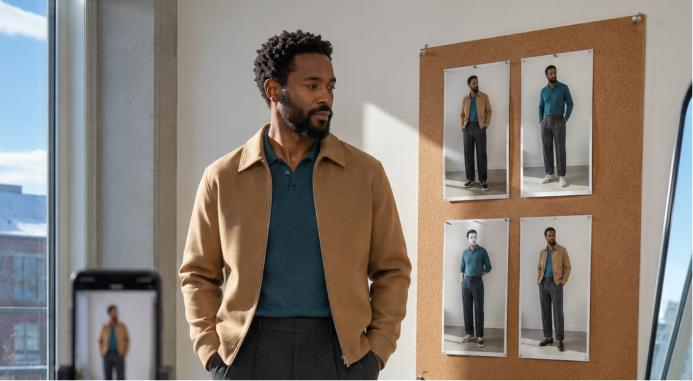
Photograph several versions of an outfit from approximately the same position.
Try the shirt tucked and untucked.
Change the shoe.
Add the jacket.
Remove it.
Compare two trouser lengths.
Look at the images together rather than relying on memory.
Patterns become easier to see.
Perhaps every successful outfit contains a shorter top layer.
Maybe a particular trouser width consistently balances your preferred jackets.
Perhaps you like stronger color contrast in photographs than you expected from the mirror.
This turns personal styling into observation rather than judgment.
The objective is not to find what makes the body look “correct.” It is to identify which combinations create the visual effect the wearer actually wants.
That photography-and-presentation perspective is also a natural extension of Finest Image, where image decisions can be considered in terms of practical visual outcomes rather than rigid fashion rules.
Styling Can Be Particularly Valuable During Life Transitions
There are moments when existing wardrobe knowledge stops working.
Starting a new career is one.
Returning to an office after years of remote work is another.
So are moving to a different climate, taking a more public-facing role, changing industries, beginning frequent business travel, or needing clothing for regular professional events.
The problem is not necessarily that the person has lost their sense of style.
Their context changed.
A wardrobe built for university may not translate directly into a corporate job.
Clothing appropriate for a traditional financial office may feel disconnected inside a design studio.
A wardrobe designed around driving may become frustrating after moving somewhere that requires substantial walking.
These are situations where a stylist can translate an abstract requirement—“I need to look more professional”—into actual garments that still feel familiar.
The New Jersey Boutique Is Betting on High-Touch Retail
This is what makes the Bedminster opening more than a local retail story.
Monkee’s is entering New Jersey at a moment when nearly every garment a customer could want is already available online.
Its competitive proposition therefore cannot simply be inventory.
The store is emphasizing curation, personal styling, attentive service, and local knowledge.
Vittitoe’s background spans marketing leadership, philanthropy, real estate, and interior design, according to the company’s announcement. She described the store as serving the different situations women in Somerset Hills encounter rather than simply presenting merchandise by trend.
That approach treats the boutique partly as an interpretation service.
A customer can already find a dress online.
The harder question is whether it works for the wedding, with the shoes already owned, in August weather, at the desired level of formality, and with enough versatility to wear again.
That is where human service attempts to justify its existence.
AI May Actually Make Human Judgment Feel More Valuable
Fashion AI is improving rapidly.
That does not necessarily weaken the case for human styling.
It may sharpen it.
When basic recommendations become nearly free, human value has to move toward the problems automation handles less naturally: nuance, interpretation, physical fit, emotional context, tactile judgment, and understanding what someone means when their words are imprecise.
Recent fashion-industry discussion reflects that tension. Vogue reported in May 2026 that fashion executives expect AI to become increasingly important infrastructure while human connection remains important in customer-facing luxury experiences; the article cited survey findings in which 66% of respondents preferred human advisors in stores.
That does not prove shoppers universally prefer human stylists. Luxury consumers are not identical to the entire apparel market.
It does suggest that convenience is not the only thing people value when making visually and emotionally complicated purchases.
When Is a Personal Stylist Actually Worth It?
Not everyone needs one.
If you understand your proportions, enjoy shopping, maintain a coordinated wardrobe, know which retailers fit you, and rarely make regretted purchases, professional styling may add little.
The value rises when the problem becomes persistent.
A stylist may be particularly useful when someone owns many clothes but struggles to create outfits, repeatedly returns online purchases, needs a new professional image, has difficulty interpreting dress codes, wants to reduce impulse buying, or faces a major lifestyle transition.
Before paying, understand exactly what the service includes.
Does the stylist audit existing clothing?
Do they accompany you shopping?
Can they recommend products outside one retailer?
Do they work within a stated budget?
Will they create outfit combinations afterward?
Can they advise on alterations?
Do they receive commissions or retailer incentives?
Can they style mostly from clothes you already own?
Those questions reveal whether you are paying for judgment or simply receiving another sales channel.
AI Styling and Human Styling Do Not Need to Be Rivals
For many shoppers, the most useful future may combine both.
Use technology for breadth.
Use human judgment for depth.
An AI assistant can search thousands of products quickly, identify potential matches, remember preferences, and suggest combinations at midnight.
A stylist can examine those options and say that the fabric is wrong for your climate, the jacket is too long for the trousers you actually wear, or the expensive new skirt duplicates something already in your closet.
The technologies solve different problems.
That is why Stitch Fix’s continued emphasis on combining AI and human stylists is instructive. The company’s model assumes that data can make the stylist more efficient without making the stylist irrelevant.
The same logic could increasingly appear inside physical boutiques.
The Real Luxury May Be Having Fewer Choices
For years, online retail equated improvement with selection.
More brands.
More filters.
More recommendations.
More products.
More personalization.
But there is a point where additional choice stops feeling useful.
The shopper does not need another 200 blazers.
They need to know which two are worth trying.
That may be why personal styling is beginning to feel relevant again.
The service is not valuable because consumers have lost access to fashion knowledge. They have more fashion information than any previous generation.
It is valuable because information, inventory, inspiration, recommendations, trends, reviews, videos, and AI-generated suggestions now arrive faster than most people can evaluate them.
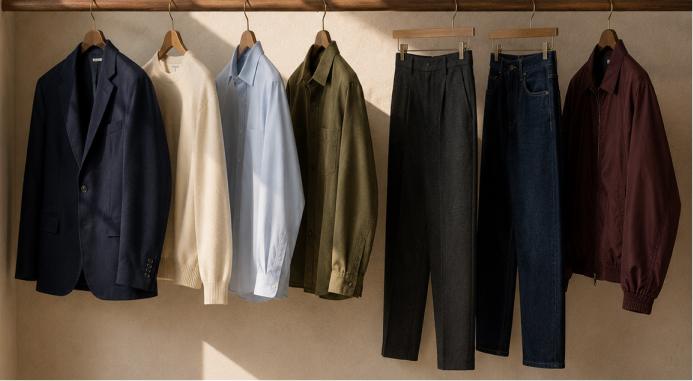
A good stylist reduces that noise.
The opening of Amanda Vittitoe’s Monkee’s boutique in Bedminster is one small, current example of retailers betting that high-touch service can still matter in a market dominated by digital convenience.
Online shopping is unlikely to reverse.
AI styling is unlikely to disappear either.
The interesting shift is that neither makes human expertise automatically obsolete.
When technology can show us almost everything, someone who understands what to ignore may become more valuable.