
Most photographers learn to think in fractions of a second.
A shutter opens. Light reaches the sensor. The shutter closes. The photograph preserves that instant.
Stephen Wilkes works almost in the opposite direction.
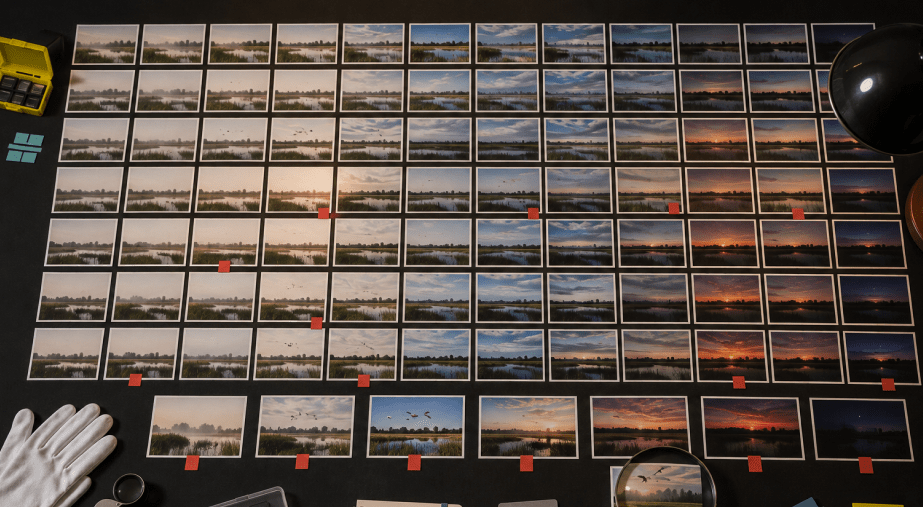
For his landmark Day to Night series, the New York-born photographer and National Geographic Explorer can remain at one fixed viewpoint for as long as 36 hours, making more than 1,500 photographs as daylight, weather, people and wildlife move through the scene. He later selects individual moments and painstakingly composites them into a single finished photograph in which morning, afternoon, sunset and night can coexist.
The method is receiving renewed attention in 2026 through “America at 250: Through the Lens of Stephen Wilkes,” running from July 31 through August 31, 2026, at Gilman Contemporary in Ketchum, Idaho. The exhibition brings Day to Night together with Wilkes’ Tapestries series and earlier photographs of Pennsylvania’s abandoned Bethlehem Steel plant.
What makes the work interesting is not simply that Wilkes takes a lot of photographs.
He changes one of photography’s fundamental variables.
Instead of asking, “Which instant should I preserve?”, he asks something closer to:
“What if the photograph could preserve the experience of watching this place change?”
One Photograph Can Contain More Than One Moment
Traditional photographs make an unavoidable trade.
When the photographer presses the shutter, one moment survives while countless others disappear.
Imagine photographing a city square from sunrise until midnight.
At 6:30 a.m., delivery workers may dominate the scene.
By 8:30, commuters arrive.
At noon, the direction and quality of sunlight have changed.
During the afternoon, shadows stretch in another direction.
At sunset, windows begin reflecting warm light.
After dark, streetlights and illuminated buildings become visually dominant.
A conventional photograph chooses one of those moments.
A Day to Night photograph can contain several.
Wilkes photographs continuously from a fixed position and later builds a final image from selected exposures. Gilman Contemporary describes the finished works as allowing dawn, midday, dusk and night to coexist within one frame.
That makes time part of the composition rather than merely the moment when the composition was recorded.
The Camera Has to Stay Still While Everything Else Changes
The concept sounds straightforward until you consider what 36 hours means mechanically.
The sun moves.
Clouds move.
People move.
Animals move.
Tides change.
Artificial lights switch on.
Weather can change.
The photographer gets tired.
The camera, however, needs to maintain its viewpoint.
National Geographic previously documented that Wilkes must keep his horizon and framing stable as he manually captures an average of around 1,500 frames over roughly 16 to 30 hours for many Day to Night works. The final construction then takes weeks of post-production.
That fixed viewpoint is fundamental.
Imagine photographing the same building at 7 a.m., noon and 8 p.m. while moving the tripod slightly between each photograph.
The roofline shifts.
Windows move relative to one another.
Perspective changes.
Foreground objects no longer align.
Combining those photographs seamlessly becomes much more difficult.
Wilkes instead allows time to move through a stable frame.
For photographers interested in improving composition, that is an unusually useful lesson: sometimes the strongest creative decision is not moving the camera.
Thirty-Six Hours Is Not Really One Exposure
It is important to distinguish Wilkes’ method from an extremely long exposure.
A 36-hour exposure would blur movement together.
Cars could become streaks.
People might disappear.
Changing light would accumulate on the sensor.
Day to Night works differently.
Wilkes makes many separate photographs.
Each exposure preserves an individual moment. He can later review those moments and determine which ones contribute to the final visual narrative.
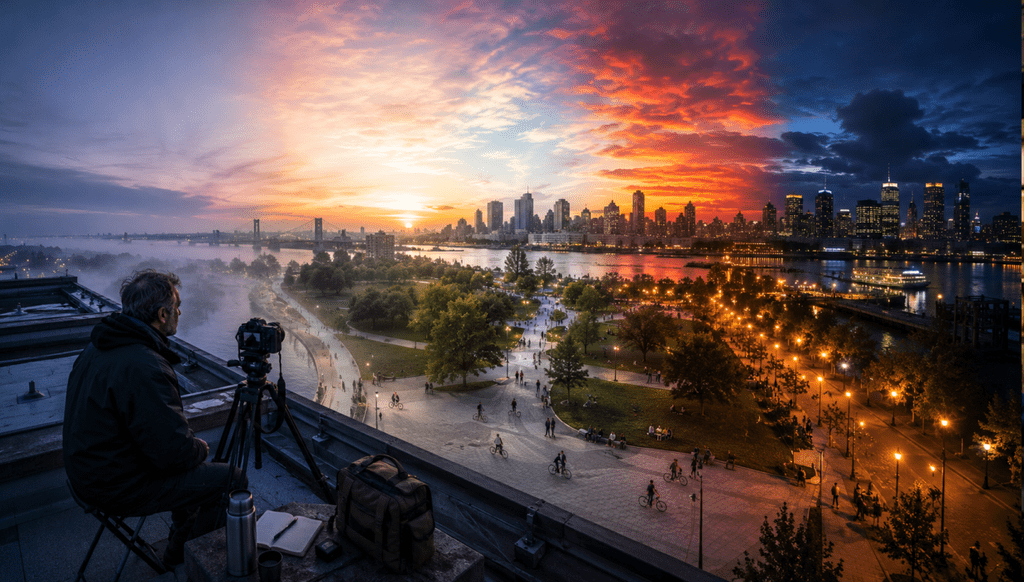
National Geographic documented an especially striking example involving flamingos and other birds: Wilkes made 1,742 photographs over 36 hours from a 30-foot scaffold and selected roughly 30 frames for the final composite.
The difference is significant.
A long exposure averages time.
Wilkes selects from time.
Taking 1,500 Photographs Is Only the Beginning
Making thousands of exposures does not automatically create a meaningful composite.
Selection becomes part of authorship.
Imagine returning from a 24-hour shoot with 1,500 frames.
Perhaps 300 contain interesting people.
Another 200 contain changing clouds.
Several capture unusual interactions.
Dozens contain beautiful light.
Many may be technically excellent.
They cannot all occupy the final composition.
Wilkes has to decide which moments deserve to survive.
That means Day to Night is partly photography and partly editing in the original meaning of the word: choosing.
The final photograph is not simply a time-lapse compressed mechanically into one frame. It reflects decisions about which events tell the story of that day.
The Photographer Becomes an Observer Before Becoming an Editor
This helps explain why spending 30 or 36 hours in one location can matter creatively.
Normally, photographers move.
They search for better angles.
Change lenses.
Walk closer.
Move farther away.
Look for another subject.
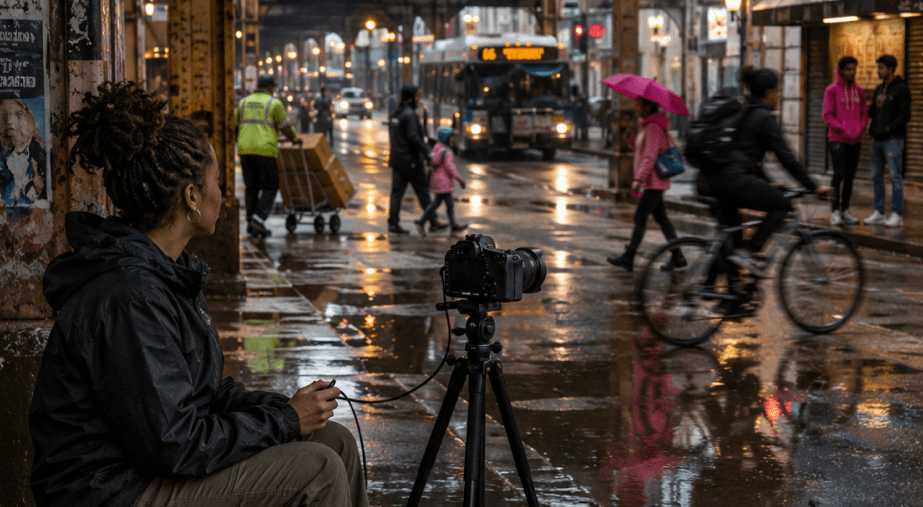
Wilkes largely removes that option after committing to the viewpoint.
The world has to come to him.
During a 2021 presidential inauguration assignment, Wilkes spent 15 hours photographing from a scissor lift in freezing rain and winds reaching 35 miles per hour. He made more than 1,500 photographs from dawn into night. He described the process to National Geographic as almost meditative because he continually watched clouds, light and human movement rather than searching for another location.
That observation becomes crucial.
The photographer has to notice not just what is happening, but what might become meaningful later.
The Fear of Missing the Moment Works Differently
Street photographers often wait for one decisive interaction.
Sports photographers anticipate a fraction of a second.
Wildlife photographers may wait hours for one behavior.
Wilkes also waits, but he is constructing something broader.
He told National Geographic that the possibility of missing an important moment creates intense concentration during these marathon sessions.
That reveals a paradox in the method.
A Day to Night image ultimately contains many moments, yet each component still depends on the photographer recognizing a particular instant.
The technique does not eliminate the decisive moment.
It collects several decisive moments and allows them to coexist.
Time Can Become a Compositional Direction
Composition is normally taught spatially.
Left and right.
Foreground and background.
Positive and negative space.
Leading lines.
Balance.
Depth.
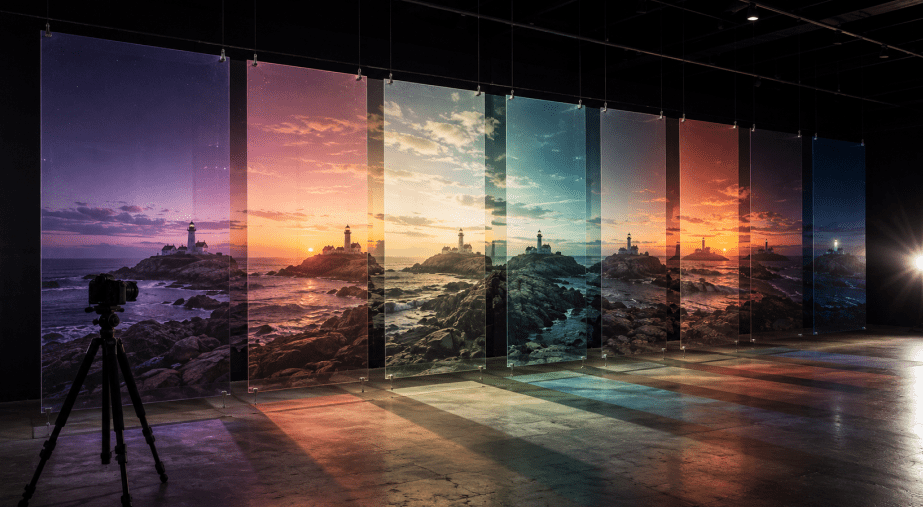
Day to Night introduces another dimension: temporal direction.
One part of the frame can represent morning while another represents evening.
The viewer’s eye is therefore moving through both physical space and time.
This can create unusual visual transitions.
A blue morning sky may gradually become warmer.
Afternoon can flow toward sunset.
Artificial lights can begin appearing as natural illumination disappears.
The photograph is no longer asking viewers to believe that every point in the image existed simultaneously.
Instead, it deliberately shows that the scene changed.
The Technique Works Particularly Well When the Place Has a Rhythm
Not every location would benefit equally from this approach.
Imagine an empty white room in which nothing changes for 24 hours.
Time passes, but the photograph may reveal very little.
Now consider Wrigley Field in Chicago, one of the works included in the current Gilman Contemporary presentation. A stadium changes as spectators arrive, the game progresses, daylight shifts and the venue transitions toward evening.
Or consider migrating birds around water.
Their positions change.
Light changes.
Weather changes.
The density of activity changes.
A successful time-compressed photograph therefore needs more than an attractive landscape.
It benefits from temporal structure.
The photographer is looking for a place where passing time produces visual information.
Wildlife Makes Time Visible in a Different Way
Wilkes’ wildlife photographs demonstrate this especially clearly.
Gilman Contemporary’s current exhibition includes works involving grizzly bears at Chilko Lake in British Columbia, sandhill cranes at Rowe Sanctuary in Nebraska, and other natural environments.
Animals do not follow the photographer’s direction.
They enter and leave.
They feed.
Rest.
Interact.
Respond to weather.
Move as daylight changes.
When moments from across that period are assembled, the final image can reveal patterns that a single exposure cannot.
That does not mean the photograph literally shows one simultaneous instant.
Its value lies precisely in showing something else: how life occupied that environment across time.
The 36-Hour Method Is Also a Lesson in Patience
Modern photography encourages speed.
Autofocus systems can identify subjects almost instantly.
Burst rates capture dozens of frames per second.
Phones automatically process images before users even see them.
AI tools can remove objects or reconstruct backgrounds in seconds.
Wilkes uses sophisticated digital production too, but his capture method places extraordinary value on waiting.
Gilman Contemporary describes his process as one requiring weeks of planning before the long photographic session even begins.
That matters because preparation determines whether those 30-plus hours are productive.
Where will the sun rise?
Where will it set?
What will the foreground look like?
How will activity move through the frame?
What position provides enough visual information for both daylight and darkness?
Once the camera is committed to that viewpoint, many compositional decisions cannot simply be fixed by walking ten feet to the side.
Scouting May Be More Important Than the Camera
The more restricted the shooting position becomes, the more important preparation becomes.
A photographer attempting a similar long-duration project needs to consider practical questions before the first exposure:
Will the location remain accessible?
Can the tripod remain stable?
Will pedestrians block the camera?
Will artificial lighting create problems after sunset?
Can batteries and storage be managed?
Will weather threaten the equipment?
Is the viewpoint safe for an extended period?
Does the composition still work after dark?
These concerns are not glamorous, but they influence the finished photograph.
A spectacular sunset cannot rescue a viewpoint that becomes visually incoherent for most of the day.
Daylight and Darkness Need to Belong to the Same Frame
Another challenge is exposure.
Morning light and nighttime illumination are radically different photographic conditions.
If a camera remains in one position for an entire cycle, exposure decisions must adapt while perspective remains stable.
That creates a combination of consistency and change.
The architecture needs to align.
The horizon needs to align.
But shutter speed, exposure and the appearance of moving subjects can change substantially as illumination falls.
The finished image therefore requires technical continuity without pretending the lighting was constant.
That is one reason the photographs feel unusual.
Our eyes recognize the place as continuous while simultaneously recognizing lighting conditions that could not have existed together.
Post-Production Does Not Make the Capture Stage Irrelevant
Because the final image is a composite, it might be tempting to think the difficult work happens mainly afterward.
The opposite is closer to the truth.
Post-production can only work with moments that were successfully captured.
If an important interaction occurs and the photographer misses it, editing cannot recover that specific documentary moment.
If the camera shifts, alignment becomes harder.
If highlights are irretrievably blown, detail disappears.
If focus fails, the frame may become unusable.
Wilkes’ process demonstrates a broader lesson that remains useful even as computational and generative tools become more capable:
the more ambitious the final composite, the more disciplined the source photography often needs to be.
A Composite Can Still Be Documentary
Day to Night also raises an interesting question about photographic truth.
The finished image is obviously not one exposure.
Morning and nighttime did not coexist.
Yet the component moments were photographed during the actual period Wilkes observed.
National Geographic’s account of his bird work describes the images as selections from events that genuinely occurred during that day, digitally blended into a seamless final composition.
That places the work somewhere between conventional documentary photography and constructed visual storytelling.
The final frame changes chronology.
It does not need to invent the underlying events.
That distinction matters increasingly as photography incorporates compositing, computational processing and generative tools.
A manipulated timeline is not necessarily the same thing as a fabricated event.
The viewer simply needs to understand what kind of image is being presented.
His Newer Work Moves in Almost the Opposite Direction
The current Idaho exhibition makes the Day to Night process even more interesting by placing it alongside Wilkes’ newer Tapestries work.
Where Day to Night can require extensive planning and hours of continuous observation, the gallery describes Tapestries as spontaneous compositions created through in-camera multiple exposures over only four to eight seconds. The photographic imagery used for those works is produced without post-production compositing or retouching, according to Gilman Contemporary.
The contrast is remarkable.
One method stretches observation across 36 hours.
The other compresses creative reaction into several seconds.
Wilkes has described the relationship metaphorically: Day to Night is closer to a carefully constructed symphony, while Tapestries functions more like jazz.
For photographers, the comparison is useful because it shows there is no universally correct working speed.
Some photographs need anticipation.
Others need reaction.
The Current Exhibition Connects Time With American History
The 2026 Gilman Contemporary exhibition gives these technical ideas a larger cultural frame.
Titled “America at 250: Through the Lens of Stephen Wilkes,” it coincides with the United States’ 250th anniversary and combines images of landscapes, wildlife, cities and industrial history.
Alongside Day to Night and Tapestries, the exhibition includes photographs from Wilkes’ earlier work at the abandoned Bethlehem Steel plant in Pennsylvania.
Wilkes’ relationship with long-form observation predates Day to Night. Gilman Contemporary notes that a 1998 Ellis Island assignment led to a five-year study of the abandoned medical wards there, eventually becoming the 2006 book Ellis Island: Ghosts of Freedom.
There is continuity in those projects.
Buildings change.
Industries disappear.
Natural environments shift.
Cities move through daily cycles.
People enter and leave.
Time is not simply something Wilkes measures with the shutter.
It is frequently the subject.
You Do Not Need 36 Hours to Apply the Idea
Most photographers will never spend a day and a half on a scaffold making 1,500 exposures.
They do not need to.
The practical lesson is simpler: stay long enough to discover how a place changes.
Instead of arriving at sunset, taking ten photographs and leaving, arrive earlier.
Observe where people move.
Notice when shadows reach particular surfaces.
Watch reflections change.
See which areas become active and which become quiet.
Return after dark.
A photographer may discover that the best photograph was not available at the moment they originally intended to shoot.
This applies to landscapes, street photography, architecture, events and even product photography in natural light.
Time changes visual information.
Try Photographing One Composition Repeatedly
A useful exercise is to choose one viewpoint and deliberately refuse to move it.
Photograph the same frame:
at sunrise,
in late morning,
at noon,
during golden hour,
at blue hour,
and after dark.
Do not worry about creating a Wilkes-style composite.
Compare the photographs individually.
Notice how different elements become dominant.
A wall that looks flat at noon may develop texture in side light.
A window invisible during the day may become the brightest part of the nighttime composition.
A street that appears architectural in the morning may become primarily about people during rush hour.
This exercise teaches something moving constantly between viewpoints cannot.
It reveals the relationship between composition and time.
Waiting Can Make You Notice Events You Could Not Plan
The longer a photographer stays, the more chance enters the process.
A bird lands in exactly the right place.
Clouds briefly separate.
A pedestrian wearing an unexpected color enters the composition.
Fog appears.
A reflection forms.
Two strangers interact.
Wilkes has spoken about this kind of serendipity in his long-duration work: sometimes events happen that he cannot control, and his job is to be present when they do.
Photography often rewards preparation precisely because preparation allows photographers to respond to the unplanned.
That may be the strongest reason to spend hours looking through essentially the same frame.
You stop searching for the picture.
You begin recognizing when the picture arrives.
A Single Photograph Does Not Have to Represent a Single Instant
For nearly two centuries, photography’s special relationship with time has been one of its defining characteristics.
The shutter cuts time into pieces.
Stephen Wilkes demonstrates that photographers can also reconstruct those pieces into another kind of visual experience.
His Day to Night photographs do not ask us to believe that dawn and midnight occurred simultaneously. They ask us to consider how a place behaves across those moments.
The current Gilman Contemporary exhibition makes that process particularly visible, bringing together long-duration Day to Night works, seconds-long Tapestries and earlier photographs concerned with American landscape and industrial history.
National Geographic’s detailed look at the Day to Night photography process shows just how demanding that idea can become: fixed viewpoints, thousands of manually captured frames and weeks of selection and compositing.
Its account of Wilkes’ 2021 inauguration photograph adds another dimension—the intense observation required to notice meaningful changes while remaining in essentially the same position for hours.
That lesson fits naturally with the broader photography and visual-imaging focus of Finest Image: better photography is not always produced by taking more pictures from more places. Sometimes it comes from understanding one composition more deeply.
Wilkes can spend 36 hours creating one photograph because the 36 hours are not simply the cost of producing the image.