
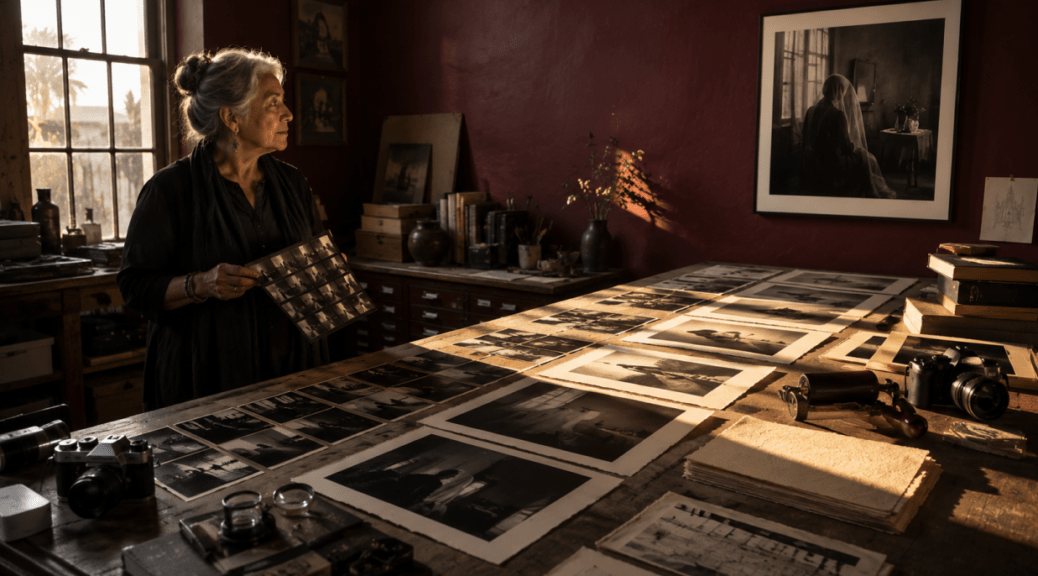
Photography advice often makes finding a personal style sound like a task that can be completed over a weekend: choose a preset, settle on a color palette, photograph similar subjects and make the portfolio look consistent.
The nearly 50-year career of Laredo-born photographer and printmaker Josephine Sacabo suggests something much more demanding—and potentially more useful.
On August 28, 2026, Sacabo returns to her hometown of Laredo, Texas, for The Right to Dream: Regreso a mi pueblo, a retrospective at the Fine and Performing Arts Gallery at Texas A&M International University (TAMIU). The exhibition brings together five major bodies of work from a career that has moved from photojournalistic street photography toward highly subjective imagery influenced by literature, poetry, dreams and photogravure. It remains on view through October 9, 2026.
Sacabo’s work has appeared in more than 40 gallery and museum exhibitions in the United States, Europe and Mexico, while her photographs are represented in collections including the Metropolitan Museum of Art, International Center of Photography, New Orleans Museum of Art and George Eastman Museum.
Yet the lesson for photographers is not simply that Sacabo eventually developed a recognizable aesthetic.
It is that her visual language changed as she discovered what she actually wanted photographs to communicate.
That distinction separates visual voice from visual style.
A 50-Year Retrospective Makes Creative Evolution Visible
The scale of The Right to Dream is important.
Organized with the Daphne Art Foundation, the Laredo exhibition presents five bodies of Sacabo’s work: El Mundo Inalcanzable de Susana San Juan, Óyeme con Los Ojos, Juana and the Structures of Reverie, Barking at God and TAGGED. Sacabo also gave a public artist talk at TAMIU on August 27, the day before the opening reception.
Seeing work across decades can reveal something that an Instagram grid rarely does.
Photographers change.
Subjects change.
Processes change.
Influences change.
Even the reason for making photographs can change.
Sacabo was born in Laredo in 1944 and studied at Bard College in New York. Before settling into the kind of imagery associated with her today, she lived and worked extensively in France and England. Her earlier photography belonged much more closely to a photojournalistic tradition influenced by photographers including Robert Frank, Josef Koudelka and Henri Cartier-Bresson.
Her current work is markedly different.
Sacabo describes a subjective and introspective approach in which literature and poetry frequently provide the starting point for images.
The transformation did not require abandoning photography.
It required discovering what she wanted photography to do.
Visual Style And Visual Voice Are Not The Same Thing
This distinction is particularly useful for photographers trying to make their portfolios more recognizable.
Style is often visible on the surface.
It can include contrast, color, grain, lighting, focal length, aspect ratio, subject placement or printing technique.
A photographer might become recognizable for desaturated portraits, hard flash, shallow depth of field or black-and-white street photographs.
Visual voice goes deeper.
Voice concerns what the photographer repeatedly notices, questions or tries to express.
Two photographers could use the same camera, lens, film simulation and lighting setup while producing work that feels completely different because they are interested in different things.
One might photograph isolation.
Another might explore humor.
Another may be interested in family relationships.
Another may repeatedly return to architecture, memory, identity or movement.
Sacabo’s career provides an unusually clear example because her techniques evolved substantially while recurring literary and emotional interests became increasingly central.
Her own biography describes her portfolios as visual manifestations of the written word, citing writers including Rainer Maria Rilke, Charles Baudelaire, Pedro Salinas, Vicente Huidobro, Juan Rulfo, Stéphane Mallarmé and Sor Juana Inés de la Cruz among her influences.
A recognizable photographic voice, then, does not necessarily mean making the same-looking photograph forever.
Her Photography Started With The Street
Sacabo’s path was not mapped out from the beginning.
In recent reporting surrounding the Laredo retrospective, she recalled an early photograph of an older woman pointing toward a child as one of the images that made her want to continue photographing.
Her earliest work developed through street photography.
Literature was already present, however.
Sacabo has explained that reading Baudelaire and thinking about the experience of moving through city streets influenced the way she approached New Orleans. The street became a place where literary ideas could encounter real people, gestures and environments.
That is different from deciding, “My style is street photography.”
Street photography was a method.
The deeper interest was already becoming emotional and literary.
This is an important distinction for photographers who feel trapped by genre labels.
You may photograph weddings without your visual voice being “wedding photography.”
You may photograph landscapes without your voice being “landscape photography.”
Genre describes what is in front of the camera.
Voice increasingly describes why you keep pointing the camera toward particular things.
Your Influences Do Not Have To Be Photographers
One of the most interesting aspects of Sacabo’s development is where she looks for ideas.
Her influences are not limited to photographers.
Poetry and literature became fundamental.
She told the Laredo Morning Times that she would encounter a phrase that moved her and begin wondering whether she could produce an equivalent feeling visually.
That approach can be useful for anyone trying to develop more distinctive photographs.
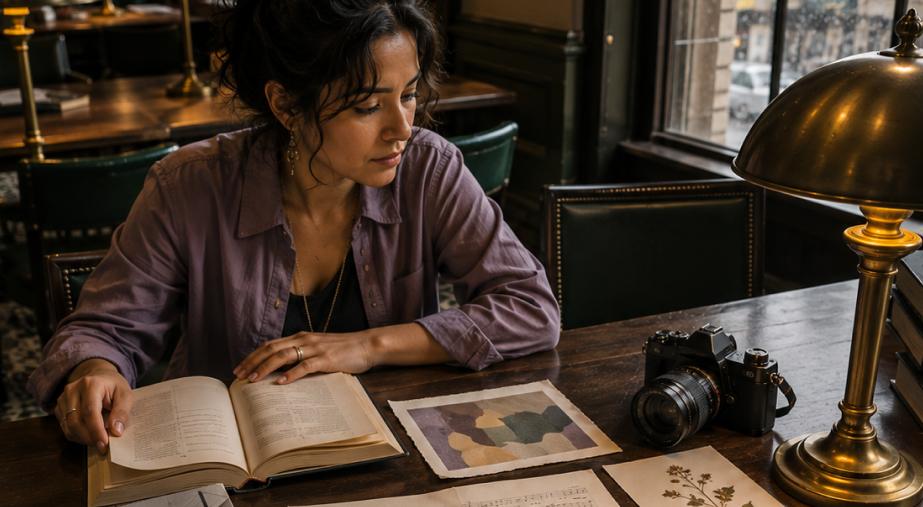
If photographers consume only photography, they may repeatedly encounter the same visual solutions.
Portrait photographers see other portraits.
Street photographers see other street photographs.
Product photographers see other product campaigns.
Wedding photographers see other weddings.
The reference loop becomes narrow.
A novel does not tell you which lens to use.
A poem does not provide an aperture.
Music does not determine your lighting ratio.
Architecture does not tell you where to position a model.
That is precisely why outside influences can be valuable. They require translation rather than imitation.
A photographer has to ask:
What does this feeling look like?
What kind of light belongs to it?
Should the subject appear close or distant?
Does the frame need to feel crowded or empty?
Should the image be literal or ambiguous?
Those questions can produce a visual language that is harder to copy because it originates somewhere deeper than a preset.
A Photographer’s Location Can Become Part Of The Voice
Place has also remained significant in Sacabo’s work.
She divides her time between New Orleans and Mexico, and her official biography describes both environments as important influences on imagery characterized as dreamlike, surreal and romantic.
Now her career is physically returning to Laredo.
That makes The Right to Dream more than a conventional gallery exhibition. It brings decades of work back to the Texas city where Sacabo was born.
For photographers, this suggests another useful exercise: examine the places that repeatedly enter your pictures.
They may be obvious locations such as a particular city, neighborhood or landscape.
But place can also appear indirectly.
Weather can become part of someone’s visual vocabulary.
So can architecture.
Interior decoration.
Roads.
Vegetation.
Nightlife.
Family homes.
Industrial environments.
Even the particular quality of daylight where a photographer lives can shape the work.
A photographer does not necessarily need to travel somewhere visually spectacular to develop a voice.
Sometimes the more important challenge is learning to recognize what is visually specific about familiar surroundings.
Technique Should Eventually Serve The Idea
Sacabo’s evolution also demonstrates why photographers should be cautious about making technique the center of their identity.
Her process changed.
Her official account explains that early portfolios were produced as toned silver gelatin prints. Later and current works use photopolymer gravure, printed on handmade Japanese tissue and chine-colléd onto velvet rag paper.
The transition was partly practical.
As photography shifted from chemical to digital processes, Sacabo’s preferred silver gelatin papers were repeatedly discontinued. She began exploring gravure and discovered that the process produced an effect she had spent roughly 30 years trying to achieve in the darkroom.
That is a remarkable example of technique following vision.
She did not simply choose photogravure because an old process looked interesting.
The process solved a visual problem she had been pursuing for decades.
Photographers often work in the reverse order.
They buy a lens and search for subjects that justify it.
They download a preset and reshape photographs around its colors.
They discover an editing technique and apply it to everything.
Those experiments can be useful while learning, but mature technique ideally becomes less conspicuous.
The viewer notices the photograph before wondering which tool created it.
Photogravure Changes The Photograph As A Physical Object
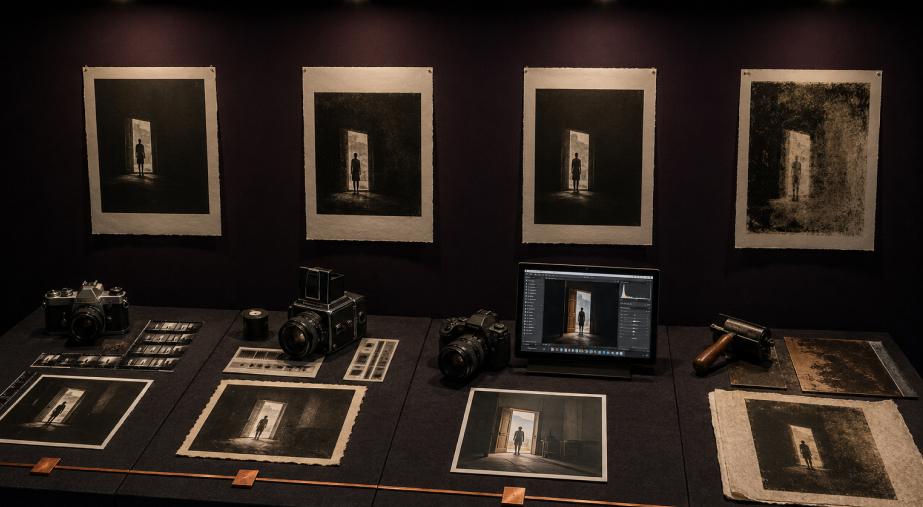
Sacabo’s printing method also illustrates something digital photography can make easy to forget: a photograph can be a physical object, not merely an image.
Traditional photogravure dates to the nineteenth century and uses a photographic image to produce a plate that can be inked and printed onto paper. Sacabo works with a modern photopolymer variation in which UV light and water are used to prepare the plate before traditional inking and pressing. Her photogravure process involves multiple stages before the final print exists.
Texture, paper, ink and pressure therefore become part of how the viewer experiences the image.
That is especially relevant now.
Most contemporary photographs are first encountered on illuminated screens. The same photograph may appear on a phone, laptop, tablet and social feed within minutes.
Physical printing forces different decisions.
How large should the photograph be?
What surface should hold it?
How much detail should remain?
How dark can shadows become before they close completely?
How does paper alter contrast?
How close should the viewer stand?
Printing can reveal that a visual voice is not limited to what happens inside the rectangular image.
Presentation can become part of the language too.
Consistency Should Come From Curiosity, Not Repetition
Photographers are frequently told that portfolios need consistency.
That advice is useful until consistency becomes repetition.
Using exactly the same preset, focal length, lighting and composition across every image may create visual uniformity without creating a meaningful body of work.
Sacabo’s career suggests another route.
The consistent element can be curiosity.
Her photographic methods have changed, but recurring interests in literature, interior experience, memory and poetic transformation create connections between bodies of work.
That type of consistency is more flexible.
A photographer can move from portraits to landscapes.
From film to digital.
From color to monochrome.
From natural light to studio lighting.
The photographs can still feel related if the underlying questions remain recognizable.
This may explain why finding a voice can take decades.
The photographer first has to discover which questions continue to matter after equipment, trends and techniques change.
Social Media Can Make Style Look Easier Than It Is
Today’s photographers face a creative environment very different from the one in which Sacabo began.
Images now circulate at enormous speed.
A photographer can discover a lighting setup in the morning, watch a tutorial at lunch, download a preset in the afternoon and publish a convincing imitation that evening.
Technically, that can accelerate learning.
Creatively, it creates another problem.
It becomes easy to confuse recognizable processing with personal expression.
An Instagram profile containing 30 photographs with identical colors may look cohesive.
But remove the color treatment.
Would the photographer’s decisions still be recognizable?
Would the subjects be related?
Would the framing reveal recurring interests?
Would the emotional tone remain?
Those questions provide a stronger test of voice than asking whether every photograph shares the same color grade.
Finding Your Voice Requires Making Enough Work To Recognize Patterns
A photographer cannot reliably identify personal patterns after making ten photographs.
Patterns become visible through volume and time.
Imagine reviewing five years of your own work without organizing it chronologically.
Certain tendencies may appear unexpectedly.
Perhaps you consistently photograph people from farther away than other photographers.
Maybe your strongest images contain one isolated person inside large environments.
Perhaps you repeatedly photograph reflections.
Maybe hands appear frequently.
Perhaps your favorite portraits happen immediately before someone smiles rather than during the smile.
Maybe you repeatedly use doorways, windows or shadows to divide frames.
Those patterns matter because they may have developed without deliberate imitation.
They are clues.
Instead of immediately forcing them into a branded “style,” photographers can ask why those choices keep recurring.
The answer may point toward something more personal.
Your Weak Photographs Can Help Identify Your Voice Too
Photographers usually study their best images.
Studying rejected photographs can be equally revealing.
Why does a technically perfect image feel wrong?
Why does another photograph with imperfect focus remain memorable?
Why do certain assignments produce competent work that feels disconnected from the rest of the portfolio?
A photographer may discover that some visual approaches simply do not correspond with what they care about.
That knowledge is valuable.
Finding a voice involves exclusion as much as discovery.
Over decades, experienced photographers accumulate thousands of examples of what they do not want to photograph.
That narrowing can eventually make their strongest work more specific.
Do Not Confuse Equipment Progress With Artistic Progress
Camera technology changes much faster than photographic identity.
Over a 50-year career, a photographer can move through multiple camera systems, films, papers, computers, printers and editing technologies.
Sacabo’s transition from silver gelatin printing toward photogravure demonstrates that materials can disappear or become impractical while the creative objective remains.
That offers an important counterweight to equipment-centered photography culture.
A better camera can solve technical problems.
It may provide more dynamic range.
Better autofocus.
Higher resolution.
Cleaner high-ISO files.
Those improvements are real.
But none automatically determines what the photographer should care about.
Visual voice develops through decisions technology cannot make on someone’s behalf.
What deserves attention?
What should remain outside the frame?
Which emotion matters?
When is an image finished?
Those questions remain even when cameras improve.
The Goal Is Not To Become Impossible To Change
There is another danger in the phrase “find your style.”
It can imply that successful photographers eventually discover one aesthetic and protect it forever.
A long career suggests the opposite.
If Sacabo had remained committed exclusively to the photojournalistic tradition of her early work, the later bodies of work now being shown in Laredo would not exist in their current form.
Changing does not necessarily mean losing your voice.
Sometimes changing technique allows the voice to become clearer.
The more useful objective may therefore be developing enough confidence to recognize which parts of your photography are fundamental and which parts are temporary.
Camera?
Temporary.
Preset?
Temporary.
Favorite lens?
Possibly temporary.
Editing software?
Certainly temporary.
The deeper interests that repeatedly make you pick up the camera may survive all of them.
Almost Anything Can Become A Photograph
Sacabo’s recent comments surrounding The Right to Dream provide perhaps the clearest explanation of her creative philosophy.
She wants viewers to recognize that thoughts, feelings, reading and everyday experiences can all contain the beginning of an image. Books, places, people and poetry ultimately become photographic material for her.
That idea offers a more useful route toward originality than trying to invent a never-before-seen photographic technique.
Start with what genuinely holds your attention.
Read outside photography.
Notice which places you repeatedly return to.
Print your work.
Study old photographs.
Recognize recurring subjects.
Experiment with processes without allowing the process to become the entire point.
Most importantly, make enough photographs for patterns to emerge naturally.
The current Laredo retrospective matters because it allows viewers to see those patterns across nearly five decades rather than through one isolated portfolio.
Local coverage of the 50-year exhibition also emphasizes the educational side of Sacabo’s return, including her public artist talk and a photogravure demonstration for TAMIU students.
For photographers following the broader visual culture explored by Finest Image, Sacabo’s career offers a reassuring alternative to the pressure to develop an instantly recognizable aesthetic.
A visual voice does not need to arrive fully formed.
It can begin on a street, change in a darkroom, encounter poetry, move between countries, adopt a nineteenth-century printing idea and continue evolving decades later.
The objective is not to make every photograph look the same.
It is to make enough meaningful work that, eventually, something recognizably yours begins connecting the photographs together.