
In today’s world, your online presence is like your business card. That small image of you online is very important.
I’ve seen many bad digital first impressions. Your LinkedIn headshot is not just for looks. It’s a smart choice for your career.
Photos on profiles get 21 times more views. This is a clear advantage in the job market.
Think of your professional image as the cover of your career book. People judge you in those first seconds.
Your resume photo promotes you 24/7. It opens doors you didn’t know existed. Make your first impression count.
Key Takeaways
- Your digital presence serves as your modern business card
- Quality professional images dramatically increase profile visibility
- First impressions in digital spaces happen within seconds
- Strategic image selection is about economics, not vanity
- Recruiters form immediate judgments based on visual presentation
- Your professional photo works as a constant brand ambassador
- Pixel quality and composition directly impact credibility
LinkedIn & Resume Standards
Let’s play a quick game of corporate dress-up. What should be on your LinkedIn profile versus your resume? The answer might surprise you more than finding out your boss actually reads your status updates.
Your LinkedIn headshot is more than a photo. It’s your digital business card, your professional handshake, and your corporate armor. It’s the difference between wearing a suit to a meeting and casual clothes to a barbecue.
The rules are simpler than assembling IKEA furniture (and far less frustrating):
- Business attire that says “I’m competent” not “I’m trying too hard”
- Neutral backgrounds that don’t compete with your face for attention
- Shoulders-up framing that says “professional” not “passport photo”
- Actual lighting that doesn’t make you look like you’re in a witness protection program
Resume photos are a different story. They’re like bringing politics to Thanksgiving dinner. In the US, they’re often discouraged due to anti-discrimination laws. Yet, they’re common in other countries. It’s all about knowing your audience.
Your LinkedIn headshot is about corporate branding. Resume photos are in a legal gray area. Choose wisely – your next career move might depend on it.
What Recruiters Notice
Ever wonder why some profiles get 21 times more views while others collect digital dust? Let me pull back the curtain on our recruiting psychology.
We’re not just scanning qualifications – we’re conducting digital anthropology. Your resume photo tells us everything about your professional self-awareness before we even read your first bullet point.

No photo? That’s like showing up to a black-tie event in sweatpants. We immediately question your attention to detail and understanding of modern business norms. Profiles without photos get pushed aside faster than a dial-up internet connection.
Recruiters develop pattern recognition like FBI profilers. We process hundreds of profiles daily, and your image serves as the visual handshake before the actual conversation.
Here’s what makes us pause and pay attention:
- Credibility signals: Professional lighting, appropriate attire, genuine smile
- Professional awareness: Understanding of industry standards and expectations
- Personal investment: Evidence you’ve actually cared about your personal brand
Meanwhile, these are the red flags that make us hit “next” faster than you can say “unemployed”:
- Party backgrounds (we’re hiring professionals, not spring breakers)
- Sunglasses indoors (are you a secret agent or just making poor choices?)
- Pixelated images (if you can’t master basic technology, how will you handle our systems?)
Your resume photo isn’t just decoration – it’s your first quantifiable metric. It shows you understand that soft skills and professional presentation matter as much as hard numbers. In today’s market, that missing photo doesn’t just suggest you’re camera-shy – it hints you might not understand how modern business actually works.
The data doesn’t lie: profiles with quality photos receive up to 21 times more views. That’s not vanity – that’s visibility. That’s opportunity.
Think of your resume photo as your digital firm handshake. It says “I get it” before you ever say a word. In a world where first impressions happen long before the first interview, that visual credibility might be the difference between getting the call and getting passed over.
So ask yourself: does your current resume photo signal professional credibility or professional confusion? The answer might determine whether recruiters see you as a candidate or just another profile in the stack.
Attire & Grooming Recap
Your LinkedIn headshot isn’t like your Tinder profile or Instagram. It’s how corporate America sees your professional skills.
It’s like finding the perfect balance between too formal and too casual. You want to look put together in solid colors. This shows you’re competent without being too flashy.
- Color theory matters: Navy, black, and charcoal show you’re in charge without being too bold.
- Fabric is fate: Wrinkles can look messy; smooth fabrics show you’re organized.
- Accessory austerity: Keep jewelry simple unless you’re in the jewelry business.
Grooming is key to looking professional. That “I woke up like this” vibe is okay for Beyoncé, but not for the boardroom. Your hair should look like you’re in control, not like you’re waiting for a haircut.
If your photo is from 2015 or has a tie-dye shirt, it’s time for a change. Your LinkedIn headshot should be recent, within two years. Anything older might make you seem out of touch or stuck in your ways.
What you’re selling is trust and reliability. Save your personality for the interview. Your photo should say “I’m a go-getter,” not “I’m the life of the party.”
The only exception? Creative fields where being yourself is the product. But for most of us in corporate, looking professional is the strongest statement.
Cropping and Framing Tips
Let’s talk about the photographic equivalent of a bad haircut – poor cropping. Your resume photo framing speaks volumes before you even utter a word. It’s the visual handshake that either says “I’m professional” or “I cropped this in five seconds while watching Netflix.”
The shoulder-up composition isn’t just some arbitrary rule – it’s visual psychology. Think about it: when you meet someone, where do your eyes naturally go? Exactly. The face, not the shoes. Your headshot should follow the same social contract.
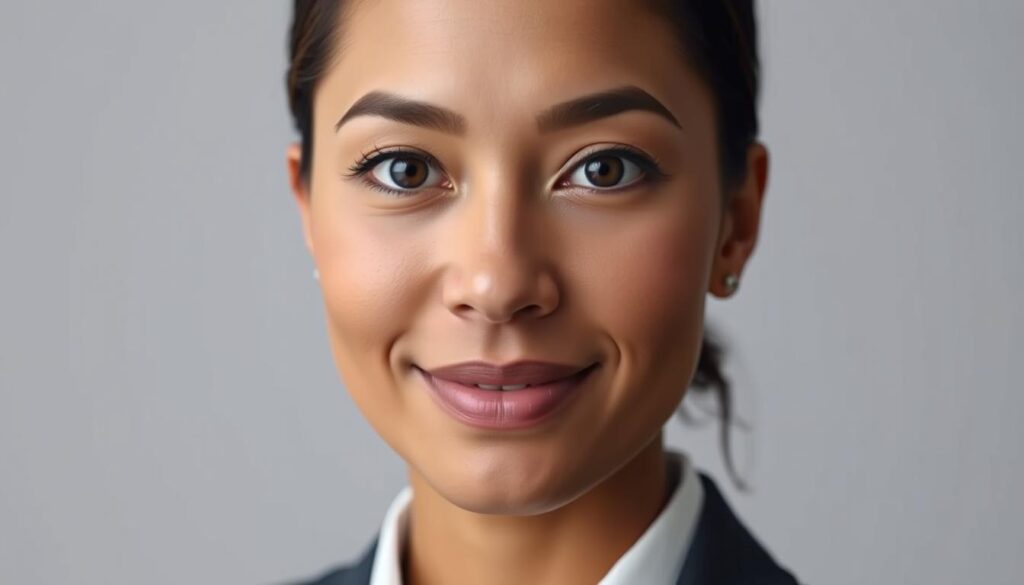
- 60% face coverage – Your features should dominate the frame
- 10-15% headroom – Enough space to breathe, not enough to float away
- Shoulders as anchor – Provides context without becoming a torso shot
Avoid the witness protection look at all costs. Nothing says “I’m hiding something” like a poorly cropped image that removes all context. Your future employer wants to see a whole person, not just a floating head.
The angle matters more than you think. Straight-on shots can feel confrontational – like a mugshot. Slight angles create dimension and approachability. Think 15 degrees, not 45. We’re going for professional, not film noir detective.
| Cropping Style | Professional Impact | When to Use |
|---|---|---|
| Shoulders Up | High professionalism | Corporate roles, executive positions |
| Bust Length | Balanced approach | Most professional settings |
| Full Body | Contextual but risky | Creative industries only |
| Extreme Close-Up | Low professionalism | Basically never |
Creative cropping has its place, but remember this isn’t your Instagram art project. As LinkedIn’s own experts note in their professional photography guide, creativity should serve professionalism, not undermine it.
The group photo crop? Don’t. Just don’t. We can always spot the ex-boyfriend’s shoulder or the wedding bouquet you’re awkwardly holding. It’s the visual equivalent of showing up to an interview with your mom.
Your resume photo framing should say “competent professional,” not “I ran out of solo pictures.” Take the extra time to get it right – your first impression depends on it.
In-Studio Checklist
Your smartphone might take better photos than your old camera. But, a bathroom selfie isn’t the same as a LinkedIn headshot. You don’t need to spend a lot to look professional.
Think of this as your guide to a great LinkedIn headshot. Start with the background. Choose neutral colors like white, gray, or muted tones. This makes you the focus, not your background.
Lighting is key, not the camera’s megapixels. Natural light from a window gives a nice glow. It makes you look friendly, not harsh.
Your smile should say “I’m ready to go” but not “I’m too excited.” Practice in the mirror to find the right balance. Take 20-30 photos and pick the one that shows your best self.
| Studio Setup | DIY Alternative | Why It Works |
|---|---|---|
| Professional backdrop | Neutral wall or sheet | Eliminates distractions |
| Studio lighting kit | Window light + reflector | Soft, flattering illumination |
| DSLR camera | Modern smartphone | More than adequate resolution |
| Director’s guidance | Mirror practice | Natural expression development |
A great LinkedIn headshot builds trust. It’s like a firm handshake without the sweat. Your smile says you’re ready, and your lighting shows you know what you’re doing.
The best LinkedIn headshot comes from combining good tech with real you. It’s not about the gear, but how well you show yourself.
Image File Best Practices
Your resume photo is more than a picture; it shows your digital skills. That old JPEG from your cousin’s wedding? It screams “I still use Internet Explorer.”
Recruiters judge your technical skills, not just your smile. A blurry photo suggests you might not be detail-oriented. Anything that looks amateur is a big turn-off.
Let’s talk about the technical side. Your photo needs to look professional and meet certain standards. It’s like wearing a suit that fits perfectly.
Resolution is key. We should focus on your qualifications, not pixels. Aim for 400×400 pixels, but 800×800 is even better for a crisp look.
File format is important too. JPEG is good for most photos, but PNG is better for transparency. Keep files under 8MB to avoid being too large.
Lighting should be even and professional. Avoid dramatic shadows unless you’re going for a detective look. You’re not aiming for that.
Color correction is crucial. Your skin tones should look natural, not like you’ve been to Mars. Getting it right is worth the investment, as poor photos can harm your chances.
Remember, your resume photo quality shows your professionalism. Make sure it says “competent modern professional” and not “I still have a MySpace account.”
Conclusion
Your resume photo isn’t just about looks; it’s about professionalism. In today’s digital world, your face is like money. It’s how people see you first.
First impressions are very real. Your LinkedIn profile is often the first thing employers see. Your photo is like a virtual handshake before you even talk.
I’ve seen careers change because of a good photo. It’s not because people don’t care about depth. It’s because we’re drawn to things that look professional and well-made.
Your resume photo is your first chance to make a good impression. Make it stand out. Be true to yourself. And keep it up to date.
The digital world is always watching. What does your photo say about you?