
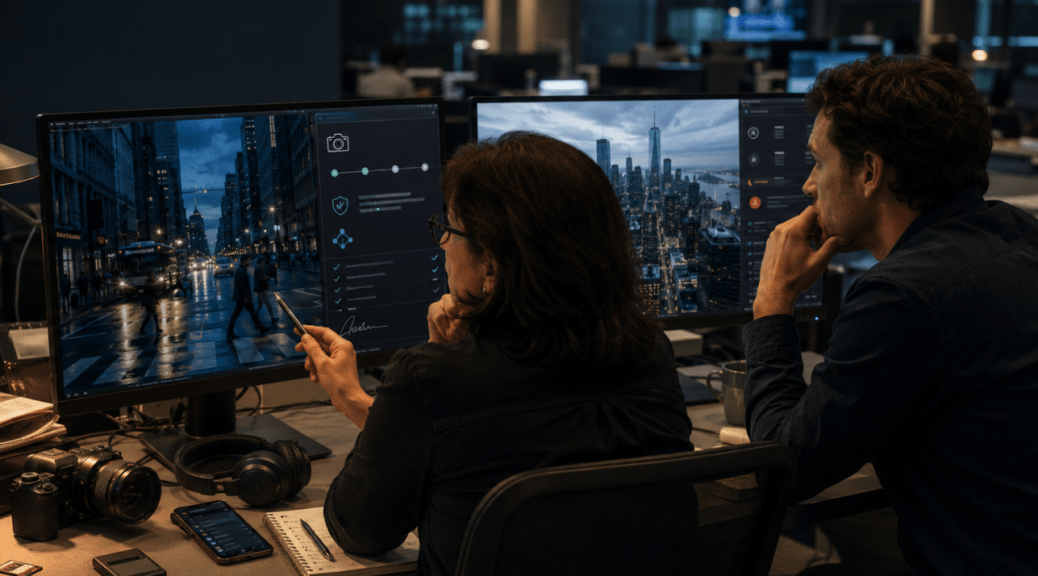
For most of photography’s history, asking whether an image was “real” meant asking whether the scene actually happened or whether the photographer had manipulated the result.
Generative AI has made that question considerably harder.
An image can now look like a conventional smartphone photograph even when no camera recorded the depicted moment. Faces, weather, buildings, crowds, products, and entire events can be synthesized convincingly enough that visual inspection alone is becoming an unreliable way to establish origin.
Apple may be preparing a different response: instead of trying to detect every artificial image after it appears, give genuine camera photographs a way to prove where they came from.
On August 11, 2026, The Verge reported that code discovered in iOS 27 beta 5 refers to a system called Apple Reference Image. According to the report, the still-unreleased feature could allow certain photographs taken with an iPhone to carry provenance information created at the moment of capture. A user could later request authentication designed to demonstrate that the photograph originated from an iPhone camera. The feature is not currently active, and Apple has not publicly promised that it will ship in the final version of iOS 27. The current details therefore come from beta software rather than a finished product announcement. (The Verge)
If Apple ultimately releases the system, its significance could extend well beyond another Camera app setting.
It could help shift photography from a world where viewers ask, “Can I spot the fake?” toward one where they ask, “Can this image show me where it came from?”
Apple Reference Image Appears to Focus on Provenance
The reported Apple system is not primarily an AI detector.
That distinction is important.
AI detectors generally analyze content that already exists and attempt to determine whether a model generated or altered it. Such systems must make judgments about pixels, patterns, metadata, compression, and other signals that may disappear when files are resized, edited, screenshotted, or passed between platforms.
Provenance takes a different approach.
Instead of looking at a finished photograph and guessing its history, a provenance system records evidence about that history while the photograph is being created or edited.
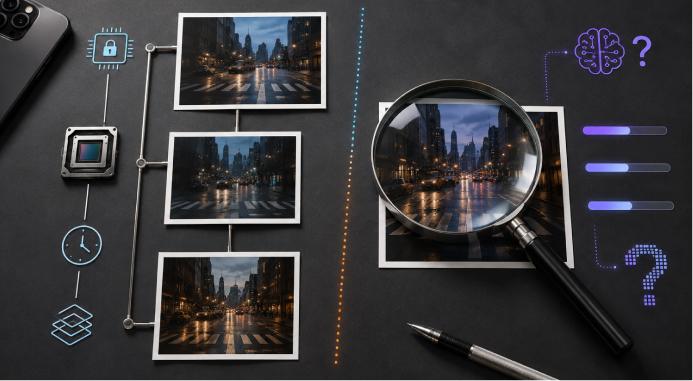
According to the iOS 27 beta reporting, Apple Reference Image could embed information tied to the capture process, including sensor-related signals, a capture timeframe, and hardware identifiers. Authentication would reportedly require an additional verification step rather than occurring automatically for every photograph.
That creates a fundamentally different claim.
A verified image would not necessarily mean, “Everything you see here is objectively true.”
It would mean something closer to, “A recognized camera system captured the source image, and there is cryptographic or hardware-linked evidence supporting that origin.”
That may sound like a subtle distinction, but it is likely to become essential.
A Camera-Verified Photograph Is Not Automatically an Unedited Photograph
Photo verification cannot restore the old assumption that photographs simply reproduce reality.
Photography has always involved interpretation.
A photographer chooses the lens, framing, moment, exposure, focal point, position, and distance from the subject. Modern smartphones add computational decisions involving HDR, sharpening, noise reduction, color processing, portrait effects, exposure blending, and other automated operations.
A photograph can therefore be authentic as a camera capture while still representing reality selectively.
Cropping also does not make a photograph fake.
Neither does adjusting brightness, correcting white balance, converting an image to black and white, or making editorial adjustments that do not change the underlying event.
The more useful question is whether the photograph’s history is transparent.
A strong provenance system could theoretically show that a camera captured an original image and that specific transformations happened later.
That is closer to how the broader C2PA Content Credentials system is designed to operate. The Coalition for Content Provenance and Authenticity describes Content Credentials as a method for attaching cryptographically verifiable information about the origin and modification history of digital content. Its specification can record camera information and actions such as cropping or color correction while preserving earlier provenance as an asset changes. (C2PA Content Credentials)
The goal is not to declare every edited photograph false.
It is to make the chain of events more visible.
“Real” May Need Several Different Definitions
If provenance becomes common, the word real may become too imprecise for serious discussions about images.
A future viewer may need to distinguish among several categories.
A camera-original photograph could mean that light from a physical scene reached an authenticated camera sensor.
An edited photograph could begin with that genuine capture but include normal post-processing.
A composite image could contain several authentic photographs combined intentionally.
An AI-modified photograph could begin with a camera capture but use generative tools to add, remove, or reconstruct significant content.
A fully synthetic image could contain no camera capture at all.
Those categories are more useful than a simple real-versus-fake binary.
They also reflect how images are already being produced.
For readers interested in photography, visual presentation, and digital imagery, understanding those distinctions is becoming part of basic image literacy, because increasingly sophisticated tools can create convincing pictures without leaving obvious visual clues.
Why Apple’s Scale Could Matter
Content provenance is not a new idea.
What could make Apple’s involvement important is scale.
The iPhone is one of the world’s most widely used cameras. A provenance system integrated directly into the standard Camera and Photos experience could put authenticated capture technology into the hands of millions of people who would never install specialized verification software or buy a professional camera designed for newsroom authentication.
That accessibility could change expectations.
Today, proving where a photograph originated is usually a specialized concern for photojournalists, forensic investigators, newsrooms, researchers, and certain professional creators.
Tomorrow, a verified capture badge could potentially matter when documenting a damaged rental car, an insurance claim, an apartment condition, a marketplace product, an accident scene, a home repair, a public event, or a viral social-media incident.
The strongest potential use cases are not necessarily artistic photographs.
They are photographs being used as evidence.
Photojournalism Has the Most Obvious Use Case
News photography faces an increasingly difficult problem.
A dramatic photograph can spread globally before editors or viewers have time to establish where it came from. A convincing synthetic image can acquire false captions, fake locations, or fabricated dates.
Provenance will not eliminate misinformation because a genuine photograph can still be miscaptioned or taken out of context.
An authentic image of a crowd photographed in Chicago in 2024 could be falsely presented as a protest in New York in 2026.
Verification of camera origin does not solve that problem.
But it can remove one layer of uncertainty.
If a newsroom can verify that a photograph originated from known hardware at capture, editors gain a stronger starting point for further verification involving photographer identity, time, location, witnesses, and context.
That is different from simply running an image through software that claims to detect whether AI was involved.
Product Photography Could Also Gain a Trust Layer
The implications extend into commercial photography.
Online shoppers already encounter a mixture of conventional product photographs, heavily retouched studio images, 3D renders, AI-generated lifestyle scenes, virtual models, and composites.
Those formats can all have legitimate uses.
The problem begins when the presentation makes it difficult to determine what is actually being shown.
Imagine a used-car marketplace where sellers can provide verified camera-origin photographs of a vehicle.
Or a vacation-rental listing where current property images carry authenticated capture information.
A resale platform could distinguish between an authenticated photograph of the actual handbag being sold and a manufacturer’s stock image.
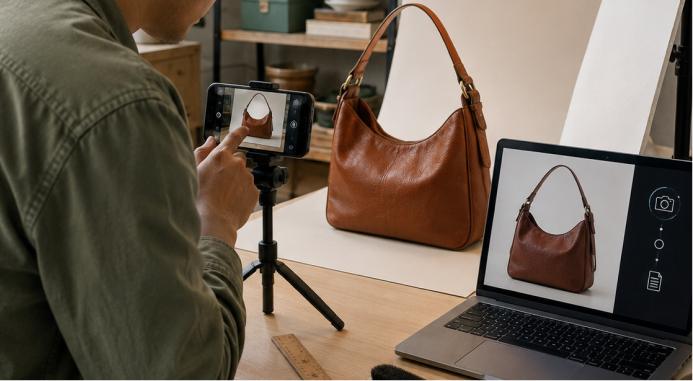
Small online sellers could use verified photography to demonstrate that the physical product in their possession actually exists.
This would not prove that a seller is trustworthy or that the item is genuine.
A counterfeit watch can still be photographed with a real camera.
But authenticated capture could answer one narrower question: did a physical camera actually photograph this object?
In online commerce, even that limited assurance may become valuable.
The Most Important Feature Might Be the History, Not the Badge
A simple “verified” badge could easily create misunderstanding.
People may interpret verification as proof that the entire visual claim is true.
That would be dangerous.
The more valuable implementation would show meaningful provenance information: capture origin, subsequent editing steps, whether generative tools were introduced, and whether the authentication chain remains intact.
This is the principle behind Content Credentials.
The C2PA standard is designed around a history rather than a single judgment. As a file changes, new provenance claims can be added without silently rewriting previous ones. (C2PA Content Credentials)
For photographers, that is a better model of creative reality.
Most professional photographs are processed.
RAW files are interpreted.
Exposure is adjusted.
Cropping happens.
Colors are refined.
Dust spots may be removed.
Declaring an image either “untouched” or “fake” ignores how photography actually works.
Provenance can potentially show what happened instead.
Privacy Will Be a Major Part of the Debate
A system that connects photographs with hardware and capture information immediately raises privacy questions.
Photographers may not want every shared image to expose a precise time, location, device identity, or other identifying details.
According to the beta reporting, Apple’s system is expected to be optional rather than permanently applied to every photograph, and verification may use Apple’s Private Cloud Compute infrastructure. The exact privacy behavior could still change before any public release.
Apple’s existing Private Cloud Compute security documentation states that PCC is designed around stateless processing: personal data provided for a request is supposed to be used only to fulfill that request and not retained after the response is returned. Apple also says the infrastructure is designed so that user information processed within PCC cannot be accessed by Apple personnel. (Apple Security)
Those are Apple’s stated architectural guarantees for PCC generally. Apple has not yet published final technical documentation explaining exactly how an Apple Reference Image service would use that infrastructure.
That distinction should remain clear until a shipping feature exists.
Apple May Be Choosing a Different Route From C2PA
One of the most interesting parts of the current report is that Apple Reference Image appears to be Apple’s own system rather than a straightforward implementation of C2PA Content Credentials.
Other technology and camera companies have increasingly explored C2PA-based provenance because a common standard offers interoperability.
That matters because an authenticity system is only as useful as the number of places that can understand it.
A photograph should ideally remain verifiable when it moves from a camera to editing software, a newspaper, a marketplace, a messaging service, or a social platform.
A proprietary system risks creating another closed verification environment.
Apple may have technical reasons for pursuing a different design, and the beta feature could still evolve considerably.
Until the company explains its architecture publicly, it would be premature to judge whether Reference Image competes with, complements, or eventually interoperates with C2PA.
Verification Does Not Mean Photographers Should Stop Editing
The rise of photo authentication may create unnecessary anxiety among photographers who use ordinary editing tools.
Authenticity should not require pretending digital photography ends when the shutter is pressed.
Editing is part of photography.
The meaningful distinction is whether editing changes presentation or changes underlying reality in a way that matters to the intended use.
A landscape photographer removing a small sensor-dust spot is performing a different operation from generating a building that never existed.
A portrait photographer adjusting exposure is doing something different from changing a subject’s facial expression with AI.
A newspaper cropping an image for layout is different from inserting an additional person into a crowd.
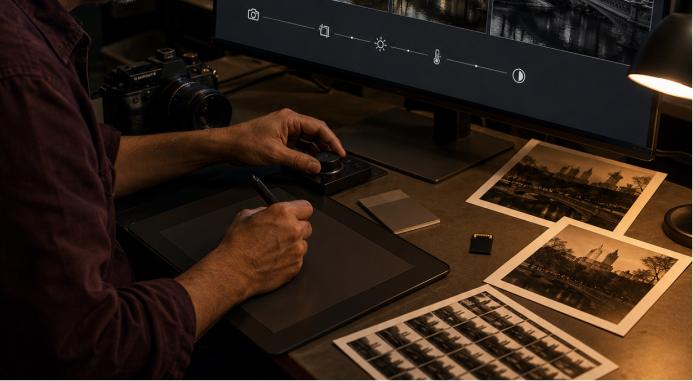
Provenance systems are potentially valuable precisely because they can move beyond treating every alteration as equivalent.
Screenshots Will Remain a Problem
One practical limitation is easy to predict.
Even sophisticated provenance metadata can be lost when somebody takes a screenshot of an authenticated image, photographs a screen, strips metadata, exports through incompatible software, or uploads to a service that removes attached credentials.
Standards such as C2PA have been working on approaches to maintaining or reconnecting provenance despite transformations, but no system can guarantee an uninterrupted history under every possible workflow.
This means the absence of authentication should not automatically mean an image is fake.
That may become one of the most important rules of visual literacy.
Verified provenance can provide positive evidence. Missing provenance is not necessarily negative evidence.
Millions of legitimate photographs already exist without modern authentication records. Older cameras will continue producing normal images. Some photographers will disable optional features. Platforms may strip data.
A responsible system must avoid dividing the world into “verified equals true” and “unverified equals suspicious.”
Photographers Could Eventually Gain Something Valuable
The conversation around authentication is often framed around fighting deepfakes, but photographers could receive another benefit: stronger evidence of authorship and origin.
A cryptographically linked capture history can potentially help establish that a photographer possessed an original image at a particular stage of its creation.
That will not replace copyright registration or resolve every ownership dispute.
It could, however, provide another layer of documentation.
Professional photographers already maintain RAW files, metadata, backups, contact sheets, export histories, and project archives partly because those materials establish the path from capture to finished work.
Provenance can make part of that process machine-verifiable.
The Future of Photography May Depend on Proving Origin
Apple Reference Image is still an unreleased feature discovered in beta software.
That fact matters more than the excitement surrounding it.
Apple could modify the system, delay it, rename it, or never release it publicly. Until the company documents the feature, the detailed mechanics reported from iOS 27 beta 5 should be treated as evidence of development rather than a final specification.
But the broader direction is already clear.
The photographic industry is moving toward a world where pixels alone cannot establish how an image was made.
Cameras may increasingly need to produce not only photographs but also evidence about those photographs.
That changes the meaning of image quality.
Sharpness, dynamic range, color, resolution, and autofocus will still matter.
Provenance may join them.
The most trustworthy photograph of the future may not simply be the one that looks convincing.
It may be the one capable of showing its history.