
A traditional lifestyle product photograph can require considerably more than a camera.
A small brand photographing a ceramic mug might need a photographer, lighting, a suitable location, surfaces, props, styling, editing, and enough production time to create several usable variations. If the company wants the same mug presented differently for Christmas, spring, Mother’s Day, or a summer campaign, portions of that process may need to happen again.
Google Product Studio proposes a different model.
Instead of physically rebuilding every environment, merchants can start with an existing product photograph and use generative AI to place the item into new lifestyle-like scenes. Google’s current Product Studio for Merchant Center also provides tools for changing or removing backgrounds, increasing image resolution, animating images, creating new product visuals, and generating video. Product Studio is also available through the Google & YouTube app for Shopify.
Google says 80% of surveyed Product Studio users have already become more efficient or expect to become more efficient by using the service. The company explicitly presents the technology as a way to reduce some of the time, resources, and budget required to plan, shoot, and edit product imagery.
That sounds like a direct challenge to lifestyle product photography.
The more interesting possibility, however, is not that AI eliminates product photographers. It is that photographers become responsible for producing an increasingly valuable foundation: an accurate, reusable master image of the real product.
Product Studio Separates the Product From the Photoshoot
The fundamental change introduced by Product Studio is simple: the product and the lifestyle environment no longer have to be photographed together.
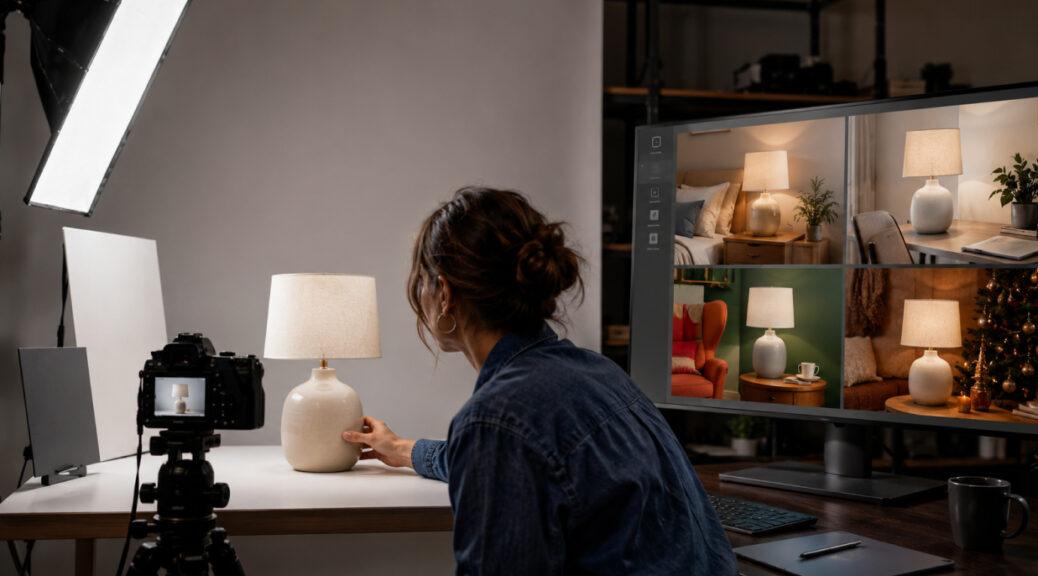
Imagine a small home-goods company selling a table lamp.
A conventional lifestyle shoot might place that lamp inside a carefully styled bedroom. The photographer controls the light, camera position, exposure, furniture, bedding, wall color, and surrounding objects.
If the company later wants the same lamp in a minimalist office, another setup may be required.
Product Studio approaches the problem differently. A merchant can select or upload the product image, describe the desired placement and surroundings, and generate a new scene around it. Google also provides seasonal, holiday, studio, interior, event, and nature-oriented themes to accelerate that process.
The economic question consequently changes.
Instead of asking, “How many environments can we afford to photograph?” a business can increasingly ask, “How many environments can we responsibly create from the product photographs we already have?”
For ecommerce photography, that is a substantial shift.
The Original Product Photograph Becomes More Important
Generative backgrounds do not eliminate the need for good source photography.
They can make it more valuable.
Google’s own best practices recommend beginning with one clearly identifiable main product and avoiding source images where people, hands, or props make the main object difficult for the system to isolate.
The implication for commercial photographers is significant.
A small ecommerce brand may not need a photographer to construct ten elaborate lifestyle scenes physically. It may still need that photographer to create an exceptionally accurate master image set.
Those photographs establish what the product actually looks like:
its shape, proportions, surface, material, color, edges, construction, texture, and important details.
AI might generate a marble countertop around a coffee maker.
It should not have to guess what the coffee maker itself looks like.
Catalog and Lifestyle Photography May Move Closer Together
Commercial photography has traditionally made a useful distinction between catalog imagery and lifestyle imagery.
A catalog photograph primarily answers:
What is the product?
A lifestyle photograph answers:
What might this product look like in my life?
Generative tools blur the production boundary between those categories.
A carefully photographed candle on a controlled background could become the starting point for multiple visual treatments: a bedroom, bathroom, dinner table, holiday interior, or spa-like environment.
A backpack might move from a clean studio photograph into a travel context.
A kitchen appliance could appear within several interior styles without physically traveling between several homes.
That does not turn the generated result into documentary photography.
It is better understood as a synthetic lifestyle presentation built around product photography.
Maintaining that distinction matters because the source photograph and generated environment provide different types of visual information.
Small Businesses Gain Access to More Visual Variety
One of the clearest opportunities is for smaller ecommerce companies.
Large brands can afford location scouts, elaborate sets, models, prop stylists, professional retouchers, and multi-day productions.
A small Shopify seller might have one camera, one light, and a folding table.
Product Studio narrows part of that production gap.
Google currently offers the tool without an additional Product Studio charge and positions it as a way to get more value from imagery merchants already possess. Assets saved to Merchant Center can become eligible to appear across Google surfaces that use merchant feed data, including Search, Shopping ads, and Performance Max campaigns.
The practical opportunity is not merely creating prettier backgrounds.
It is creative iteration.
A merchant can experiment with several visual directions before deciding which deserves further investment.
Generate a concept.
Review it.
Reject inaccurate versions.
Modify the description.
Try another environment.
Then reserve a conventional production budget for scenes where real locations, people, physical interaction, or precise lighting genuinely add value.
Seasonal Product Photography Could Change Dramatically
Seasonal ecommerce photography is particularly suited to this workflow.
Think about how many temporary environments retailers traditionally create:
Christmas tables, autumn interiors, spring gardens, back-to-school desks, summer patios, Valentine’s Day scenes, and short-lived promotional imagery.
Google explicitly positions Product Studio as a way to refresh imagery for holidays, seasons, and sales.
Traditionally, seasonal assets might be photographed months before consumers ever see them because locations, props, photographers, retouchers, products, and campaign deadlines all need to align.
Generative scenes can shorten that cycle.
A retailer with strong master photography may be able to create contextual variations much closer to the campaign date.
That could make commercial imagery more responsive to weather, trends, inventory, regional differences, and rapidly changing campaigns.
But speed introduces another responsibility.
An image being fast to create does not make it accurate.
Product Accuracy Is the Non-Negotiable Boundary
Lifestyle photography has always involved staging.
A photographer can place a bottle beside flowers that were never present during ordinary product use. A furniture company can photograph a chair in a house the customer will never visit.
AI generation extends that staging because the entire surrounding environment may never have physically existed.
The important boundary is the product itself.
A generated scene becomes misleading if it materially changes the item’s:
shape,
size,
material,
color,
pattern,
controls,
components,
included accessories,
or functional characteristics.
Imagine an AI-generated photograph of a backpack that invents an additional exterior pocket.
That is no longer simply a creative background.
It has become inaccurate product information.
The distinction is especially important for jewelry, electronics, apparel construction, handmade goods, furniture, tools, and other products where small visual details can influence a purchasing decision.
Google Itself Warns That Product Studio Has Limits
Product Studio remains experimental.
Google says the service can produce unexpected results and works better with certain types of products. Its current guidance specifically identifies consumer packaged goods with the product prominently centered as a strong use case. It also identifies limitations involving hands, wall art, light fixtures, and certain other imagery.
That tells photographers something important.
Products are not equally easy for generative systems to handle.
A simple opaque container against a clean background is relatively straightforward.
A transparent perfume bottle containing liquid is harder.
Highly polished chrome produces reflections that need to correspond to the environment.
Jewelry contains tiny geometric details where a small generation error can change the actual design.
Garments need believable fabric behavior.
Glassware requires plausible transparency and refraction.
Light fixtures are particularly challenging because the product itself affects the illumination of the surrounding scene.
Professional product photographers spend years learning to manage these physical characteristics.
Generative AI does not make those challenges disappear.
Photography First, Generation Second Is a Stronger Workflow
For many businesses, the most dependable approach will be hybrid.
Start by photographing the physical product properly.
Capture a clean hero photograph.
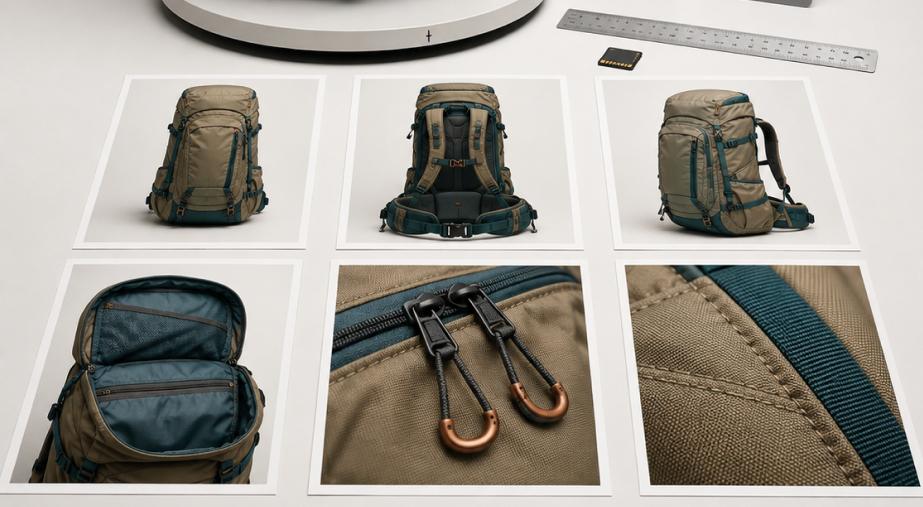
Photograph important alternative angles.
Create close-ups of materials and functional details.
Document packaging when it matters.
Include useful scale information.
Maintain consistent and accurate color.
Then use those reliable visual assets as the foundation for additional contextual imagery.
This creates a useful hierarchy.
Original product photography establishes evidence.
Generated lifestyle imagery establishes context and mood.
That distinction also fits the broader photography and visual-presentation focus of Finest Image, where image quality matters because photographs influence how people understand appearance, detail, and presentation.
More Images Only Help When They Provide More Information
Generative AI makes producing visual variations dramatically easier, but quantity alone is not a useful ecommerce strategy.
Suppose a shopper wants to see the back of a shoe.
Generating five attractive environments around the same front-facing photograph does not solve that problem.
The shopper still needs to see the back.
If someone wants to understand the compartments inside a bag, another atmospheric café scene provides little evidence.
If furniture dimensions are difficult to interpret, an accurate scale photograph may be more useful than a decorative generated interior.
A strong ecommerce image set therefore needs different types of visuals for different jobs.
Some images should provide documentary information: alternative angles, construction details, scale, material, packaging, and functionality.
Others can provide aspiration and context.
Generative AI is much better suited to expanding the second category than replacing the first.
Product Photographers May Begin Shooting More Modularly
Product Studio also suggests a change in how photographers can plan commercial shoots.
Instead of producing only finished compositions, photographers can create source assets designed for reuse.
That means prioritizing clean product separation, controlled shadows, accurate edges, consistent angles, high resolution, predictable lighting, and sufficient visual information for the object to survive placement in several different contexts.
This is a more modular approach to product photography.
A photographer might eventually deliver two distinct groups of files.
The first would contain traditional finished photographs.
The second would contain flexible product assets intended for compositing, generative backgrounds, video creation, seasonal campaigns, and future formats that did not exist when the original shoot happened.
That can make professional photography more reusable rather than less relevant.
Lighting Consistency Will Become a Bigger Problem
Generating a convincing background is only part of creating a believable lifestyle image.
Light tells viewers whether the product actually belongs there.
Imagine a shoe originally photographed with broad studio illumination coming from the left.
An AI system then places it into a dramatic sunset scene where the visible sunlight comes strongly from the right.
If the shoe keeps its original highlights and shadows, something can feel artificial even if a viewer cannot immediately identify the problem.
Color temperature matters too.
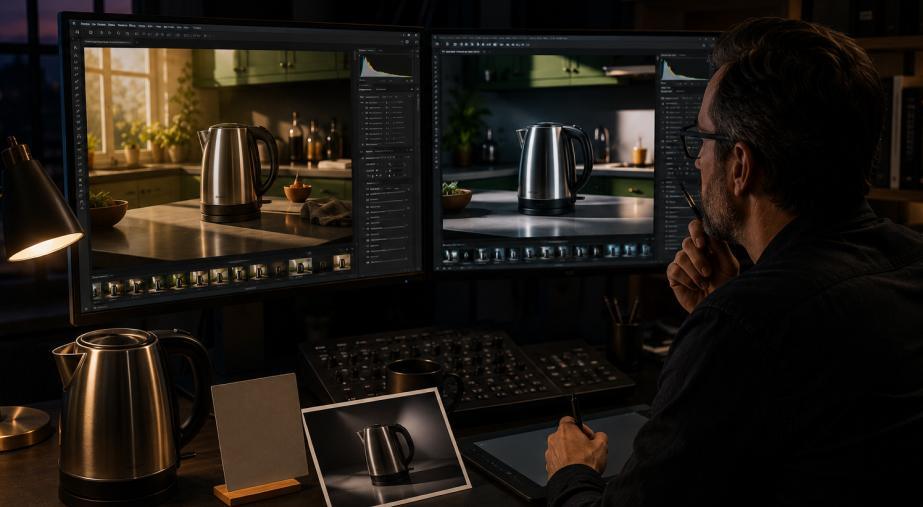
A product photographed under neutral studio lighting can appear pasted into a warm candlelit room if its illumination remains completely neutral.
Reflective products make the issue more obvious.
A polished kettle supposedly sitting inside a dark green kitchen should not visibly reflect a large white photography studio.
This is where trained visual judgment remains valuable.
The question is not only:
“Does the generated background look realistic?”
It is:
“Does the product appear to physically exist inside that environment?”
Product Video Is Entering the Same Workflow
Product Studio is already extending the concept beyond still photography.
Google’s current Product Studio video-generation guidance allows eligible merchants to use product imagery to create videos in horizontal, vertical, or square formats. Google recommends beginning with clear, well-lit, high-resolution photographs and choosing source images that remain visually consistent in lighting, background, and style.
That recommendation is revealing.
Automated video still depends on photography fundamentals.
If the original photographs contain inconsistent white balance, poor lighting, inaccurate color, or weak composition, automation does not magically create a coherent commercial campaign.
AI changes how the material is assembled.
It does not eliminate the need for strong source material.
AI Image Provenance Is Becoming Part of Ecommerce
The distinction between photographed and generated imagery is also becoming technically important.
Google’s current AI-generated content requirements state that images created using generative AI must contain metadata identifying them as AI-generated. Google specifically tells merchants not to remove embedded digital-source metadata from images created with tools such as Product Studio.
Google also says its advertising products have been rolling out AI-label settings for certain AI-created or edited assets, while noting that use of its labeling tools does not by itself guarantee compliance with applicable regulations.
That creates another reason to maintain organized commercial image workflows.
Businesses may increasingly need to know:
Which photograph came directly from the camera?
Which file was conventionally retouched?
Which background was generated?
Which image contains substantial AI modification?
Where is the untouched original?
For photographers and brands, provenance may become another part of professional asset management.
AI Cannot Decide Whether a Scene Makes Sense for the Product
A technically beautiful generated photograph can still be commercially wrong.
Imagine an AI scene showing an electronic product being used outdoors in heavy rain even though it lacks the necessary water resistance.
Or a generated image placing an object next to food in a way that implies food-safe use when the manufacturer makes no such claim.
A scene could show a product in an incorrect orientation.
It could generate accessories that appear to be included with the purchase.
It could imply a scale that makes a small object look substantially larger.
These are not simply image-quality problems.
They are product-knowledge problems.
A person still needs to determine whether the environment creates an implication the company can support.
Lifestyle photography does more than produce atmosphere.
It teaches consumers how to interpret a product.
The Photographer’s Value May Move Toward Visual Direction
If basic background generation becomes inexpensive, photographers can differentiate themselves through decisions that are harder to automate reliably.
Which angle makes the product understandable?
What lighting reveals the material accurately?
Which reflections need to be controlled?
What details require macro photography?
Which elements should never be generated?
How should the object be positioned for future reuse?
Does a generated environment fit the brand?
Are the shadows physically believable?
Has the product changed?
Does the scene imply something untrue?
Those questions belong to photography, retouching, visual communication, and art direction.
Generating a background can become easy.
Knowing whether the finished image is trustworthy remains considerably harder.
Product Studio Could Make Original Photography More Valuable
The simplest interpretation of Google Product Studio is that businesses will need fewer lifestyle photoshoots.
For some kinds of imagery, that will probably be true.
A small retailer may no longer need to construct five different physical sets merely to produce five seasonal backgrounds.
But that does not necessarily mean the retailer needs fewer good product photographs.
Google is encouraging merchants to derive more assets from existing product imagery, distribute those assets across multiple channels, animate photographs, and turn them into video. At the same time, its documentation repeatedly stresses the importance of appropriate source images and warns that experimental generation can produce unexpected results.
That increases the value of creating a reliable visual master for every product.
Commercial shoots may therefore become more systematic.
Instead of spending most of the budget constructing one elaborate environment, photographers may spend more time producing accurate, adaptable source material: clean hero photographs, multiple angles, close-ups, controlled lighting, consistent color, and reusable compositions.
The environments can then multiply digitally.

The Future Is Less About Photography Versus AI
Google Product Studio makes it tempting to frame the change as a competition.
Photographer versus generator.
Physical set versus artificial background.
Traditional photoshoot versus AI.
For ecommerce businesses, the more useful distinction is between what requires visual evidence and what allows creative interpretation.
The physical product deserves accuracy.
Its color, proportions, materials, components, construction, and important details should not become creative guesses.
The environment has always been more flexible. Photographers already construct artificial sets, simulate window light, use seamless backgrounds, composite photographs, remove supports, and retouch distracting elements.
Generative AI expands that flexibility dramatically.
What Google Product Studio reveals about the future of lifestyle product photography is therefore more nuanced than the disappearance of the photoshoot.
A carefully photographed physical product can become the trusted center of a much larger collection of adaptable digital environments.
For small businesses, that can lower the cost of visual experimentation.
For shoppers, it can create more opportunities to imagine products in context—as long as generated imagery remains accurate enough not to mislead them.
For photographers, the value proposition changes.
The premium skill may no longer be simply creating one beautiful finished lifestyle scene.
It may increasingly be creating accurate, adaptable and visually trustworthy source photography capable of supporting dozens of future images without losing the truth of the product.