
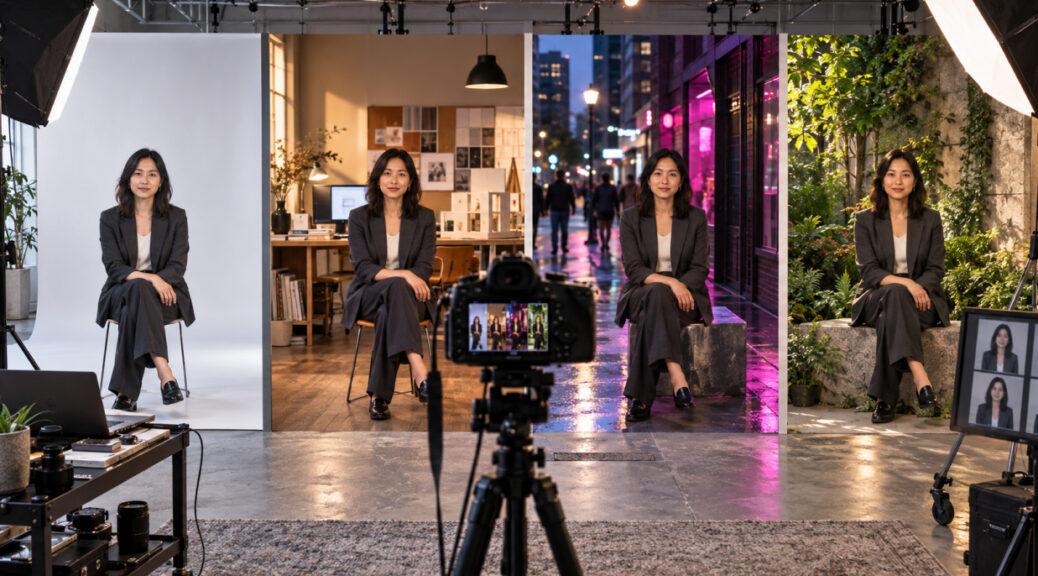
A portrait does not begin and end with a face.
The room behind you, the street beneath your feet, the objects surrounding you and even the amount of empty space in the frame can influence what a viewer thinks the photograph is trying to say.
Saks Fifth Avenue’s Fall 2026 campaign offers a timely example.
Launched on September 3, 2026, the retailer’s “Let’s Go!” campaign was photographed by Nadine Ijewere and features Scarlett White, Felice Noordhoff, Divine Mugisha, Sanique and Jae Lee. Rather than placing every subject against a neutral studio background, Saks used its New York flagship and city parks as part of the visual storytelling.
The choice was deliberate. Saks described the campaign as connecting fashion with New York’s energy, while Exemplar Luxury Group creative executive Elle Strauss said the visual world was intended to feel spontaneous, confident and distinctly New York.
It illustrates a useful principle far beyond fashion advertising:
where you take a portrait can become part of the first impression you make.
A professional headshot in a white studio, a portrait inside an artist’s workshop and a photograph of the same person walking through Manhattan can present three very different versions of that person—even when their face, clothing and expression barely change. How to Create Review Page Images That Build Visual Trust?
A Background Is Never Completely Neutral
Photographers often describe a background as though its primary job is to stay out of the way.
Sometimes that is exactly what it should do.
A passport photograph, for example, intentionally minimizes environmental information. The purpose is identification, so the background should communicate almost nothing.
Environmental portraiture works differently.
The setting can provide information before the viewer has consciously analyzed the subject.
An architect photographed inside a modern building occupies a different visual world from the same architect photographed against seamless gray paper.
A chef photographed inside a working kitchen acquires immediate professional context.
A musician photographed backstage communicates something different from one photographed in a suburban park.
None of those environments proves anything about the person’s character. A photograph is not a reliable personality test.
But environments provide visual cues, and viewers use cues when forming impressions.
Research published in the Journal of Personality and Social Psychology found that people formed impressions about individuals based on their offices and bedrooms even without seeing the occupants themselves. The researchers found that physical environments could produce consistent impressions among independent observers, although stereotypes and other limitations also affected those judgments.
For portrait photography, that means the space surrounding the face deserves attention.
Saks Made New York Part Of The Portrait
The Saks Fall 2026 campaign demonstrates the principle at commercial scale.
Ijewere photographed the campaign around Saks Fifth Avenue’s New York flagship and outside in parks. Saks described the imagery as combining the city’s energy with the season’s luxury fashion.
That is very different from photographing identical clothes against a uniform studio sweep.
New York supplies additional information.
Architecture suggests place.
Streets and parks create movement.
The flagship establishes a relationship with Saks itself.
Public environments can introduce unpredictability and energy that would be difficult to reproduce perfectly inside a studio.
As a result, location stops functioning as scenery and starts functioning as part of the campaign’s identity.
That same principle can apply to an ordinary portrait.
The Same Person Can Tell A Different Story In A Different Place
Imagine photographing one person four times.
In every photograph, the person wears the same navy jacket. Their expression remains relaxed. The camera remains at approximately eye level.
Only the environment changes.
Photograph them against a light-gray studio background and the viewer has very little contextual information. Attention moves toward the face, clothing and expression.
Photograph them behind a desk with books and a laptop and the portrait begins suggesting work.
Move them to a crowded city sidewalk and the photograph feels more active and public.
Place them beside a window in their home and it becomes more personal.
The person has not changed.
The visual story has.
This is why choosing a portrait location should not be treated as an afterthought.
The photographer is deciding how much contextual information the viewer receives.
Studio Portraits Reduce The Number Of Clues
There is a reason professional headshots frequently use simple backgrounds.
Removing environmental detail concentrates attention.
The viewer notices facial expression, eye contact, grooming and clothing because there is little else competing for attention.
That can be extremely useful.
A corporate directory may need hundreds of portraits to look consistent.
An actor may need a headshot that keeps attention firmly on facial appearance.
A passport photograph needs visual standardization for identification.
A clean professional profile photograph may need to work at extremely small sizes on websites and apps.
In those situations, environmental storytelling can become unnecessary visual noise.
A simple background also gives the photographer greater control over light, color and composition.
The absence of context becomes a photographic choice.
Environmental Portraits Answer “Who Is This Person?” Differently
An environmental portrait has another objective.
Instead of removing clues, it introduces selected ones.
A ceramic artist can be photographed beside unfinished pieces.
A carpenter can stand inside a workshop.
A designer can be surrounded by material samples.
A professor can be photographed in a laboratory or classroom.
A musician can occupy a rehearsal room.
The viewer is not merely looking at the subject’s appearance. They are looking at the relationship between person and place.
This can be particularly useful for personal branding because the environment can communicate information that would otherwise require a caption.
But it introduces responsibility.
The setting should be genuine enough to make sense.
Photographing someone inside an impressive-looking environment that has no meaningful relationship with them can create an image that feels manufactured.
Background Clutter Competes With Your Face
More context is not automatically better.
A poorly chosen environment can weaken a portrait.
Imagine a video-call profile photograph made inside a home office.
The expression is good.
The light is flattering.
But behind the subject are tangled cables, an open closet, several brightly colored packages and a lamp appearing to grow directly out of their head.
The viewer’s eye now has multiple places to go.
Visual clutter can affect attention. Research summarized by the American Psychological Association has examined how background clutter influences attention in virtual interactions, illustrating that environmental information is not simply invisible to viewers.
For portrait photography, the practical lesson is straightforward:
inspect the background as carefully as the face.
Before pressing the shutter, look around the edges of the frame.
Check what intersects with the head.
Look for bright objects.
Notice text.
Watch reflections.
Identify objects that could accidentally become the strongest visual element.
Sometimes moving the camera a few inches solves the problem.
Color Can Change The Emotional Temperature Of A Portrait
Location also determines color.
A warm wooden room creates a different visual atmosphere from a concrete office.
A green park differs from a dark theater.
A white studio differs from a neon-lit street.
Color can influence the emotional tone of the image even before viewers consider individual objects.
This does not mean there is a universal formula such as “blue makes you trustworthy” or “red makes you powerful.” Human perception is more contextual than those simplified rules suggest.
Instead, think photographically.
Does the background separate the subject from the environment?
Does clothing disappear into the wall?
Is one background color overwhelming the skin tones?
Are several competing colors pulling attention away from the eyes?
A successful portrait often depends less on finding a supposedly psychological color and more on creating visual hierarchy.
The face should still matter.
Light Changes When The Location Changes
Changing locations also changes one of the most important components of any portrait: light.
A studio gives the photographer substantial control.
Outdoors, the sun may be hard and directional.
Under a tree, patches of sunlight can cross the face.
Inside an office, overhead fixtures can create shadows under the eyes.
Near a large window, the subject may receive soft directional illumination.
On a city street, buildings can act like enormous flags and reflectors.
This means two portraits of the same person can produce different impressions partly because the location changes how their face is illuminated.
A darker environment with strong directional light may feel dramatic.
A bright open environment with soft light may feel more approachable.
Again, neither impression necessarily describes the person’s actual personality.
It describes the photograph.
That distinction is important.
Camera Position Determines How Much Environment Matters
Location alone does not determine the result.
Framing decides how much of it the viewer gets to see.
A tight head-and-shoulders portrait might reveal only a small area behind the subject.
Step backward and suddenly the room becomes important.
Move farther back and the photograph can become almost as much about the environment as the person.
Lens choice also affects that relationship.
A longer lens and tighter framing can visually isolate the subject.
A wider composition can include architecture, furniture, streets or landscapes.
Neither approach is inherently better.
The question is what the portrait needs to communicate.
If the purpose is facial recognition, environmental information may be unnecessary.
If the person’s work or lifestyle is central to the story, removing the environment may discard useful information.
Your Professional Headshot Does Not Need To Look Corporate
This is especially relevant as professional identities become less standardized.
Not everyone works in a traditional office.
A photographer, architect, chef, designer, musician, fitness professional and software developer may all want different kinds of professional portraits.
A plain studio background remains a perfectly useful option.
But “professional” does not automatically mean gray background, business jacket and artificial smile.
The setting can help establish professional context.
A designer might benefit from a clean studio environment.
A hospitality professional could be photographed inside a thoughtfully composed venue.
A maker may look more natural in a workshop.
A remote worker could use a carefully organized home environment.
The key is intentionality.
The background should contribute something rather than merely proving that a location exists.
First Impressions Also Come From Clothing And Posture
Environment is only one layer.
The American Psychological Association has highlighted research showing that factors including clothing and posture can contribute to first impressions.
Portraits combine those signals simultaneously.
A person’s clothing interacts with the background.
Posture interacts with furniture.
Expression interacts with lighting.
Camera height affects body language.
The amount of space surrounding the subject affects composition.
That is why changing only the location can have surprisingly large consequences.
The new environment changes the relationships among all the other visual elements.
A formal jacket photographed in an office can reinforce formality.
The same jacket photographed outside a café may feel more relaxed.
The garment has not changed.
Its context has.
Be Careful About Reading Personality From A Photograph
There is an important limitation to all of this.
A portrait can shape an impression without revealing objective truth about the person.
Someone photographed in a library is not necessarily intellectual.
Someone photographed outdoors is not automatically adventurous.
A serious expression does not prove that someone is unfriendly.
An expensive office does not establish competence.
Photography compresses a complicated person into a fraction of a second.
Viewers then interpret the available cues.
Those interpretations can also be influenced by stereotypes, cultural expectations and personal experiences. Research into judgments based on physical environments has itself found that stereotypes can partially affect observer impressions.
Photographers should therefore distinguish between creating visual context and pretending a photograph can objectively reveal character.
Your Zoom Background Works In A Similar Way
The same principle now extends beyond traditional portraits.
Video calls have turned millions of bedrooms, kitchens and home offices into professional backgrounds.
A camera positioned for a meeting does not show only your face.
It may show books, furniture, artwork, windows, lighting and personal objects.
Even when viewers are not consciously studying those details, the environment forms part of the visual experience.
That makes video-call framing another form of environmental portraiture.
You do not need a perfectly styled office.
You do need to know what the camera sees.
Removing one distracting object, changing your position relative to a window or rotating the camera away from a cluttered corner can change the photograph substantially without changing your appearance at all.
Social Profile Photos Have A Different Location Problem
Profile pictures introduce another complication: size.
An environmental portrait that looks beautiful full-screen may become ineffective when reduced to a tiny circle.
The face can disappear.
The location becomes an indistinct collection of colors.
That means the correct background depends partly on where the portrait will be displayed.
For LinkedIn or another professional profile, facial visibility at small scale may matter more than showing an entire workplace.
For a personal website’s About page, a wider environmental portrait may have enough space to communicate context.
For an editorial feature, the photographer may intentionally show much more environment.
The best location cannot be separated from the final use of the photograph.
Fashion Photography Makes The Principle Easier To See
This is what makes Saks’ “Let’s Go!” campaign useful beyond fashion.
The clothing could have been photographed in a studio.
Instead, Ijewere’s photographs use New York as part of the campaign’s visual language. Saks says the campaign includes its flagship and iconic parks and is intended to capture the city’s energy.
The retailer is also displaying original Ijewere photography in a “Beautiful People” gallery exhibition inside a new concept space at the New York flagship, further connecting the photographs with a physical place rather than treating them purely as ecommerce assets.
For an advertising campaign, that helps establish a world.
For an individual portrait, the scale is smaller but the principle remains.
A location can tell the viewer where to place you before they know anything else about you.
Choose A Background For What You Want The Photograph To Do
The easiest way to choose a portrait location is not to ask which background looks most impressive.
Ask what information the photograph needs.
If the photograph primarily needs to show your face, simplify the setting.
If it needs to establish your profession, consider including meaningful environmental cues.
If it needs to feel personal, use a location that genuinely relates to your life.
If it will appear as a tiny profile image, prioritize facial visibility.
If it is an editorial portrait, give the environment enough room to become part of the story.
And if the background adds nothing useful, remove it from the equation.
The location should serve the portrait rather than compete with it.
Saks’ Fall 2026 campaign demonstrates what happens when that relationship is intentional. New York is not simply behind the models. It contributes to what the campaign wants the photographs to feel like.
The same is true on a much smaller scale whenever someone chooses where to take a portrait.
Your face may create the first point of attention.
But the room, street, studio or landscape surrounding it helps decide what kind of first impression that face arrives with.