
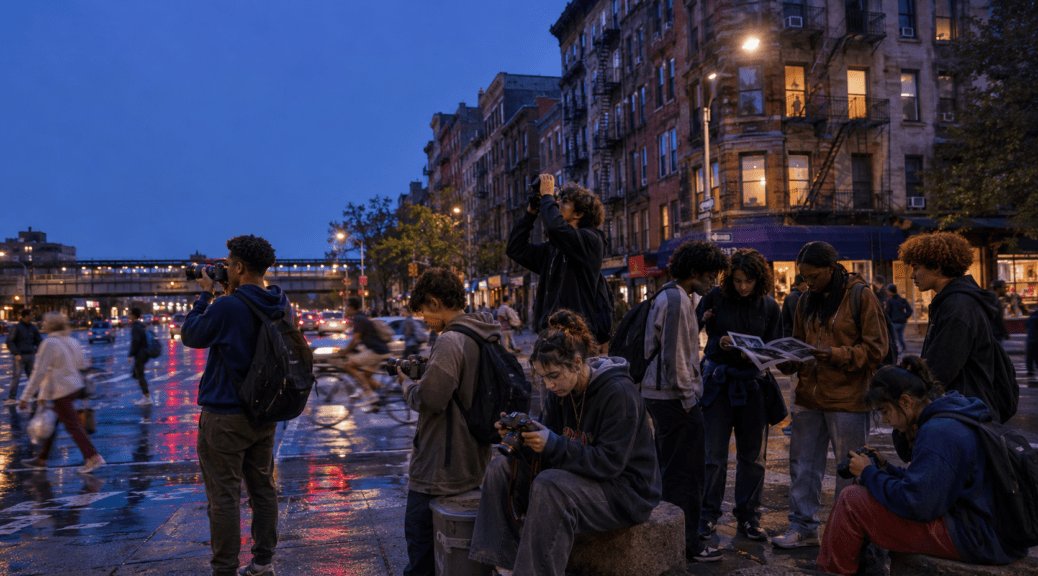
New York is often photographed as a spectacle of recognizable skylines, crowded avenues, subway platforms, and constant movement. In Through Motion and Repose: Expanding the Walls 2026, however, 17 teenage photographers present a city understood from much closer range. Their New York includes streets and public transportation, but it also exists inside family rooms, familiar doorways, quiet relationships, overlooked objects, and moments when the city appears to stop.
The photography exhibition opened at the Studio Museum in Harlem on July 1, 2026, and remains on view through January 31, 2027. It features artists from the museum’s 2026 Expanding the Walls program, an eight-month photography initiative for high school-aged New Yorkers. The participants live across Manhattan, the Bronx, and Queens and attend a mixture of public, private, preparatory, and transfer schools. (Studio Museum in Harlem)
Seen together, their images offer neither a tourism campaign nor a single statement about adolescence. They reveal how young photographers experience New York as a continual negotiation between public speed and private stillness, visibility and introspection, independence and family life.
A New York Seen From Inside Teenage Life
The exhibition’s title establishes its defining tension. “Motion” describes a familiar version of New York: traffic, subway travel, pedestrians, changing architecture, and people passing through one another’s frames. “Repose” introduces a less frequently emphasized city made from waiting, remembering, observing, and spending time at home.
The Studio Museum explains that some participants used blur and soft focus to communicate the flux of streets, subways, and architecture. Others photographed people, places, and familiar objects at close range, allowing the details of everyday life to become central subjects rather than background material. (Through Motion and Repose)
That combination changes how New York is represented. The city does not appear only as a monumental landscape photographed from an observation deck or across a river. It becomes a network of smaller emotional territories: a corner where people gather, light entering a room, a partially open door, a family figure, or a garden-like space discovered within a dense urban environment.
The teenage photographers are not positioned outside the city as detached observers. They are photographing an environment they must move through every day. Their images therefore reflect a form of knowledge built through repetition: knowing how a subway station feels at a particular hour, how a neighborhood changes between school and evening, and which domestic details carry meaning that an unfamiliar photographer might overlook.
Motion Becomes A Language For Urban Experience
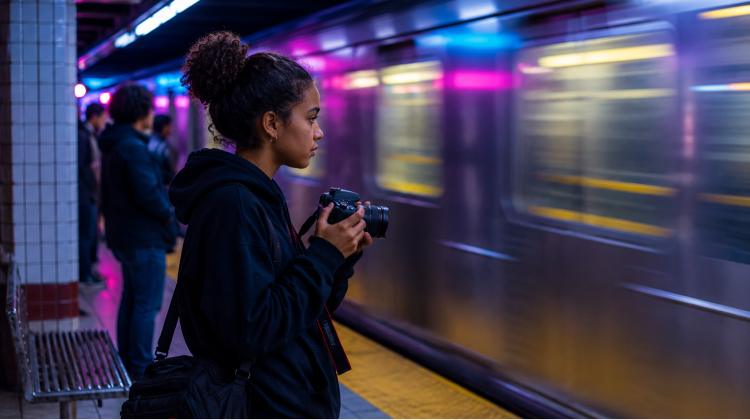
Motion blur is sometimes treated as a technical problem to be corrected. Within this exhibition, it becomes an expressive choice. A softened figure or unstable architectural line can communicate speed, uncertainty, distraction, or the feeling of attempting to notice something before it disappears.
For teenagers moving across New York, motion is not merely visual. It structures daily life. Travel between school, home, cultural institutions, friends, and neighborhoods creates an experience composed of transitions. The city is repeatedly seen through train windows, reflected surfaces, moving crowds, and brief encounters.
The photographers’ use of blur and soft focus allows their images to resist the expectation that a successful photograph must freeze every detail. Instead, an image can preserve the sensation of movement even when the final print remains still. The technique makes time visible by showing what a conventional sharp exposure would remove.
Christopher Soriano’s Suits at the Corner is one of the works prominently presented by the museum. Its title directs attention toward a particular social scene and location rather than a generalized view of New York. It suggests that a street corner can function as a stage where clothing, posture, interaction, and neighborhood identity meet.
The museum presents Soriano’s work as a 16-by-20-inch digital chromogenic print, the same format used for several other featured photographs. The consistent print dimensions establish a shared exhibition structure while allowing each participant’s individual visual decisions to remain distinct.
Movement also helps the photographers describe a city that cannot be fully controlled. Pedestrians enter frames unexpectedly, subway cars arrive and leave, weather changes light, and buildings interrupt intended compositions. Rather than eliminating those conditions, the exhibition treats them as part of what it means to photograph New York.
Repose Makes The Home Part Of The City
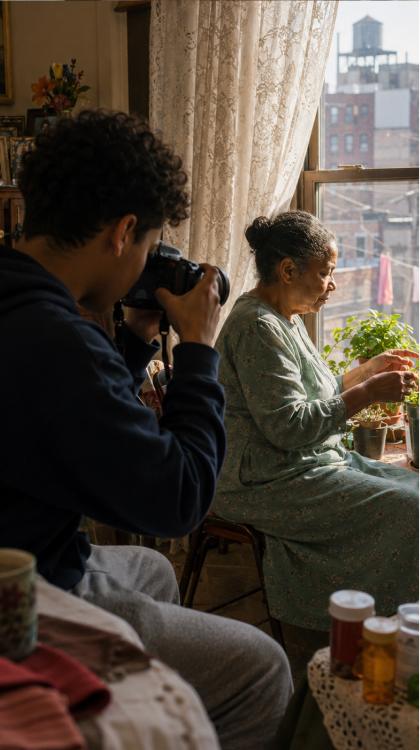
The quieter half of the exhibition is equally important. By turning toward relatives, interiors, personal possessions, and familiar rooms, the photographers challenge the idea that urban photography must happen exclusively in public.
Home is not separate from New York life. It is where the city’s movement is processed, where families maintain routines, and where young people build identities that may not be immediately visible on the street. Domestic photography can therefore reveal as much about the city as an image of Times Square or a crowded train.
The titles of the works highlighted by the museum indicate how varied these private encounters can be. Fairooz Ahamed’s Will You Remember Me? introduces questions of memory and recognition. Nathaly Lopez Alvarez’s The door left open suggests an unresolved boundary between spaces. Isabella Amankwa-Jones’s Silver Mama centers a family figure, while Ismael Parache Henry’s Fairygarden gives an ordinary environment a more imaginative identity.
Those titles should not be treated as complete explanations of the images, but they establish emotional registers that differ sharply from standard city photography. Memory, kinship, fantasy, access, and uncertainty appear alongside architecture and public movement.
Jordyn Vargas’s Untitled (dust beam) directs attention toward a phenomenon that could easily disappear without a camera: light making particles visible in an interior space. The subject is modest, but that modesty carries meaning. It shows how photography can transform close observation into a record of time, atmosphere, and place.
This attention to domestic detail also gives the subjects greater control over how they are seen. Photographing a loved one within a familiar environment can produce a different relationship than making a portrait of a stranger in public. The photographer may already understand the subject’s gestures, habits, and surroundings, allowing the image to emerge from an existing relationship rather than a brief encounter.
Seventeen Artists Resist A Single Definition Of Youth
The exhibition features Agnes Baidoo, Angel Torres, Christopher Soriano, Fairooz Ahamed, Isabella Amankwa-Jones, Ismael Parache Henry, Janelly Rosendo, Jony Pineda Feliz, Jordyn Vargas, Keyaris Canty, Lalah Harper, Nathaly Lopez Alvarez, Nyasia Massey, Rijika Chowdhury, Stephanie Muñoz, Valentina Megraw, and Yoselyn Lucero.
Naming every participant matters because the exhibition is not the product of an anonymous category called “New York youth.” Seventeen artists bring 17 combinations of neighborhood experience, family history, cultural perspective, technical preference, and artistic ambition.
The Studio Museum states that the 2026 cohort includes students from Manhattan, the Bronx, and Queens. Their educational backgrounds also vary, ranging across public, private, preparatory, and transfer schools. That diversity does not mean the exhibition can represent every teenage experience across all five boroughs, but it makes the collective view more complex than a project drawn from a single school or neighborhood.
The distinction is important when adults interpret art made by teenagers. Youth exhibitions are sometimes discussed primarily as educational achievements, with the work treated as evidence that a program succeeded. Through Motion and Repose asks viewers to consider the photographs as artistic decisions: where the camera is placed, when the shutter is released, what remains outside the frame, and how motion or intimacy changes the meaning of a scene.
The photographers are young, but youth is not the exhibition’s only subject. They are making images about community, architecture, memory, family, public behavior, light, movement, and the visual structure of New York. (How to Choose the Perfect Location for Entrepreneur Branding Photos)
James Van Der Zee Connects The Images To Harlem’s Photographic History
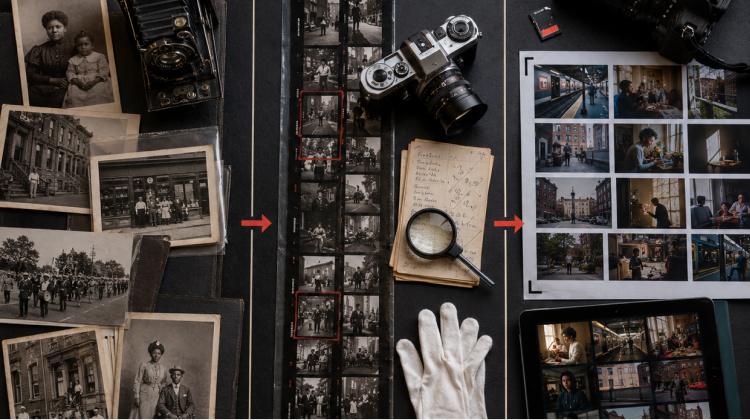
The Expanding the Walls program uses the Studio Museum’s James Van Der Zee Collection and Archive as an entry point for thinking about photography, community, history, and representation. Van Der Zee, who lived from 1886 to 1983, created an extensive visual record of Harlem residents, organizations, celebrations, businesses, and social life.
The 2026 participants selected two Van Der Zee photographs to appear alongside their work at different times during the exhibition: Parade on Seventh Avenue in Harlem from 1917 and Capital Grill Restaurant, Seventh Ave from approximately 1940. (Exhibition announcement)
The selection creates a cross-generational conversation about what deserves to be documented. A parade and a restaurant are not abstract representations of a city. They are specific public environments where clothing, work, commerce, community, and social visibility intersect.
Placing those photographs near images made by teenagers in 2026 allows viewers to compare how city life is organized across different periods. Street design, fashion, photographic technology, and neighborhood businesses may change, but photographers continue to face related questions: Who occupies public space? Which people become visible? What can an image preserve about a community that may later be transformed?
The program also introduces participants to photographers and image-makers including Dawoud Bey, Harlan Bozeman, LaToya Ruby Frazier, Cameron Granger, Elle Pérez, Texas Isaiah, Andre D. Wagner, and Carrie Mae Weems. These artists offer different approaches to portraiture, place, social history, identity, and the politics of representation.
The connection to established photographers does not require participants to imitate them. It gives the teenagers a visual vocabulary through which they can recognize that family photographs, neighborhood scenes, and everyday encounters belong within serious artistic and historical discussions.
Eight Months Of Study Shape The Final Images
Expanding the Walls is not organized as a short photo walk or a one-day introduction to cameras. Founded in 2001, the free program operates for eight months and combines photographic instruction with workshops, museum visits, field excursions, conversations with visual artists, and critical discussions about history and community.
The program’s 2026 schedule ran from January 10 through July 30. Participants met during weekday afternoons and Saturdays, with a more intensive summer schedule beginning June 30. Each student developed an individual photography project rather than contributing images to a predetermined institutional theme.
The material support is notable. Participants receive transportation fare, a $1,000 stipend upon completion, and a Canon EOS Rebel DSLR camera. Their work is then exhibited for an entire museum season.
Providing equipment changes who can continue making photographs after the program ends. Camera access is frequently one of the first barriers confronting young photographers. A student may learn composition and editing during a workshop, but that instruction has limited long-term value when the equipment disappears at the end of the session.
Transportation support also acknowledges a basic reality of cultural participation in New York. A free program is not completely accessible when students must repeatedly pay to travel across boroughs. The stipend further recognizes that eight months of regular participation requires time and commitment.
These practical elements do not determine the artistic quality of the work, but they create conditions in which sustained experimentation becomes possible. Participants can make unsuccessful frames, revise ideas, return to locations, and learn how a group of photographs develops into a coherent project.
The Museum Gives Teen Photography Institutional Weight
Through Motion and Repose is presented both inside the Studio Museum and through a dedicated online exhibition. The physical installation gives the prints scale, sequence, and a relationship to the museum’s other artworks. The online format allows audiences outside New York to see additional photographs and learn more about the artists.
The exhibition also arrives during the Studio Museum’s first year in its new purpose-built home at 144 West 125th Street. The building opened to the public on November 15, 2025, returning the institution to its longtime Harlem location with expanded galleries and educational facilities.
That setting changes how the photographs are encountered. Hanging a teenage artist’s print in a museum does not automatically make it important, but it asks viewers to spend time with the image under the same conditions of attention given to established artists.
The opening celebration on July 2 reinforced that approach through teen-led gallery tours. Participants discussed their work in relation to one another and to Harlem, while visitors could also take part in collage activities, instant photography, and custom frame-making. (Opening celebration)
Allowing the photographers to lead tours is especially significant. It prevents adult curators from becoming the only interpreters of images made by young people. The artists can explain their choices, establish connections, and respond to questions in their own words.
What The Photographs Reveal About New York Now
The exhibition reveals a New York in which motion and stillness are not opposites. They are interdependent parts of urban life. The noise of streets gives domestic quiet its intensity, while private relationships influence how public spaces are seen and remembered.
It also reveals that teenagers are not passive inhabitants waiting to become authoritative observers later. They already understand how neighborhoods are experienced from the inside, how family spaces carry history, and how the city’s visual identity changes depending on who controls the camera.
Their photography resists several familiar shortcuts. New York is not reduced to landmarks. Young people are not presented as a single demographic. Harlem is not treated only as a historic backdrop. Home is not excluded from urban documentary photography, and technical sharpness is not assumed to be the only path toward visual clarity.
The strongest implication of Through Motion and Repose is that a city’s image is never complete. Every generation inherits an archive produced by earlier photographers, but it must decide which details, people, and environments deserve to be added.
The 17 participants do not deliver a final explanation of New York City. They contribute something more useful: closely observed evidence of how the city feels when experienced at their age, from their relationships, through their daily routes, and within the spaces they know well.
Why These Images Matter Beyond A Teen Exhibition
The value of Through Motion and Repose does not depend on predicting which participant might develop a professional photography career. Its importance lies in treating young people as image-makers capable of shaping the public record now.
Photographs often become historical evidence long after their original circumstances have changed. An ordinary street corner, apartment interior, family portrait, or beam of light may eventually reveal details about clothing, architecture, relationships, and neighborhood life that no official document preserved.
By connecting contemporary teenagers with James Van Der Zee’s archive, the Studio Museum makes that possibility visible. The participants learn from photographs that survived across generations, then produce their own records of New York in 2026.
Through Motion and Repose: Expanding the Walls 2026 remains on view through January 31, 2027, at the Studio Museum in Harlem, located at 144 West 125th Street in New York City. The exhibition is also available online, extending the photographers’ observations beyond the neighborhoods and rooms where the images began.