
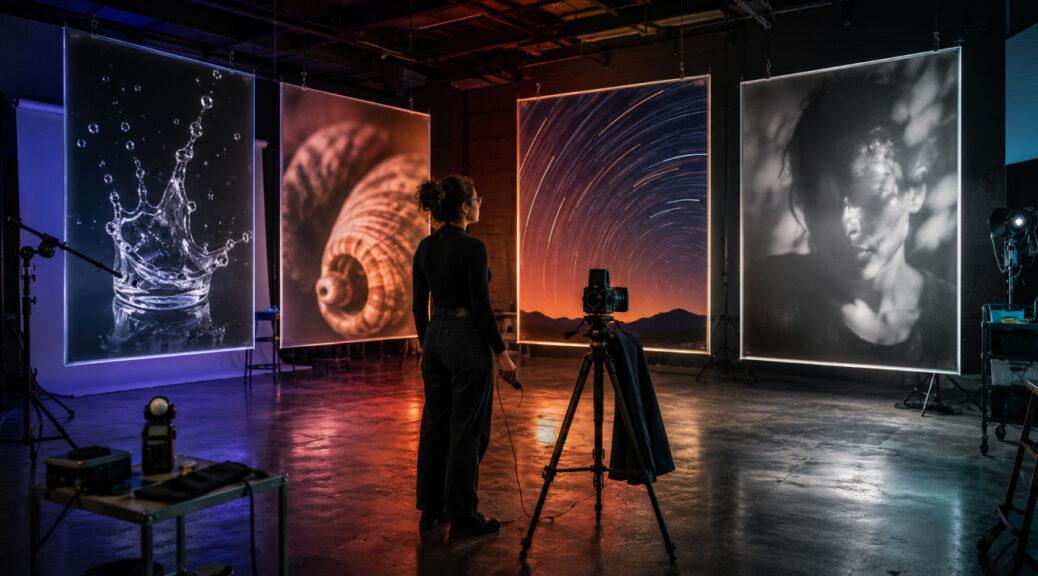
Photography is often described as a method of preserving what was in front of a camera. A person stood in a room, light crossed a landscape, an object rested on a table, or an event happened at a particular moment. The photograph appears to hold evidence that the scene existed.
That description is accurate, but incomplete.
A new exhibition at Phoenix Art Museum argues that photography can also interrupt time, expose invisible phenomena, make familiar objects appear strange, and reshape how viewers understand reality. Ecstatic Time: The Alchemy of Photography opened in Phoenix, Arizona, on July 29, 2026, with nearly 100 objects drawn from the University of Arizona’s Center for Creative Photography in Tucson. It remains on view through January 3, 2027.
Curated by Emilia Mickevicius, the exhibition spans photography from the 1860s to the present. Its subjects range from still lifes and surreal scenes to solar eclipses, high-speed experiments, time-based conceptual works, and an image recorded by NASA’s Mars Pathfinder rover. Rather than presenting photography as a chronological progression of cameras and processes, the show examines what happens when the medium exceeds ordinary human vision.
The central idea has consequences beyond museum photography. Every image is shaped by timing, framing, equipment, chemistry, light, scale, selection, and context. A photograph may begin with reality, but it does not simply duplicate reality. It reorganizes what can be seen.
Photography Is Never A Neutral Window
A camera does not observe the world in exactly the same way a person does. It isolates a rectangular section from a larger environment, converts three-dimensional space into a flat surface, and separates one fraction of time from everything that happened before and after it.
Even an apparently straightforward photograph contains decisions. The photographer chooses where to stand, which lens to use, when to release the shutter, what to exclude, how bright or dark the exposure should be, and whether the final image will appear in color or black and white. Editing, printing, sequencing, captioning, and display add further layers of interpretation.
Those choices do not automatically make a photograph deceptive. They make it constructed.
The distinction matters because viewers often associate photographic detail with truth. A sharply rendered face, building, or landscape can look objective even though the image presents only one position and one moment. Photography provides evidence, but the meaning of that evidence depends on how the image was produced and where it appears.
Ecstatic Time addresses this tension by focusing on photographs that openly transform their subjects. Phoenix Art Museum describes the medium as capable of revealing, altering, and “defamiliarizing” what it records. That last quality is essential: photography can make something known appear unfamiliar enough to demand a second look. The official Phoenix Art Museum exhibition is therefore structured around perception rather than a simple history of photographic technology.
A Photograph Can Create A Different Kind Of Time
The exhibition takes its title from filmmaker and theorist Hollis Frampton’s idea of “ecstatic time.” The term describes an experience distinct from the uninterrupted movement of clock time or the ordered sequence of history.
A photograph removes its subject from that continuous movement. A gesture that lasted less than a second can remain visible for decades. A building demolished years ago can still be examined. A person who has aged or died remains fixed at the instant when the exposure was made.
This separation produces one of photography’s most familiar contradictions. The photograph proves that a moment passed, yet it also prevents that moment from fully disappearing.
The word “ecstatic” is connected to the Ancient Greek ékstasis, commonly understood as standing outside oneself. Applied to photography, it suggests that the camera can pull a subject outside ordinary time and place it into another temporal condition: the continuous present of the image.
The photograph does not restore the original moment. Viewers cannot hear its sounds, enter its surrounding space, or know everything happening outside the frame. They receive a visual fragment that can be revisited and interpreted under new circumstances.
That is why the same photograph can change meaning over time. A family snapshot may later become a historical document. An experimental exposure may acquire scientific value. A street photograph initially admired for composition may eventually be studied for what it reveals about clothing, architecture, labor, race, or public behavior.
The University of Arizona’s account of photography beyond the literal explains that the exhibition combines 19th-century prints with modern conceptual works rather than arranging them as a conventional timeline. The structure asks viewers to compare different ways cameras suspend, stretch, and reorganize time.
Flash Photography Reveals Moments The Eye Cannot Hold
One of the clearest examples of photography exceeding ordinary vision is Harold Edgerton’s Splash of a Milk Drop. The negative was made around 1938, while the dye-transfer print included in the exhibition was produced in 1977.
A falling drop and the liquid it strikes move too quickly for the unaided eye to examine as a stable form. High-speed photographic techniques convert that brief action into a structure that can be studied. The camera does not merely record what a person saw. It produces a visible version of something the person could not hold in sight.
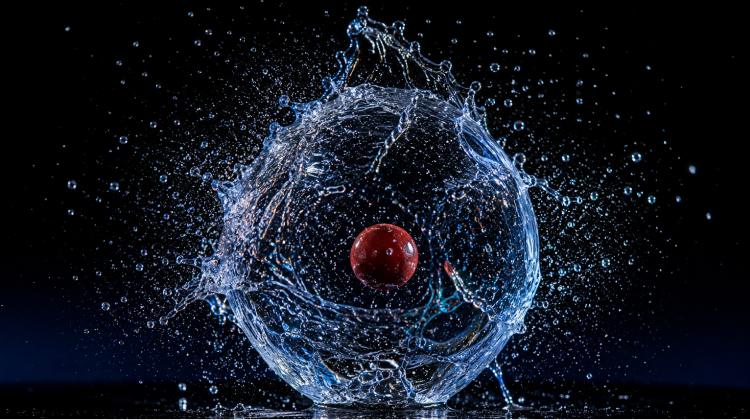
Edgerton’s Bullet through Banana from 1964 pushes that principle further. The event exists for an extremely short interval, but photography isolates a phase of the action and gives it duration. Motion becomes form.
This type of image changes the relationship between photography and evidence. The subject is real, but its appearance in the photograph depends on equipment capable of dividing time more precisely than normal vision. The image is simultaneously documentary and transformative.
The exhibition’s first thematic section, Awake and Dreaming, brings these technical disruptions into conversation with surreal and enigmatic photographs by Ilse Bing, Manuel Álvarez Bravo, Kozo Miyoshi, and Garry Winogrand. Their approaches differ, but the grouping emphasizes how camera vision can make an ordinary environment appear psychologically uncertain or visually impossible.
A flash can expose a gesture hidden by darkness, turn moving water into sculpture, or freeze an expression that no observer consciously registered. The result may look strange precisely because it contains more visual information than the original human experience.
Still Life Photography Changes The Status Of Objects
A second section, The Thing Itself, presents a large arrangement of still lifes by photographers including Harold Edgerton, Edward Weston, Masahisa Fukase, and Abelardo Morell.
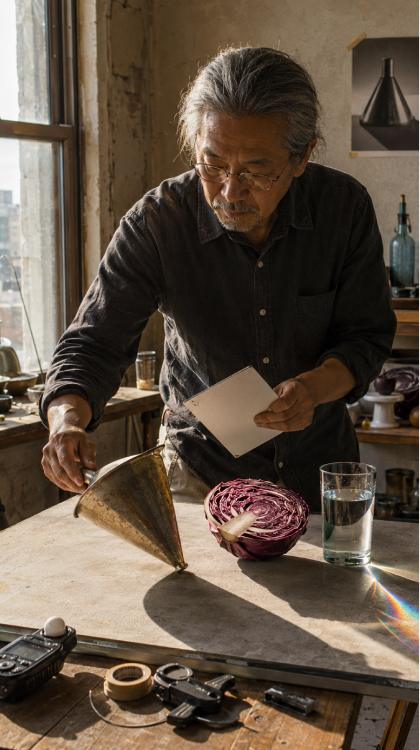
Still life appears to be one of photography’s most literal forms. The objects do not move, the photographer can control the light, and the scene can be examined before the exposure. Yet removing an object from normal use can radically change how it is perceived.
A tool photographed against a plain surface no longer functions primarily as a tool. Its curves, scratches, shadows, proportions, and materials become the subject. Food can appear architectural. Glass can become a study of reflection. A common household item can seem mysterious when enlarged or isolated.
Photography performs this transformation through attention. The camera gives an object a boundary and asks the viewer to look at it longer than ordinary life usually permits.
The exhibition’s still-life wall is described as a photographic cabinet of curiosities. That comparison emphasizes discovery rather than classification. The images are not valuable only because they identify objects. They reveal how light, viewpoint, scale, and photographic process can produce new visual relationships among things that might otherwise appear unremarkable.
Edward Weston’s MGM Studios from 1939, used prominently in the exhibition’s presentation, illustrates how a photograph can detach a subject from its expected context. Whatever the original practical identity of an object or setting, the frame can turn it into texture, geometry, tone, and visual rhythm.
This does not mean the object loses its history. It means the photograph creates an additional identity for it.
Cameras Extend Vision Beyond The Human Body
Photography’s relationship to reality becomes more complex when the camera records places or phenomena that a person could not directly observe.
The exhibition’s Out of this World section contains astronomical photography, including an eclipse image made by Ansel Adams and a photograph transmitted by NASA’s Mars Pathfinder rover. These images expand photography beyond everyday distance and perception.
A camera attached to a scientific instrument, telescope, spacecraft, or remote vehicle does not reproduce a normal human viewpoint. It acts as an extension of human inquiry. Exposure length, sensor sensitivity, optics, filters, transmission systems, and image processing determine what becomes visible.
The resulting photographs provide access to real phenomena, but they remain translations. An astronomical image may condense long periods of light into a single exposure. A planetary camera converts reflected light into data before that data becomes a viewable image. Color may be adjusted to distinguish features or communicate information.
Recognizing this mediation does not make scientific photography less reliable. It helps viewers understand why photographic truth depends on method.
A photograph from Mars can be evidence of a real landscape while also being a technically constructed image. The camera’s distance from Earth, limited field of view, resolution, and operating conditions shape what humans are able to see.
The official exhibition materials describe this section as evidence that photography gives audiences access to subjects that are distant, fleeting, or invisible under ordinary conditions. That ability makes the camera more than a recording device. It becomes an instrument that enlarges the perceptual range of the human body.
Experimental Processes Make Light An Active Material
Photographers do not always use light solely to describe a subject. In experimental work, light can become the subject, the tool, and the physical force altering the photographic material.
Chris McCaw’s Sunburned GSP #340 (SF Bay Bridge) from 2009 appears in the exhibition as a gelatin silver print. Its inclusion points toward photography’s material dimension: an image is not only a view but also the result of light interacting with a sensitive surface.
That interaction changes across processes. A gelatin silver print, dye-transfer print, digital file, negative, instant photograph, and camera-less photogram may depict similar subjects while producing different textures, tonal ranges, colors, and physical characteristics.
Process therefore affects meaning. A photograph created through a prolonged exposure expresses time differently from one made with an instantaneous flash. A hand-produced print carries different material evidence than an image viewed only on a phone screen.
This is one reason the exhibition’s subtitle refers to alchemy. The word should not be understood as supernatural transformation. It describes the conversion of light, time, chemistry, machinery, and physical materials into an image that did not previously exist in that form.
The camera encounters reality, but the photographic process gives that encounter a new surface.
Photographs Can Make Reality Feel Dreamlike
The presence of recognizable subjects does not prevent a photograph from creating uncertainty. Kikuji Kawada’s New Couple Who Closed Their Eyes, Tokyo from 1974, another work highlighted by Phoenix Art Museum, begins with people and a named location. Its title nevertheless introduces a psychological and interpretive space beyond simple description.
Closing the eyes changes the relationship between subject and camera. The people are physically present before the lens, yet they are not visually engaging with their surroundings or the viewer. The photograph records their appearance while suggesting an inward experience the camera cannot directly access. (Key Lighting Techniques)
This gap between visible surface and private meaning is central to photographic interpretation.
Portraits can show expression, posture, clothing, location, and relationships between people, but they cannot provide complete access to thought or intention. Viewers fill that absence with cultural knowledge, personal experience, and assumptions.
Surreal and enigmatic photographs make this instability more obvious. Reflections, unusual angles, deep shadows, blur, cropping, or unexpected combinations can transform a real scene into an image that feels invented.
The camera may not fabricate the physical subject, but it can reorganize that subject until certainty becomes difficult. Photography records reality and simultaneously reminds viewers that seeing is not the same as fully knowing.
Historical Photographs Change As The Present Changes
The exhibition’s fourth section, Incisions in History / Segments of Eternity, places conceptual works by Hiroshi Sugimoto and Lew Thomas alongside 19th-century photographs that look toward earlier historical periods.
The grouping emphasizes that a photograph does not remain locked to its original interpretation. Its meaning continues to develop as the distance between the image and the viewer increases.
A photograph made in the 1860s once belonged to the present. Its clothing, architecture, technologies, and social arrangements may have seemed ordinary to its first viewers. In 2026, those same details become historical evidence.
The change happens even when the physical image remains unaltered. The world around it has moved.
Contemporary viewers may also recognize information that earlier audiences ignored or misunderstood. An archival photograph can reveal who was permitted to occupy a space, whose labor remained unnamed, how communities represented themselves, or how institutions shaped public memory.
This is why historical photographs require context. Dates, captions, makers, locations, printing processes, ownership records, and original purposes can alter interpretation. Without that information, an image may appear self-explanatory while concealing important limitations.
Photography can preserve a fragment of the past, but it cannot independently explain that past.
The Exhibition Was Built Around Surprise Rather Than Fame
Emilia Mickevicius developed Ecstatic Time from a personal database of unusual works she encountered while researching the Center for Creative Photography’s storage collection. For approximately three years, she noted photographs that surprised, puzzled, or delighted her.
That origin explains why the exhibition does not function as a list of the most famous images in photographic history. It combines canonical figures such as Ansel Adams and Edward Weston with less expected objects and experimental processes.
Curatorial selection becomes part of the argument. By arranging the works according to perception, time, dreams, still life, and expanded vision, Mickevicius creates relationships that may not have existed when the photographs were made.
A photograph placed beside another photograph can acquire a new meaning. Similar shapes become visible. Different historical periods appear connected. A scientific image may begin to resemble an abstract artwork, while an artistic experiment may reveal an investigative quality associated with science.
The exhibition therefore demonstrates another way photography exceeds recording: images generate meaning through sequence and context.
Phoenix Art Museum and the Center for Creative Photography co-organized the show to mark the 20th anniversary of the Norton agreement. Established through support from Mr. and Mrs. John R. Norton, the partnership has brought works from the Tucson center’s collections to Phoenix audiences for two decades. The Center for Creative Photography holds approximately 120,000 fine prints and more than 300 archives connected to photographers, galleries, scholars, and organizations.
Photographic Transformation Is Not The Same As Deception
Understanding that photographs transform reality should not lead to the claim that all images are equally unreliable.
There is an important difference between the unavoidable choices involved in making a photograph and the deliberate falsification of what an image represents. Framing a scene, selecting an exposure, or using high-speed equipment changes how reality appears. Inventing an event and presenting it as documentary evidence creates a different ethical problem.
Context determines what viewers should expect. (Your pictures of Scotland: 24 – 31 July)
An experimental museum photograph may openly prioritize imagination, process, or perceptual uncertainty. A scientific photograph should provide information about how the image was collected and processed. A journalistic photograph carries expectations concerning accuracy, captions, staging, and alterations. A commercial image may be designed to persuade rather than document neutrally.
Visual literacy requires asking what kind of image is being viewed, who made it, how it was produced, and why it is being shown.
The same technical effect can serve different purposes. Motion blur may truthfully communicate speed, artistically abstract a subject, or conceal information. Cropping may improve composition or remove critical context. Color adjustment may correct a camera file, clarify scientific data, or misrepresent a scene.
Photography does more than record reality because every photograph establishes a relationship between the world, the image-maker, the technology, and the viewer. That relationship must be examined rather than assumed.
What Ecstatic Time Asks Viewers To Notice
Ecstatic Time: The Alchemy of Photography does not reject photography’s documentary power. It expands the definition of what photographic evidence can be.
Harold Edgerton’s high-speed work makes invisible fractions of motion available for study. Astronomical and planetary photographs extend sight beyond ordinary human distance. Still lifes give overlooked objects a new visual presence. Conceptual works separate photographic time from the sequence of daily life. Historical photographs change as later audiences bring new questions to them.
The exhibition asks viewers to slow down and notice how each image was made. Subject matter is only the beginning. Exposure, light, material, timing, framing, scale, and placement determine what the photograph allows people to perceive.
For photographers, that idea opens a wider creative field. A camera does not need to be limited to confirming what something looked like. It can investigate how motion behaves, how time accumulates, how objects acquire symbolic weight, and how a familiar scene changes when isolated from its surroundings.
For viewers, the exhibition offers a useful discipline: look beyond what a photograph shows and consider what the photographic process has done.
Ecstatic Time is on view in the Norton Photography Gallery at Phoenix Art Museum, 1625 North Central Avenue in Phoenix, through January 3, 2027. Entrance is included with general museum admission, and the museum offers voluntary-donation hours on Wednesdays from 3 to 8 p.m.