
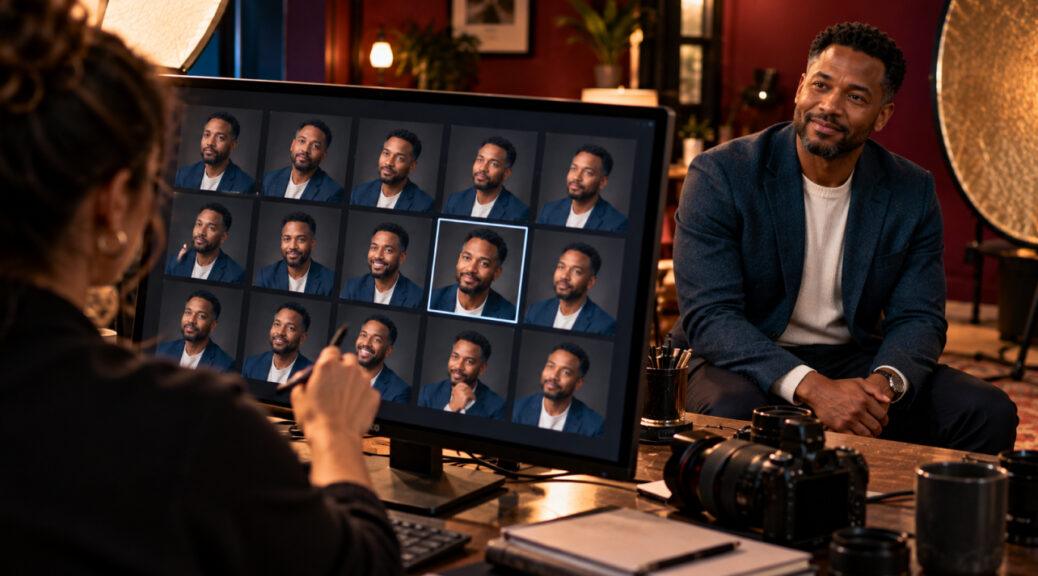
A professional headshot can be technically perfect and still feel wrong.
The lighting may be flawless. The jacket may fit perfectly. The background may look expensive. The skin may be carefully retouched. Yet if the person who appears in the photograph does not resemble the person who walks into a meeting, joins a video call or sits down for an interview, all that polish can work against the image.
That tension is becoming more important as AI-generated portraits and increasingly sophisticated editing tools make it easier to create an idealized professional appearance.
On October 1, 2026, Associated Press business writer Dee-Ann Durbin examined that issue with Houston headshot photographer Chris Gillett, Goodwin Recruiting area director Emily Lauro, marketing director Jenny Battershell and Providence, Rhode Island journalist Philip Eil. Their perspectives point toward a surprisingly simple definition of an authentic professional headshot: it should be intentional and flattering, but it should still be recognizably you. Associated Press headshot reporting
That does not mean professional photography should eliminate posing, lighting, styling or careful image selection. Those are precisely the tools that allow a photographer to communicate personality.
Authenticity is not the absence of photographic technique. It is using those techniques without creating a false identity.
Authentic Does Not Mean Casual or Unedited
There is an easy mistake to make when talking about authentic photographs: assuming the most authentic picture must be the least controlled one.
It does not.
A poorly lit smartphone photograph taken from an awkward angle is not automatically a more truthful representation of someone than a professionally produced portrait. It is simply a photograph made under different conditions.
A professional photographer can improve lighting, camera position, posture, expression and composition without changing the person’s identity.
The distinction is between presentation and transformation.
Presentation asks how to photograph the person effectively. Transformation begins when the image alters characteristics so extensively that the resulting person no longer corresponds closely with reality.
That boundary matters because headshots increasingly function as introductions. They appear on company websites, professional directories, speaker biographies, author pages and social platforms before two people ever meet.
Research also demonstrates that different photographs of exactly the same person can generate substantially different impressions. In a study by Princeton’s Alexander Todorov and Jenny M. Porter, different images of one individual produced considerable variation in social judgments, sometimes comparable to differences observed between different people. The researchers also found that people preferred different photographs depending on the context in which the image would be used. Research on facial-image first impressions
Selecting a professional headshot is therefore not merely selecting “what you look like.” It is selecting one particular representation from many possible versions of your appearance.
Recognizability Comes Before Perfection
The clearest dividing line between a polished headshot and an inauthentic one is recognizability.
Chris Gillett told the AP there is no universal schedule dictating how frequently people need new headshots. The more useful test is whether the photograph still looks like the person using it.
Emily Lauro made a similar point from the recruiting side. Her advice was not to avoid looking your best; it was to avoid creating such a perfected version that the image and the real person appear disconnected.
That can happen without malicious intent.
A photograph may simply be too old. Hair color may have changed substantially. Someone may now wear glasses every day when the photograph shows them without them. Facial hair, hairstyle or other distinguishing aspects of appearance may be completely different.
Retouching can create the same problem when taken too far.
Removing a temporary blemish is different from reconstructing someone’s jaw. Correcting a distracting flyaway hair is different from changing the shape of the face. Balancing exposure is different from altering apparent age until normal skin texture disappears.
The useful question is not, “Was this photograph edited?”
Almost every professionally finished digital photograph receives some form of adjustment.
Ask instead: Would a new client, recruiter or colleague immediately recognize this person from the photograph?
If the answer is uncertain, authenticity has probably been pushed too far.
Expression Matters More Than a Perfect Smile
Authenticity often lives in surprisingly small details.
Gillett told the AP that even tiny movements around a smile or eyebrow can change what an expression communicates. His approach places particular emphasis on the face rather than elaborate full-body posing, which is why he favors traditional head-and-shoulders compositions for headshots.
This explains why simply telling someone to “smile” often produces an unsatisfying portrait.
A person may pull the corners of the mouth upward while the rest of the expression remains tense. The result technically qualifies as a smile, but it may not resemble the expression that colleagues see when that person is genuinely pleased to meet someone.
A skilled headshot session creates opportunities for real reactions.
Conversation can help. So can movement between frames rather than holding one pose continuously. A photographer may ask the subject to reset the shoulders, breathe out, look away and return to the camera, or respond to something rather than mechanically maintaining the same expression.
The objective is not necessarily a large smile.
A trial lawyer, therapist, engineer, artist and startup founder may each want a different balance of warmth, confidence, seriousness and energy. The expression should make sense for both the person and the professional situation.
That connects naturally with the broader principles in Finest Image’s first impressions and career guide: visual presentation is one part of a larger introduction, not a substitute for what someone communicates after the introduction begins.
Approachability and Competence Are Different Signals
A headshot often needs to accomplish two things simultaneously: make someone appear approachable enough to engage with and professional enough to trust with the work at hand.
Recent research helps explain why that balance is important.
A 2026 study on multimodal first impressions analyzed approximately 45,000 spontaneous descriptors people used when evaluating faces, voices and names. Researchers found that approachability and competence consistently emerged as important dimensions of social evaluation. Multimodal first-impression research
A headshot cannot demonstrate that someone actually possesses either quality.
That distinction matters.
A photograph can influence an initial impression of competence or approachability, but it cannot establish professional ability, integrity, intelligence or character.
A major 2026 meta-analysis published in Personnel Psychology reinforces that limitation. Junhui Yang, Brian W. Swider, Bingjie Lu, Kaidi Wang and T. Brad Harris analyzed 204 independent samples from 145 studies involving workplace first impressions. They found that communication cues had stronger and more consistent relationships with first impressions than more subjective cues such as physical appearance. 2026 workplace first-impression study
That is an important corrective to headshot advice that promises too much.
A good photograph can open an introduction. It cannot do the work of the person afterward.
The Eyes Should Look Engaged, Not Engineered
Professional headshot advice frequently focuses on the eyes, sometimes to the point of turning eye position into a formula.
That can produce another kind of artificiality.
For most professional portraits, the useful goal is simpler: the eyes should appear engaged with the camera rather than vacant, distracted or excessively intense.
Small changes can make a difference.
A subject who has been staring into a lens for several minutes may gradually lose the alertness present in the first few frames. A photographer who continually asks the subject to narrow the eyes may create an expression that looks calculated. Conversely, very wide eyes combined with a fixed smile can produce an unintended sense of tension.
The best expression is often found between those extremes.
This is also why choosing a headshot exclusively according to which frame makes the jaw, hair or skin look “best” can be a mistake. A technically flattering frame may contain an expression that does not feel like the person.
The face should be evaluated as a complete expression.
Good Posing Should Be Almost Invisible
An authentic professional headshot is usually posed.
It simply should not look aggressively posed.
A slight rotation of the shoulders can add dimension. Moving the chin subtly can improve the relationship between the face and neck. Adjusting posture can keep someone from appearing collapsed or uncomfortable.
Those changes are normal portrait direction.
Problems begin when the pose becomes more noticeable than the person.
Extreme shoulder angles, exaggerated chin positions, forced crossed arms or dramatic “power poses” may work for a particular creative brief, but they should not automatically be treated as professional-headshot formulas.
The right pose also depends on the subject.
Someone with naturally expressive body language may look comfortable with more movement. Someone quieter may appear most authentic in a simpler composition.
Photographers are not trying to make every client stand identically. They are trying to find a repeatable position in which the subject looks comfortable enough for personality to remain visible.
Clothing Should Match the Professional Reality
Authenticity extends beyond the face.
If someone works every day in an open-collar shirt, putting that person in an unusually formal three-piece suit solely because “headshots should look professional” may create the wrong message.
The opposite can also happen. Dressing too casually for a highly traditional professional context may make the image feel disconnected from the person’s actual role.
Gillett’s examples in the AP report illustrate the importance of context. A startup founder might want an image emphasizing energy and innovation, while someone in financial services might prioritize stability and reliability.
Neither requires a costume.
Clothing should support the professional identity that already exists.
That usually means choosing garments the person could realistically wear when meeting the audience represented by the photograph: clients, colleagues, patients, readers, investors or employers.
Fit, condition, color and distracting patterns often matter more than simply increasing formality.
Lighting Should Reveal You, Not Redesign You
Professional lighting is supposed to improve how a face is photographed.
That is not the same as making every face look identical.
A large diffused light can create smoother transitions between highlights and shadows. A reflector can prevent one side of the face from becoming excessively dark. Background separation can make the subject clearer when a headshot is displayed at a small size.
Those are photographic decisions, not identity alterations.
Authentic lighting should still preserve recognizable facial structure, skin tone and age.
The same principle applies to skin texture. Professional lighting may naturally make texture less prominent, and sensible post-production can address temporary distractions. But eliminating every line and pore can move a photograph away from the person it supposedly represents.
Age is not a technical defect.
Neither are freckles, natural facial asymmetry, gray hair or the normal characteristics that make one face distinguishable from another.
AI Headshots Make Recognizability More Important
Artificial intelligence has complicated the boundary between enhancement and invention.
The October AP report noted that AI services can now generate polished professional portraits from ordinary selfies at substantially lower cost than many conventional photography sessions. But both photographers and recruiters interviewed for the story raised concerns about results that look overly edited or unrealistic.
The problem is not simply whether AI was involved.
The practical question remains whether the resulting portrait accurately represents the individual.
An AI-generated image may subtly change facial structure, hair density, teeth, apparent age, body proportions or clothing. Individually, each modification may seem minor. Combined, they can produce a convincing photograph of someone who does not quite exist.
That creates a particularly awkward professional introduction: the image may look excellent until the first video meeting.
Current LinkedIn guidance provides a useful baseline. The platform says a profile photograph should reflect the member’s likeness, even when the image is an illustration, caricature or other artistic representation. LinkedIn profile photo guidelines
The broader professional environment is moving toward stronger identity signals as well. On September 23, 2026, LinkedIn announced that more than 115 million members had verified their identity or workplace, with about 75 verifications occurring every minute. Those figures are LinkedIn’s own platform data, but they demonstrate how strongly the company is emphasizing professional authenticity as AI-generated content becomes easier to produce.
A polished portrait that undermines recognizability moves in the opposite direction.
Recruiters Are Looking Beyond the Photograph
One of the most useful points in the AP reporting is what recruiters did not say.
Emily Lauro explained that an absent or imperfect LinkedIn photograph would not stop her from contacting a qualified candidate whose experience fit an available position. Jenny Battershell also advised against automatically placing headshots on resumes, citing both potential bias and complications with automated resume-scanning systems.
That puts professional headshots in their proper place.
They matter, but they are not credentials.
A headshot should help someone recognize you and understand the professional context in which you are presenting yourself. It should not be designed as though the viewer will decide whether you are qualified based on facial appearance.
This distinction also protects against a harmful assumption: that there is one face, hairstyle, age, expression, body type or style of dress that “looks professional.”
Professionalism is demonstrated through work and behavior. Photography communicates context.
The image should support the person’s professional story rather than attempting to manufacture one.
The Best Headshot May Not Be the Most Flattering Frame
When reviewing photographs after a session, people naturally gravitate toward the image in which they think they look most attractive.
That is understandable, but it is not always the best selection criterion.
Research by Todorov and Porter demonstrates why. Different photographs of the same individual can generate different social impressions, and people’s image preferences change depending on the intended context.
For a professional headshot, ask a different set of questions.
Does this look like me today? Does the expression feel familiar? Would someone recognize me when we meet? Does the clothing make sense for my work? Is the photograph communicating the degree of warmth or seriousness I intended? Does anything in the lighting, pose or retouching distract from my face?
The winning photograph may not be the one in which every feature looks maximally flattering.
It may be the one in which everything feels believable at the same time.
Authenticity Is Consistency Between the Photograph and the Person
Philip Eil’s experience offers a useful example of what professional photography can do that goes beyond cosmetic improvement.
For the author photographs connected to his first book, Eil worked with a photographer in Providence, Rhode Island, creating both studio close-ups and environmental portraits near the Seekonk River, a place that held personal significance for him. The resulting photographs did more than document his face; they connected the person, the work and the setting.
That is a form of authenticity too.
An authentic headshot does not have to be plain. It can be carefully lit, deliberately composed and professionally retouched. It can communicate confidence. It can make someone look approachable. It can use clothing, background and expression to establish context.
What it should not do is promise a person who disappears when the photograph ends.
The strongest professional headshot creates continuity between the digital introduction and the eventual real-world encounter.
When the person walks into the room, the reaction should not be, “You look completely different from your picture.”
It should be recognition.
And ideally, the photograph should feel like the same person on a particularly good professional day.