

Workplace shorts have moved from a simple yes-or-no dress-code issue into a more useful question: what does professional presence need to communicate in a specific setting? For some teams, the answer may include warm-weather comfort. For others, especially client-facing, legal, public-sector, or formal administrative environments, the answer may still be no.
As a visual communication issue, shorts are not just a garment. They change the proportion of an outfit, alter the formality level, and affect how others read readiness, authority, and attention to context. That does not mean shorts are automatically careless. It means they need clearer standards than many casual items, because the gap between polished and too relaxed can be narrow.
The practical goal is not to make every office accept the same look. It is to help employees and employers separate personal comfort from professional signals, then decide what is appropriate for the work being done.
Workplace Shorts And The New Dress-Code Question
How Workplace Shorts Read In A Room
Shorts expose more leg than trousers, which makes them visually closer to leisurewear in many business settings. That is the first perception barrier. A blazer, structured shirt, belt, and closed-toe shoes can raise the formality level, but the shorter hem still sends a different message than full-length trousers.
The strongest case for workplace shorts is usually practical rather than fashion-led. Heat, commuting conditions, building temperature, job movement, and employee comfort all affect whether an outfit supports good work. A person who is physically uncomfortable may appear distracted, flushed, or less composed. From an image perspective, comfort can support credibility when the garment still respects the setting.
The visual question is simple: does the outfit still look intentional? Intentional dress usually shows in fabric, fit, grooming, footwear, and proportion. Cotton twill, linen blends, wool blends, or structured technical fabrics tend to read more professional than athletic mesh, distressed denim, or beachwear fabrics. A clean hem, a moderate length, and a pressed finish also help the garment look chosen rather than thrown on.
Context Matters More Than The Trend
Different workplaces use different visual codes. A creative studio may accept tailored shorts with a camp-collar shirt. A county office, court-adjacent role, finance meeting, or executive reception desk may expect more coverage and a more traditional silhouette. Neither position is automatically outdated or progressive. Each reflects the trust cues that workplace wants to project.
For employees, the safest move is to read the room before testing the boundary. Notice what leaders wear, what client-facing staff wear, and what is worn on days with visitors, board members, patients, vendors, or public meetings. If shorts appear only on internal casual days, that is a different signal from seeing them in leadership presentations.
Policy Boundaries Still Shape Shorts At Work
Written Rules Reduce Guesswork
Dress-code uncertainty creates unnecessary stress. Employees may wonder whether they will be judged as careless, while managers may apply standards unevenly. A written policy helps reduce that friction by naming the garment, the setting, and any limits on length, fabric, footwear, or role.
Public-sector examples show how specific policies can be. Douglas County, Georgia’s May 29, 2025 Board of Commissioners minutes include an office dress-code policy noting that shorts are allowed only for specific roles and must not be more than about two inches above the middle of the knee, according to the Douglas County dress-code minutes. That type of detail gives employees a measurable boundary rather than a vague instruction to “look professional.”
Other policies still keep shorts outside business-professional dress. Nevada’s work-attire policy dated November 5, 2025 lists shorts among clothing not allowed under Business Professional standards, according to the Nevada work-attire policy. This is a useful reminder: broader cultural acceptance does not override an employer’s stated expectations.
Employees Should Ask Better Questions
If workplace shorts are not clearly addressed, avoid asking only, “Can I wear shorts?” That question can sound like a request to lower the standard. A better question is more specific: “Are tailored knee-length shorts acceptable on internal office days during hot weather if worn with closed-toe shoes and a collared or structured top?”
That phrasing shows that you understand image, audience, and limits. It also gives a manager something practical to approve, adjust, or decline.
- Ask whether shorts are allowed for all roles or only certain job functions.
- Clarify whether the rule changes for client meetings, public-facing duties, or presentations.
- Confirm expectations for length, fabric, footwear, and grooming.
- Check whether the policy applies differently on casual days, field days, or high-heat periods.
For a related practical discussion of garment choices, fabric, and professional comfort, see this site’s advice on shorts with professionalism.
Choosing Shorts That Support Professional Presence
Build The Outfit From The Message
Professional image is built through repetition. If your usual work image is composed, responsive, and prepared, one warm-weather garment is less likely to damage credibility. If your image already feels inconsistent, shorts may amplify that inconsistency.
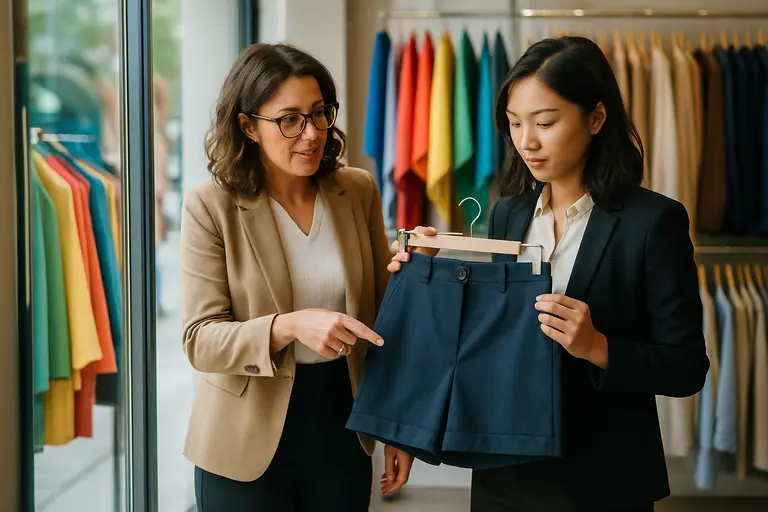
A practical workplace shorts standard begins with length. Mid-thigh may work in some fashion-forward settings, but knee-adjacent lengths are easier to defend in general office environments. The fit should allow movement without looking oversized or tight. The waistband should sit cleanly, and pockets should not bulge. Wrinkling matters because shorts occupy less visual space than trousers; every crease is more noticeable.
Footwear often decides whether shorts look professional or recreational. Loafers, clean leather sneakers, low-profile flats, or simple closed-toe shoes usually create a stronger work signal than flip-flops or beach sandals. Socks should look intentional rather than accidental. If the lower half of the outfit is more casual, the upper half needs structure: a crisp shirt, fine-gauge knit, lightweight blazer, or neat overshirt can help balance the look.
Body Language Must Match The Clothing
Clothing sets the first frame, but body language carries it forward. Shorts can make posture feel more casual, especially if the wearer sits with legs spread, slouches, or treats the outfit as permission to relax every other signal. A polished shorts outfit still needs professional movement: upright posture, composed gestures, attentive eye contact, and calm pacing.
This is especially true in trust-sensitive fields. Any role that depends on confidence, confidentiality, or formal process needs visual choices that do not distract from the work. For example, roles involved in verification services, covered by resources such as PolygraphianZ, highlight that personal appearance should facilitate clarity rather than overshadow it.
Image selection also applies to professional photos and online profiles. If your workplace accepts shorts, that does not automatically mean shorts belong in your headshot, speaker bio, or LinkedIn banner. Static images travel farther than a single office day. Choose images that match the audience you most need to reassure.
The Shift Toward Workplace Shorts In Professional Attire
The shift toward shorts in professional attire is not a universal dress-code reset. It is a negotiation between comfort, climate, role expectations, and the visual language of credibility. Some offices will permit them. Some will limit them to specific roles or weather conditions. Some will continue to exclude them from business-professional standards.
For employers, the best policy is clear, specific, and fair. If shorts are allowed, define acceptable length, fabric, condition, footwear, and restricted situations. If they are not allowed, explain the business reason and apply the rule consistently. Vague standards invite confusion and can make employees feel judged for guessing wrong.
For professionals, the best approach is to treat workplace shorts as a context-dependent tool, not a right or a rebellion. Choose structure over novelty. Choose proportion over trend. Choose an outfit that lets colleagues and clients focus on your competence rather than your hemline.
Done well, shorts can fit some modern workplaces without weakening professional presence. Done carelessly, they can make an otherwise capable person appear unaware of the room. The difference is rarely the garment alone. It is the judgment behind it.