
A photographer can spend hours deciding whether one image belongs in a portfolio.
Someone seeing the work for the first time may recognize the answer in seconds.
That difference is one reason professional photography still depends so heavily on critique, editing and portfolio reviews—even as cameras, software and artificial intelligence make it easier than ever to produce, sort and manipulate enormous numbers of images.
That process is particularly visible this week in Chicago.
The 18th annual Filter Photo Festival runs from September 23 through September 26, 2026, at the Columbia College Chicago Student Center, 754 S. Wabash Avenue. The four-day program includes exhibitions, artist conversations, workshops and portfolio reviews involving photographers and professionals from the gallery, publishing and curatorial worlds.
The 2026 Filter Photo Festival describes portfolio reviews as a central part of the event. Emerging and established photographers can sit face-to-face with gallery directors, curators, editors and publishers for individual 20-minute sessions.
Those 20 minutes illustrate something important about making photographs.
Taking the picture is only one part of photography.
Understanding what you have made can require another pair of eyes.
Photographers Know Too Much About Their Own Photographs
Every photograph contains information that the viewer can see.
But for its creator, it can contain much more.
The photographer remembers where the picture was taken.
They may remember how difficult it was to reach the location, how long they waited for the light, how nervous the subject was or how many unsuccessful attempts came before the final frame.
Perhaps the photograph was made during an important relationship or at a difficult moment in the photographer’s life.
None of that information automatically exists for a stranger looking at the finished image.
This creates a fundamental gap between making and viewing photographs.
A technically ordinary image may feel extraordinary to its creator because of everything associated with making it.
Another photograph that felt effortless to make may actually communicate much more strongly to an outside viewer.
Neither reaction is necessarily wrong.
They are simply based on different information.
That is why showing photographs to someone who was not there can be useful.
The outsider sees something closer to what an eventual audience will see:
the photograph itself.
A Portfolio Review Is Not Simply Someone Judging Your Pictures
The phrase “portfolio review” can make the process sound like an examination.
In practice, the useful question is often less about whether individual photographs are good or bad and more about what the photographer is actually trying to accomplish.
Filter Photo’s portfolio review program says participants receive constructive feedback as well as information about exhibiting and publishing their work. Its 2026 sessions run from September 24 through September 26, with photographers meeting reviewers individually for 20 minutes.
That creates an unusual situation.
A photographer who may have lived with a project for months or years has to place it in front of someone encountering it almost instantly.
The reviewer notices relationships the photographer may no longer notice.
Which image attracts attention first?
Where does the project become repetitive?
Does one photograph introduce a visual idea that never returns?
Does the sequence become stronger when an apparently important image disappears?
Does the photographer’s explanation promise something the pictures themselves do not communicate?
These are not purely technical questions.
They concern how photographs behave when they leave their maker.
Familiarity Can Make Weaknesses Harder to See
Repeated exposure changes how we perceive our own creative work.
A photographer editing the same project every evening may become so familiar with particular frames that they stop experiencing them as a new viewer would.
The image becomes connected to memory rather than simply to visual information.
There is also the problem of investment.
Suppose a photographer wakes before sunrise, drives four hours, hikes into difficult terrain and waits in freezing conditions to make one landscape photograph.
That effort is real.
But the viewer cannot see the four-hour drive.
If another image made ten minutes from home communicates the idea more effectively, the amount of effort behind the first photograph does not automatically make it stronger.
Portrait photographers face a similar problem.
A portrait may feel important because obtaining the subject’s trust was difficult. A street photograph may seem exceptional because the photographer remembers how improbable the moment was.
Outside viewers can help separate the experience of making an image from the experience of seeing it.
That distinction can be uncomfortable.
It can also be extremely useful.
More Photographs Can Make Editing Harder
Digital photography solved one expensive limitation of film: photographers no longer have to pay for every exposure they make.
That freedom is enormously useful.
It also creates a new editing problem.
A portrait session can produce hundreds or thousands of files.
A sports photographer may capture long bursts around a fraction of a second.
Wedding photographers can return from a single event with enormous collections of visually similar moments.
Travel photographers may accumulate years of work before attempting to turn it into a coherent project.
The difficult question becomes less frequently “Did I get a photograph?”
It becomes:
Which photograph should survive?
Imagine ten portraits made within several seconds.
The lighting barely changes.
The background does not change.
The camera settings remain identical.
But in one frame, the subject’s shoulders relax.
In another, the eyes appear more engaged.
One smile feels deliberate.
Another happens between expressions.
There may be no technical metric capable of explaining why one feels more convincing.
Editing requires comparison.
And comparison benefits from distance.
A Second Person Can Notice Repetition
Photographers often develop recognizable visual habits.
That is not necessarily a problem.
Repeated interests can become style.
A photographer might consistently use centered compositions, strong shadows, empty space, direct flash, muted color or subjects looking away from the camera.
Those patterns can give a body of work coherence.
But repetition can also become automatic.
If every portrait uses the same distance, every landscape places the horizon in the same position and every street photograph depends on the same visual trick, the portfolio may begin repeating itself without developing its idea.
The photographer may not notice because each image represents a different experience.
The viewer sees the pattern immediately.
This is one of the most useful things another person can bring to an edit: they see the collection, not the memories attached to each photograph.
Removing A Photograph Can Strengthen The Remaining Ones
One of the hardest lessons in portfolio editing is that a strong photograph can still be wrong for a particular project.
An image might be technically excellent.
It might work beautifully on its own.
It might even be one of the photographer’s favorites.
But if it disrupts the visual language of the sequence, explains too much or repeats information already communicated more effectively elsewhere, removing it can make the overall body of work stronger.
This is where editing differs from ranking.
A portfolio does not necessarily consist of the photographer’s 20 highest-rated individual pictures.
It is a relationship among images.
The relevant question becomes not only:
“Is this photograph strong?”
but also:
“What does this photograph do here?”
That shift is central to building photo essays, exhibitions and books.
Sequencing Changes What A Photograph Means
Filter Photo’s 2026 program makes this particularly explicit.
On September 23, artist Adrianna Ault leads the sold-out workshop Finding the Thread: Developing a Photo Book Narrative. Participants bring workprints from ongoing projects and examine editing, pairing, narrative construction and how sequencing can create meaning and cadence within a book.
The photobook narrative workshop starts with a problem familiar to many photographers: how do you turn a collection of separate images into one coherent visual story?
That is different from choosing favorites.
Place a photograph of an empty bedroom after a portrait and the viewer may imagine that the room belongs to the person.
Reverse the order and the portrait can feel like an answer to a question introduced by the room.
Place two visually similar photographs together and they may become a comparison.
Separate them and their similarity may become a recurring motif.
The individual files have not changed.
Their relationships have.
Prints Can Reveal Problems A Screen Hides
Ault’s workshop specifically asks photographers to bring workprints.
Tarrah Krajnak’s Critique Intensive, scheduled for September 25, similarly asks participants to bring a portfolio of 20 to 30 prints for an extended group critique focused on sequencing, editing and conceptual development.
That physical requirement is worth noticing.
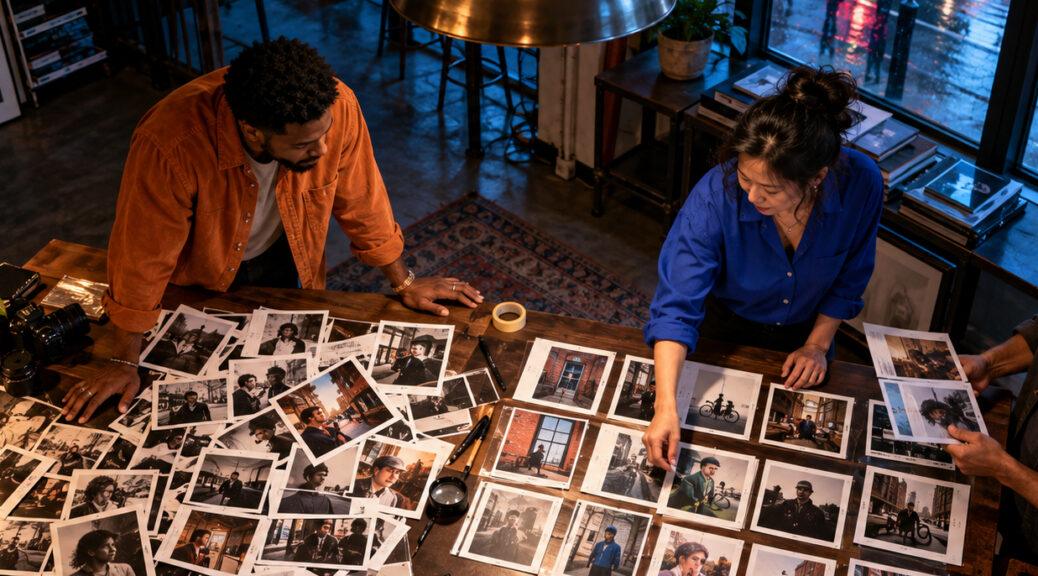
Photographs behave differently when they can be moved around a table or wall.
Two images can be placed side by side.
A sequence can be rearranged in seconds.
One photograph can be removed and the empty space observed.
Several similar images can be grouped together, making repetition suddenly obvious.
Scale also becomes visible.
A photograph that feels dominant on a laptop may become surprisingly quiet when printed beside another image.
Color relationships can change.
So can pacing.
This is one reason physical workprints remain useful even in thoroughly digital photographic workflows.
They turn editing into a spatial problem.
Critique Can Test Whether An Idea Exists Outside The Artist’s Head
A photographer may know exactly what a project is about.
That does not necessarily mean the photographs communicate it.
This is where critique becomes more difficult—and more valuable.
If a photographer says a project explores loneliness but several viewers consistently interpret the pictures primarily as architectural studies, there is a gap worth investigating.
That does not automatically mean the viewers are correct and the photographer is wrong.
Art does not require every viewer to reach the same interpretation.
But repeated misunderstanding is information.
Perhaps the project needs another image.
Perhaps it needs fewer.
Perhaps the sequence is emphasizing the wrong visual idea.
Perhaps the artist statement is trying to supply meaning that the photographs are not carrying.
An outside viewer cannot dictate what a project should mean.
They can reveal what the project currently communicates to someone who does not already know the answer.
The Best Critique Is More Specific Than “I Like It”
Photography feedback often becomes too subjective too quickly.
“I love this.”
“I don’t like this.”
“This is my favorite.”
Those reactions are genuine, but they do not always tell the photographer what is happening.
More useful critique identifies the mechanism behind the reaction.
Perhaps the viewer keeps returning to a portrait because the direct eye contact interrupts a sequence dominated by distant figures.
Perhaps another photograph feels redundant because the previous image already communicates the same spatial relationship.
Perhaps the first five pictures establish a quiet visual rhythm that the sixth suddenly breaks.
Specific observations give the photographer something to evaluate.
They transform taste into information.
Different Reviewers Can See Different Projects
Another advantage of events like Filter Photo is that the reviewers do not all occupy the same professional role.
The 2026 reviewer list includes people working across galleries, museums, publishing, arts administration and photography organizations.
That diversity matters because there is no single universal way to evaluate a portfolio.
A curator may think about how a project behaves in an exhibition.
An editor may immediately consider narrative clarity.
A publisher may pay closer attention to whether the work can sustain a book.
A gallery professional may consider how individual images and the broader body of work operate together.
The photographer does not have to accept every recommendation.
In fact, conflicting advice can itself be useful.
If five reviewers offer five different solutions, the photographer still has to decide which direction belongs to the work.
Critique does not remove authorship.
It tests it.
Feedback Becomes Less Useful When It Turns Into Instructions
There is an important limitation.
Not every outside opinion improves a project.
A reviewer can misunderstand the work.
A teacher can push a photographer toward the teacher’s own aesthetic preferences.
Online audiences can reward images that perform well as thumbnails rather than photographs that belong in a long-term project.
Friends may avoid criticism because they want to be supportive.
Other photographers may unconsciously encourage someone to make work that resembles their own.
Useful feedback therefore requires interpretation.
The photographer needs to distinguish between an observation and a command.
“You should remove this photograph” is one recommendation.
“I lose the thread of the project when I reach this photograph” contains more useful information.
The second statement describes an experience.
The photographer can then decide what to do with it.
You Do Not Need A Professional Portfolio Review To Get Another Pair Of Eyes
Formal reviews can provide access to experienced professionals, but the underlying editing principle is available to almost any photographer.
Print a project cheaply.
Put the photographs on a table.
Ask someone to arrange them.
Show the sequence without explaining what it means first.
Notice where they pause.
Ask which images feel repetitive.
Ask which photograph they remember ten minutes later.
Ask where they believe the project begins and ends.
The person looking does not necessarily need to be a professional photographer.
Sometimes someone unfamiliar with photography terminology can provide valuable information precisely because they respond to the images without thinking about equipment, technique or how difficult a photograph was to make.
The goal is not to surrender creative decisions.
It is to gather evidence about how the work behaves outside your own head.
A Portfolio Is Also A Conversation With An Audience
Filter Photo closes its 2026 festival on September 26 with a free Portfolio Walk and Closing Party from 5 to 7 p.m. at the Columbia College Chicago Student Center.
The Portfolio Walk is built around photographers seeing what other photographers have been making and talking about the work.
That communal element is significant.
Photography can be solitary at almost every stage.
One person walks with the camera.
One person waits.
One person chooses when to press the shutter.
One person sits in front of the computer afterward.
But photographs eventually become communicative objects.
Someone else sees them.
The transition from private creation to public viewing is where outside feedback becomes especially valuable.
AI Can Sort Images, But That Is Not The Same As Seeing A Project
Modern software can already help photographers organize enormous libraries.
Algorithms can identify faces, group similar photographs, recognize objects and accelerate parts of the selection process.
Those tools can be valuable.
But the questions raised in a serious critique are different.
Does this photograph change the rhythm?
Does the project become too literal here?
Why does this portrait feel emotionally distant even though the subject is close to the camera?
Are these three images actually saying the same thing?
Does the final photograph resolve the sequence too neatly?
Those questions involve relationships, intentions and interpretations.
They do not necessarily have one objectively correct answer.
That is why human feedback remains relevant even as photographic workflows become increasingly automated.
Eventually The Photographer Has To Decide
There is a paradox at the center of critique.
Photographers need outside perspectives precisely because other people do not see the work as they do.
But the photographer ultimately remains responsible for deciding what the work becomes.
Good critique does not replace that decision.
It makes the decision more informed.
A reviewer might identify an image as unnecessary, and the photographer may keep it.
A group may dislike a sequence that the photographer believes is essential.
Someone may completely misunderstand the intended meaning and accidentally reveal a more interesting interpretation.
The objective is not consensus.
It is distance.
The photographer temporarily gets to experience the project through someone else’s attention.
That may be the deeper reason portfolio reviews continue to occupy such an important place at photography festivals.
Cameras can show photographers whether an image is sharp.
Histograms can show exposure.
Software can identify technical problems.
AI can increasingly organize and evaluate files according to predefined criteria.
But none of those tools completely answer the question photographers eventually have to confront:
What does this body of work communicate to someone who did not make it?
For that, another person remains one of the most useful tools a photographer can have.