
The first impression in hiring is changing. Before a candidate speaks to a recruiter, attends an interview, or explains their professional experience, an application may already have been evaluated through digital screening tools, structured hiring criteria, or an employer’s internal review process.
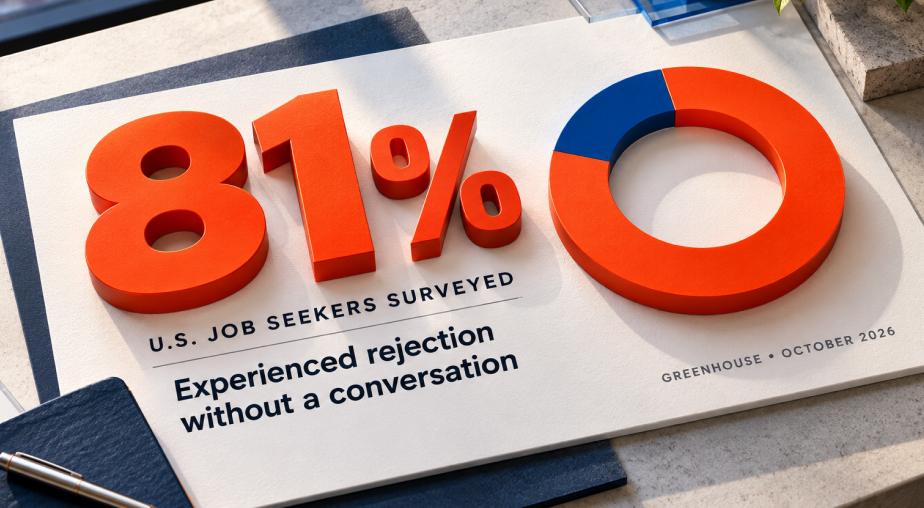
On October 20, 2026, New York-based hiring technology company Greenhouse released its 2026 Future of Hiring Candidate Report, revealing that 81% of surveyed U.S. job seekers had experienced at least one rejection during the previous year without speaking to anyone at the hiring company, whether human or AI.
The Greenhouse hiring report surveyed more than 2,800 job seekers across the United States, United Kingdom, Ireland, Germany, and Australia, including 1,200 U.S. respondents.
The distinction matters: the 81% figure describes how many surveyed candidates experienced rejection without a conversation. It does not mean that 81% of all job applications were rejected, nor does it establish that artificial intelligence caused those decisions.
Nevertheless, the findings illustrate a significant challenge for job seekers. Professional qualifications, carefully written resumes, and polished personal branding may not guarantee an opportunity to explain what someone can contribute.
For recruiters and human resources departments, the report raises equally important questions about candidate experience, transparency, and how employers evaluate professional credibility.
As AI-assisted applications and automated recruitment tools become more common, the relationship between first impressions, LinkedIn personal branding, professional identity, and hiring decisions deserves closer examination.
What The 81% Hiring Rejection Statistic Actually Reveals
Greenhouse’s October 2026 research suggests that rejection without meaningful interaction has become a familiar experience among American job seekers.
Beyond the headline finding, 31% of U.S. respondents said they were rejected without a conversation often or almost always. Among Generation Z respondents, that figure increased to 38%.
These numbers describe candidates’ reported experiences rather than independently audited employer rejection records. They also do not identify one universal explanation for why applicants were unsuccessful.
Some employers may receive far more applications than their recruitment teams can reasonably interview. Others use structured eligibility questions, applicant tracking systems, recruiter screening, or automated tools to narrow candidate pools.
A candidate can therefore receive a rejection without knowing whether the decision resulted from missing qualifications, a highly competitive applicant pool, an administrative rule, or an automated recommendation.
This uncertainty can make the hiring process feel impersonal.
Greenhouse also found that 71% of U.S. job seekers had taken an additional step to attract employers’ attention. These efforts included seeking referrals, while 27% reported paying for a resume service.
The findings suggest that candidates increasingly feel responsible for overcoming obstacles they cannot fully observe.
However, more effort does not necessarily produce better results when applicants lack clear information about the skills, experience, and evidence employers actually prioritize.
For job seekers, the challenge is to communicate relevant qualifications more effectively. For employers, it is to create selection processes that recognize those qualifications fairly and explain expectations clearly.
The New First Impression Happens Before The Interview
Traditionally, professional first impressions were associated with face-to-face meetings, confident introductions, appropriate clothing, and effective communication.
Those elements still matter, but they are no longer necessarily the first things an employer encounters.
Today, a candidate’s initial presentation may consist of a resume, an online application, answers to screening questions, or information contained in a professional networking profile.
Recruiters may assess job titles, employment history, qualifications, relevant skills, and evidence of previous work before scheduling any conversation.
Artificial intelligence adds another dimension to this process.
On September 29, 2026, LinkedIn announced Hiring Assistant 2, an updated AI-powered recruiting tool designed to help employers identify candidates and organize relevant hiring information.
According to LinkedIn’s official announcement, 64% of U.S. talent acquisition professionals surveyed said it was becoming harder to determine which candidates and qualifications were trustworthy.
The research was conducted by Censuswide in August 2026 among 500 U.S. recruiting professionals and 500 U.S. executives at companies with at least 200 employees.
LinkedIn said Hiring Assistant 2 would bring together signals including candidate verification, relevant work experience, screening responses, and applicant tracking system information. Additional capabilities were scheduled to begin rolling out to eligible customers in November 2026.
This development reflects a broader change in recruitment: employers increasingly want evidence that a candidate’s professional identity and reported abilities are genuine.
For job seekers, that makes accuracy and consistency more valuable than an elaborate personal presentation unsupported by actual experience.
Why AI-Generated Applications Are Creating An Authenticity Problem
Artificial intelligence has made it easier for job seekers to prepare resumes, organize career histories, and adapt applications to different positions.
Greenhouse found that 77% of U.S. job seekers had used AI during their job search in the previous year.
However, the same technology has created concerns about authenticity.
According to the company’s October report, 60% of U.S. respondents had changed or considered changing their writing because they worried employers might mistake it for AI-generated content.
Specifically, 39% reported rewriting an application for that reason, while another 21% had considered doing so.
The result is a complicated situation.
Candidates may use AI to improve the clarity of their applications, then worry that polished language makes those applications appear less credible.
Employers, meanwhile, may struggle to distinguish genuine experience from generic statements that sound convincing but provide little evidence.
Greenhouse Chief People Officer Sharawn Tipton identified this disconnect as a central problem in modern hiring, describing a process in which candidates struggle to gain attention while employers review increasingly similar applications.
The practical lesson is not that job seekers should avoid AI entirely.
AI can help organize information, identify unclear sentences, or prepare for interviews. The important distinction is between improving the presentation of real qualifications and manufacturing claims that cannot be supported.
A credible application should include specific responsibilities, genuine achievements, relevant examples, and language that accurately represents the candidate’s professional experience.
Adding invented skills, exaggerated job titles, or misleading credentials creates risks that professional branding cannot resolve.
Why LinkedIn Personal Branding Still Matters In 2026
The growth of automated recruitment does not eliminate the importance of personal branding. Instead, it changes where personal branding can contribute.
A resume is primarily a document describing qualifications and employment history. A LinkedIn profile can provide additional professional context through work examples, career summaries, recommendations, published material, and a recognizable professional identity.
For consultants, executives, entrepreneurs, and creative professionals, that broader presentation can help potential collaborators understand their experience and areas of expertise.
However, LinkedIn personal branding should not be confused with a guaranteed hiring advantage.
Greenhouse’s survey did not establish that candidates with professional photographs, stronger LinkedIn profiles, or larger professional networks were less likely to experience rejection without a conversation.
A polished profile also cannot compensate for missing job requirements.
Its practical value lies in giving interested readers a clearer understanding of the person behind the application.
For example, a marketing specialist might use a LinkedIn profile to showcase completed campaigns, published analysis, and measurable professional accomplishments.
A photographer could demonstrate technical experience through a consistent portfolio. A consultant might provide case studies explaining previous client projects without disclosing confidential information.
These materials make professional identity more concrete.
A strong personal brand should therefore communicate a consistent message across the resume, professional biography, LinkedIn profile, and relevant portfolio.
The objective is not to appear impressive at every opportunity. It is to make genuine experience easier to recognize and understand.

What Professional Headshots Can And Cannot Accomplish
Professional photography remains an important part of personal branding, particularly when a person’s image appears on business websites, speaker biographies, LinkedIn profiles, or professional publications.
A recognizable headshot can help establish visual consistency across these platforms.
It can also communicate aspects of personal presentation, including expression, clothing, and the intended professional setting.
However, a headshot should not be treated as evidence of competence, honesty, or suitability for employment.
On October 1, 2026, Associated Press business writer Dee-Ann Durbin examined the role of authenticity in professional headshots, featuring insights from Houston-based photographer Chris Gillett and recruiting professionals at Goodwin Recruiting, a company based in New Hampshire.
The Associated Press professional headshot report emphasized the importance of recognizable photographs that reflect a person’s actual appearance.
Goodwin Recruiting area director Emily Lauro cautioned against excessive editing that makes someone look substantially different from their real-life appearance.
That distinction is especially relevant as AI-generated headshots become more accessible.
A photograph that substantially changes facial features, creates unrealistic clothing, or presents an unfamiliar version of someone may undermine the consistency that personal branding is supposed to establish.
Professionals preparing for new portraits should consider their intended audience, the platforms where their photographs will appear, and whether their clothing reflects their everyday professional identity.
Finest Image’s professional headshot outfit guide provides additional guidance on clothing colors, fabrics, and styling choices for professional portraits.
A headshot can support recognition and a coherent professional presentation. It cannot demonstrate technical skills, replace a strong application, or establish that an employer will offer an interview.
Should Job Seekers Include A Professional Photo On Their Resume?
The distinction between professional networking and formal recruitment becomes particularly important when deciding where to use a headshot.
In the United States, job seekers generally should not assume that a photograph belongs on their resume.
In the Associated Press report, Jenny Battershell, director of marketing at Goodwin Recruiting, explained that photographs can complicate automated resume processing and introduce opportunities for appearance-related bias.
The U.S. Equal Employment Opportunity Commission also advises employers against requesting applicant photographs during the pre-employment process.
According to the agency’s employment practices guidance, employers should focus on information relevant to determining whether a person is qualified for the position. The EEOC explains that a photograph needed for identification may be obtained after an employment offer has been accepted.
This guidance reflects an important difference between a professional image used for personal branding and information that should influence a hiring decision.
An applicant’s appearance may reveal or suggest characteristics unrelated to job performance, potentially introducing unfair assumptions.
For most conventional U.S. job applications, a clear, text-focused resume remains the more appropriate choice unless a legitimate role-specific requirement indicates otherwise.
A professional photograph may still be suitable for a LinkedIn profile, personal website, conference biography, or other public-facing professional context.
Candidates should use photographs where they support communication, rather than assuming every hiring document benefits from visual presentation.
What Recruiters Need To See Beyond A Polished Application
One of Greenhouse’s most revealing findings concerns the gap between what candidates can communicate through applications and what they want employers to understand.
The company’s research found that 96% of U.S. job seekers wished they could demonstrate something more clearly than their applications allowed.
More than half, 52%, specifically wanted better opportunities to communicate their ability to learn and adapt.
This matters because traditional resumes are structured around previous responsibilities, employers, qualifications, and accomplishments.
Those details are useful, but they may not fully demonstrate how someone approaches unfamiliar problems, responds to feedback, or develops new skills.
A candidate changing industries may possess transferable experience that does not fit neatly into conventional job-title comparisons.
Similarly, a professional returning to work after an extended absence may have relevant abilities that are not immediately apparent from a chronological employment history.
Recruiters can address some of these limitations through structured interviews, practical work samples, and consistent assessments connected to actual job requirements.
Candidates can help by preparing concise examples of projects, decisions, responsibilities, and results.
For instance, describing how a team improved a customer service process can be more informative than simply claiming to possess excellent communication skills.
The same principle applies to personal branding.
A professional portfolio should provide meaningful evidence of work rather than relying on impressive visual presentation alone.
The strongest first impression is one supported by information that remains credible when examined more closely.
How Job Seekers Can Build A Credible Professional Identity
A credible professional identity begins with consistency.
Employment dates, job titles, qualifications, and descriptions of professional experience should align across resumes, LinkedIn profiles, biographies, and relevant portfolio pages.
Small differences in wording are normal, particularly when documents serve different purposes. Substantial contradictions, however, can make professional information harder to verify.
Candidates should also make their experience understandable to people who may not be familiar with their previous organizations.
A technical specialist might explain the business purpose of a project rather than listing software tools without context. A manager could describe the scale of a team and the responsibilities involved.
For professionals who work publicly with clients or audiences, visual consistency can complement this information.
A recognizable photograph, appropriate clothing, a clear biography, and a coherent portfolio help establish continuity across professional platforms.
But personal branding should remain proportionate to the role being pursued.
A candidate applying for an operational position may benefit more from clearly documented experience and relevant certifications than from an elaborate personal website.
A creative director or independent consultant may have a stronger reason to invest in detailed portfolio presentation.
Networking can also provide opportunities to communicate qualifications beyond application forms. Professional associations, industry events, and genuine referrals may help candidates connect with people who understand their work.
None of these activities guarantees an interview.
They can, however, make professional experience more accessible and reduce the gap between a short application and the person’s broader capabilities.
What HR Teams Can Do To Make First Impressions Fairer
The responsibility for improving hiring experiences does not rest entirely with applicants.
Employers control the criteria used to evaluate candidates, the information requested during applications, and the opportunities people receive to demonstrate their qualifications.
Greenhouse’s research suggests that many candidates experience frustration even after reaching the interview stage.
Among U.S. respondents who had interviewed, 96% reported at least one complaint, with 45% identifying employer ghosting as an issue.
These findings point toward a need for clearer communication throughout recruitment.
HR teams can improve the process by explaining essential job requirements, distinguishing mandatory qualifications from preferences, and avoiding unnecessary application steps.
Selection criteria should also be consistently applied.
The EEOC’s guidance for employers recommends screening applications according to consistent standards and ensuring that recruitment decisions do not rely on legally prohibited discrimination.
That principle remains important when automated technology is involved.
AI-supported systems may assist with organizing information or identifying relevant qualifications, but employers still need to understand how those systems affect applicants and whether their selection methods are appropriate for the work being performed.
Professional photographs, personal style, and presentation choices should not become substitutes for job-related evidence.
A fair hiring process should make it possible for qualified candidates to demonstrate relevant skills without requiring them to conform to unnecessary appearance-based expectations.
AI Interviews Are Changing The Employer’s First Impression Too
The first impression in recruitment is not created by candidates alone.
Employers also communicate their professionalism through job descriptions, application platforms, interview procedures, and the way they respond to applicants.
Greenhouse’s October 2026 research found that 48% of U.S. respondents had participated in an AI interview during the previous year.
Among those who had experienced one, 70% said it allowed them to demonstrate their skills well.
Only 7% of U.S. respondents said they would refuse an AI-led interview outright.
These findings suggest that candidates may be more open to automated conversations than some employers assume, provided the experience is useful and transparent.
In an October 20 article about AI interview screening and candidate experience, Greenhouse examined how interview design influences trust.
The company identified clear communication, relevant follow-up questions, opportunities for candidates to ask questions, and human oversight as important elements of a constructive experience.
Its survey also found that 49% of U.S. candidates wanted assurance that a person would review their interview responses, while 40% wanted to understand how they would be evaluated.
Additionally, 88% supported at least one legal requirement promoting transparency and accountability in AI interviews. That figure measures respondents’ preferences, not the existence of a universal legal requirement.
For HR departments, the implications extend beyond efficiency.
An unclear or impersonal screening experience can influence how applicants perceive the employer, even when the company ultimately hires someone else.
Transparent communication and respectful candidate treatment are therefore important parts of employer branding.
Why Authenticity Is Becoming A Stronger Professional Branding Strategy
The Greenhouse and LinkedIn findings reveal a common challenge from opposite sides of the hiring process.
Job seekers want opportunities to demonstrate their abilities, while recruiters want reliable information that distinguishes qualified candidates from applications that may appear increasingly similar.
Technology can help organize that information, but it does not eliminate the need for sound judgment.
For candidates, authenticity should mean presenting accurate qualifications, relevant accomplishments, and a professional identity that remains consistent across platforms.
For employers, it should mean evaluating candidates according to meaningful evidence rather than relying on appearance, assumptions, or unexplained automated decisions.
Professional photography belongs within this broader framework.
A carefully created headshot can support a recognizable personal brand and help people present themselves confidently in public-facing professional environments.
Its value is greatest when it accurately represents the person and complements a credible career history.
The central finding of Greenhouse’s October 2026 report is not that job seekers need better photographs or more elaborate resumes to overcome rejection.
It is that a substantial share of surveyed American candidates experienced rejection before having an opportunity to speak with anyone at the employer.
Addressing that problem requires more than stronger personal presentation. It requires recruitment processes that make relevant experience visible, provide meaningful opportunities for assessment, and maintain trust between candidates and hiring teams.
In 2026, the most useful professional first impression is not necessarily the most polished one. It is the one that gives employers a clear, accurate, and fair basis for understanding what a candidate can contribute.