

A great outfit can solve one day.
A great wardrobe can solve hundreds of them.
That difference is at the center of advice celebrity stylist and creative director Chelsea Volpe shared on August 4, 2026, while discussing fall clothing with People. Volpe, who has dressed actresses including Julianne Nicholson and Sadie Sink, summarized her approach in eight words: “Stop buying outfits and start building a wardrobe.”
Her argument is timely because modern shopping makes it extremely easy to buy clothing one look at a time. A jacket appears in a social-media post, a skirt looks perfect in a product photograph, or an upcoming event creates pressure to assemble something new. The individual purchase may look good, but six months later the closet can be full while getting dressed still feels difficult.
The alternative is to treat clothing as a connected visual system.
Instead of asking only whether a new item looks good, ask whether it works with what you already own, whether the fit makes you want to wear it repeatedly, whether its color expands your existing combinations, and whether it suits the situations that actually make up your life.
For anyone interested in improving personal image rather than simply accumulating fashion, that change in thinking matters.
An Outfit Solves an Occasion, but a Wardrobe Solves a Routine
Buying an outfit usually begins with a specific event.
You need something for an interview, wedding, dinner, presentation, vacation, or first day at a new job. You find a top, trousers, shoes, and perhaps a jacket that work together.
Nothing is inherently wrong with that.
The problem begins when most of the closet is built this way.
A collection of individually successful outfits can still create a weak wardrobe because the pieces have few relationships with one another. The patterned blouse only works with one skirt. The unusual shoes require one pair of trousers. The formal jacket never looks right with your everyday clothing.
Every combination becomes dependent on its original partners.
Volpe’s August 2026 advice was instead to focus on “elevated separates that mix effortlessly together.” In the same interview, she highlighted dark denim, wide-leg trousers, satin shirts, knit polos, midi skirts, loafers, structured bags, and outerwear as examples of pieces that can move between combinations rather than functioning as one-use looks. The specific products matter less than the underlying principle. You can read the original Chelsea Volpe fall wardrobe advice for the current seasonal context.
A wardrobe starts becoming useful when pieces stop having only one job.
Build Around the Life You Actually Have
The most important wardrobe question is not “What should everyone own?”
It is “What do I repeatedly need to get dressed for?”
Someone working remotely four days a week has different clothing requirements from an attorney appearing in court. A college student walking across campus needs different shoes from someone commuting primarily by car. A person attending frequent industry events has different outerwear needs from someone whose social life revolves around outdoor activities.
Look at an ordinary month.
How many days require professional clothing?
How many are casual?
How often do you exercise?
Do you need evening clothes frequently or twice a year?
Do you walk long distances?
What climate are you dressing for?
Those answers should determine how much space each clothing category receives.
A common wardrobe problem occurs when fantasy receives more attention than reality. Someone may own six formal dresses because each seemed exciting in the store but only one pair of comfortable trousers suitable for three ordinary workdays every week.
Dressing better often begins by reversing that imbalance.
Choose Anchor Pieces That Connect Several Categories
A useful wardrobe usually contains several anchor pieces.
An anchor is not necessarily neutral, expensive, minimalist, or traditional. It is simply a garment that works repeatedly with other clothing.
Dark jeans might be an anchor.
So might a forest-green blazer, burgundy cardigan, navy skirt, cropped leather jacket, white overshirt, or pair of loafers.
The test is connectivity.
Suppose you wear an olive jacket with dark jeans, black trousers, a cream skirt, a navy dress, and a white T-shirt. That jacket is contributing to multiple sections of your wardrobe.
Now compare it with another jacket that only works with one pair of trousers and requires a particular shoe.
The second jacket may be more dramatic, but the first is doing considerably more wardrobe work.
This is also why generic lists of “10 pieces every woman needs” or “essential items every man should own” are often less helpful than they sound.
A beige trench coat is not an essential if you dislike beige and never wear trench coats.
A vivid red jacket may be much more useful if red already appears throughout your wardrobe.
The goal is not uniformity.
It is compatibility.
Use a Color System Instead of Buying Random Colors
Color is one of the fastest ways to create—or destroy—wardrobe connectivity.
A closet does not have to consist of black, white, beige, and navy. It simply helps to repeat enough colors that new pieces have somewhere to go.
One practical system is to choose several core neutrals and several recurring colors.
For example:
| Wardrobe Role | Example Colors | Purpose |
|---|---|---|
| Core neutrals | Navy, cream, charcoal | Easy foundations for trousers, jackets, shirts and shoes |
| Recurring colors | Burgundy, forest green, pale blue | Add personality while remaining easy to repeat |
| Occasional accents | Coral, mustard, violet | Create variety without controlling the entire wardrobe |
A burgundy knit might work with navy trousers, cream jeans, a charcoal skirt, or dark denim.
A forest-green jacket might connect to many of the same pieces.
Suddenly a closet containing 25 carefully related garments can create more believable combinations than a closet containing 60 unrelated purchases.
This is the type of practical image system that fits naturally with broader personal style and image guidance: the objective is not owning more impressive individual items but making the overall presentation easier to maintain.
Apply the Three-Outfit Test Before Buying
One of the simplest wardrobe-building habits is to pause before purchasing something and create three complete outfits using items you already own.
Imagine considering a burgundy midi skirt.
Before paying, picture it with:
your cream knit and loafers;
your pale-blue shirt and ankle boots;
your black top and cropped jacket.
If those combinations already exist in your closet, the skirt has immediate connections.
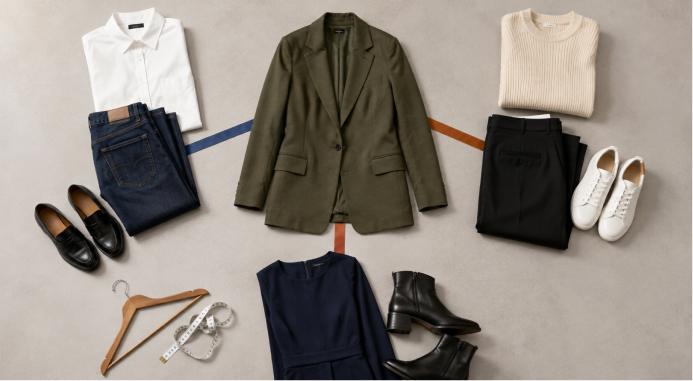
Now imagine that the skirt only works after you also buy another blouse, another shoe, and a different coat.
The price of the skirt is no longer the real cost of adding it to your wardrobe.
This method does not mean everything must be practical.
Sometimes a spectacular evening coat, unusual dress, or statement shoe is worth buying simply because you love it.
But it helps to recognize that purchase for what it is rather than pretending every statement piece will become a daily wardrobe foundation.
Fit Determines Whether a “Versatile” Piece Actually Gets Worn
A garment can match every color in your closet and still fail as a wardrobe investment when it does not fit in a way you enjoy wearing.
Research published in the Journal of Retailing and Consumer Services examined this relationship in a sample of 502 U.S. fashion consumers aged 18 and older. The study, by Md. Jakir Hossain, Hyo Jung Chang, and Robert Paul Jones, investigated fit preference, fit performance, self-evaluation, body satisfaction, self-esteem, confident clothing decisions, and psychological well-being.
The findings do not mean a well-fitting jacket automatically creates self-esteem. They do reinforce that fit is tied to how consumers evaluate clothing and themselves.
That matters when building a wardrobe.
A theoretically perfect white shirt is not a wardrobe basic if you avoid it because the shoulders pull every time you move.
Black trousers are not versatile when the waistband becomes uncomfortable after an hour.
A blazer cannot be considered an anchor when the sleeves constantly need adjusting.
Instead of asking whether a garment fits a universal definition of flattering, evaluate whether it performs the way you want on your body.
The full clothing fit and self-evaluation study provides useful context for why fit involves more than measurements alone.
Stop Treating Repetition as a Fashion Failure
Wardrobe building only works when you repeat clothing.
That should be obvious, but many people still feel they should avoid wearing a favorite item because they wore it recently.
The result is strange: the garments that fit best and create the strongest image remain in the closet while less successful clothing gets worn simply for the sake of variety.
Repeat the good trousers.
Repeat the jacket that fits perfectly.
Wear the same loafers with four different outfits.
Style the same shirt under a sweater, open over a T-shirt, beneath a blazer, and with sleeves rolled in warmer weather.
Repetition is not evidence of limited style.
It is how personal style becomes recognizable.
A wardrobe becomes visually yours partly because certain silhouettes, colors, garments, and combinations appear again and again.
Make One Purchase Unlock Several Clothes You Already Own
One of the best new purchases is often the one that makes old clothing useful again.
Consider someone who owns three skirts but rarely wears them because every jacket in the closet is too long for the proportions they prefer.
A shorter jacket could potentially unlock all three skirts.
Someone may own several office trousers but lack a comfortable shoe positioned between sneakers and formal heels.
One loafer or flat could solve several outfits.
Another person may own multiple dresses that work indoors but no lightweight layer appropriate for commuting.
One cardigan or jacket could make those dresses easier to use.
This reframes shopping as problem-solving.
The question changes from “What do I want to buy?” to “What is preventing the clothes I already own from working?”
That is a much more specific problem.
Specific wardrobe problems usually require fewer purchases than vague dissatisfaction.
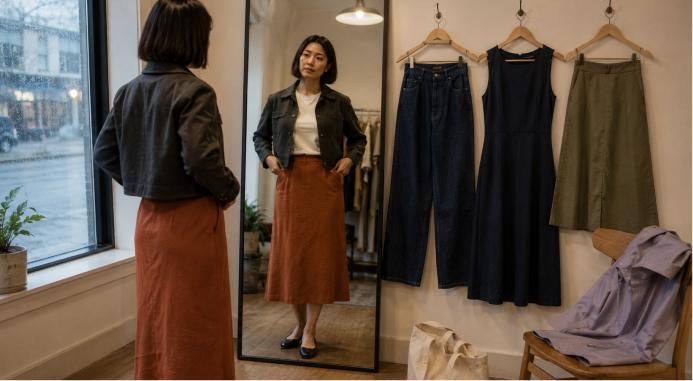
Secondhand Shopping Makes Gap-Filling More Practical
A wardrobe strategy based on specific gaps also works well with resale because the shopper can search for a type of garment rather than simply browse whatever is new this season.
That market is increasingly significant in the United States.
ThredUp released its 14th annual Resale Report on April 2, 2026, with research conducted by GlobalData. The company reported that the U.S. secondhand market grew nearly four times faster than the broader retail clothing market in 2025, while the global secondhand apparel market is projected to reach $393 billion by 2030. Gen Z and millennials are projected to drive more than 70% of global market growth through that year.
Those numbers do not mean buying used clothing automatically creates a better wardrobe.
Resale has the same potential problem as conventional retail: inexpensive or unusual pieces can still become closet clutter.
Its advantage appears when the shopping objective is specific.
If you know you need a cropped navy jacket, straight dark denim, a cream cardigan, or a practical leather shoe, secondhand inventory can expand the search without requiring you to chase whatever retailers currently classify as a trend.
The current 2026 ThredUp Resale Report offers broader data on how quickly that part of the clothing market is developing.
Do Not Turn Wardrobe Building Into Minimalism Unless You Want To
“Build a wardrobe” is sometimes interpreted as “own 20 neutral clothes.”
Those are not the same idea.
A capsule wardrobe can work brilliantly for someone who enjoys minimalism.
It can feel restrictive to somebody who loves prints, vintage clothing, dramatic color, unusual accessories, or changing silhouettes.
A wardrobe system can contain 30 pieces or 130.
The relevant question is whether the owner understands how those pieces relate.
A maximalist wardrobe can still be organized around recurring colors.
A vintage collector can build around familiar silhouettes.
Someone who loves statement jackets can use simpler supporting pieces so those jackets become easier to wear.
The objective is not to remove personality in the name of efficiency.
It is to build enough structure that personal style becomes easier to express.
Trends Should Update a Wardrobe, Not Rebuild It
Chelsea Volpe’s fall 2026 recommendations include seasonal ideas such as dark denim, satin, funnel-neck jackets, suede, wide trousers, burgundy, coffee brown, forest green, and soft pink.
A wardrobe system gives those trends somewhere to land.
Suppose burgundy already coordinates with much of your closet. Adding a burgundy knit this fall can feel current without becoming disposable when the season changes.
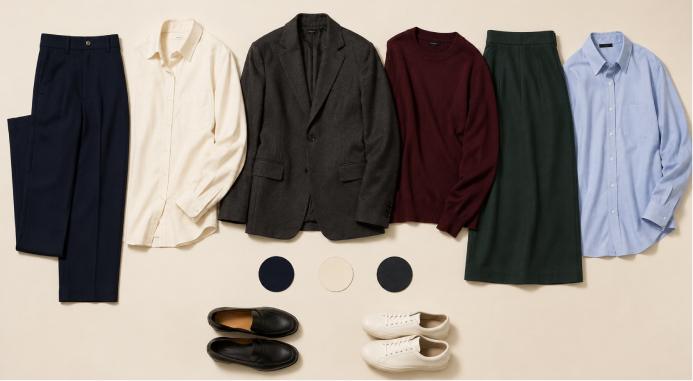
Perhaps suede works naturally with your denim, coats, and autumn palette. A suede bag can refresh several existing outfits.
A funnel-neck jacket makes sense only when its proportions, climate usefulness, and colors fit the rest of your clothing.
This produces a healthier relationship with trends.
Instead of rebuilding your identity each season, you update an existing visual language.
Audit Your Closet by Connections, Not by Quantity
A full wardrobe audit does not need to begin with throwing things away.
Start by identifying what works.
Which five garments do you wear most?
Which shoes repeatedly solve outfit problems?
Which colors appear naturally?
Which jackets work with the largest number of bottoms?
Which clothes receive compliments but also feel comfortable enough to wear without constant adjustment?
Then identify isolated pieces.
An isolated garment is not necessarily bad. It simply has fewer connections.
Ask why.
Does it need tailoring?
Is the color difficult?
Do you lack the right shoe?
Does it belong to a type of event you rarely attend?
Did you buy it for an imagined version of your lifestyle?
Those answers reveal more than the total number of items in the closet.
A Better Wardrobe Makes Personal Image More Consistent
The biggest advantage of wardrobe building may be predictability.
When clothing works together, fewer mornings become styling emergencies.
You know which trousers fit.
You know the shirt that works with them.
You know which jacket changes the outfit from casual to professional.
You know which shoes can handle an entire day.
You already understand the colors.
That consistency matters for personal image because appearance is rarely determined by one spectacular outfit.
It is built through repetition: arriving at work looking considered, having appropriate clothing for a social event, knowing what photographs well, dressing comfortably for travel, and being able to increase or decrease formality without starting from zero.
Volpe’s advice works because it changes the unit of measurement.
Do not evaluate every garment as an isolated purchase.
Evaluate what it does to the wardrobe.
Does it connect?
Does it solve a gap?
Can you wear it repeatedly?
Does it fit?
Can you style it three ways?
Does it suit your real life?
An impressive outfit can make one strong impression.
A well-built wardrobe makes strong presentation easier to repeat.