
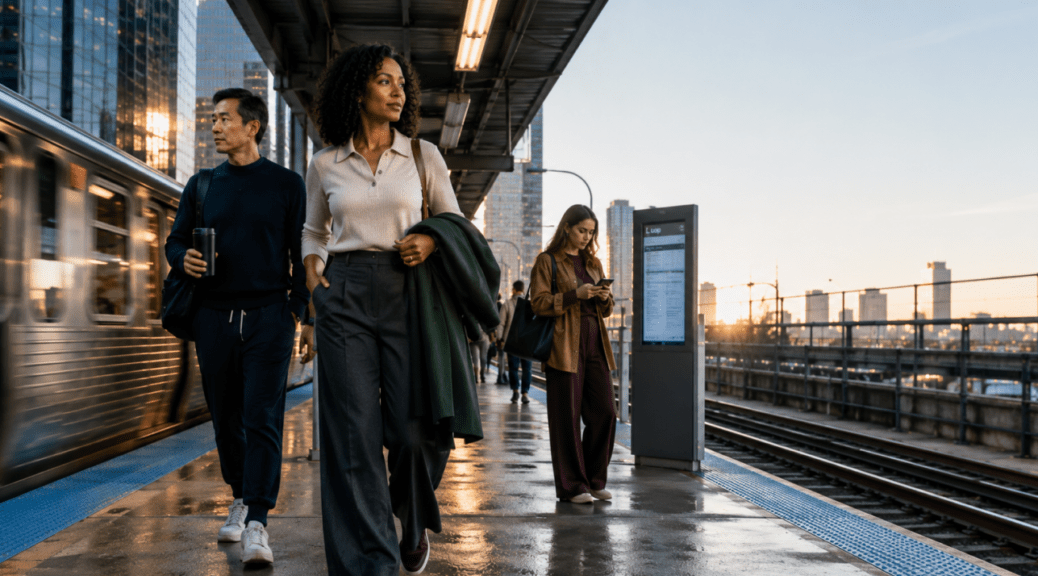
Comfortable clothing has a reputation problem.
Sweatpants, oversized sweaters, loose trousers, soft knits, and relaxed matching sets can make someone feel physically at ease, but they are also frequently associated with staying home, running errands, or putting less effort into an outfit.
That assumption is becoming harder to defend.
On August 4, 2026, content creator Anna Sitar launched a 24-piece loungewear collection with Pacsun built around the idea that comfort and style do not need to exist on opposite sides of the wardrobe. The collection, Sitar’s third collaboration with Pacsun, had been in development for roughly eight to ten months and includes wide-leg lounge pants, matching sets, micro shorts, polo sweaters, and boatneck tops. Sitar and the design team also emphasized soft faux-cashmere-style material, interchangeable pieces, and colors including butter yellow, blues, deep green, and neutrals. (People’s August 2026 Anna Sitar interview)
More interesting than the collection itself is the reasoning behind it. Sitar, 29, told People that her personal style has become increasingly relaxed and that she no longer feels the same pressure to dress differently simply because she is entering a particular room. She connected comfort with confidence and described clothing as an extension of personality rather than a costume for gaining approval.
That idea raises a useful image question: Can comfortable clothes actually make you look more polished, confident, and intentional—or do they inevitably make you appear under-dressed?
The answer depends less on whether an item is technically “loungewear” and more on its fit, fabric, condition, proportions, coordination, and suitability for the setting.
Comfort does not automatically create a strong image.
Neither does discomfort.
Comfortable and Under-Dressed Are Not the Same Thing
A person can be comfortable and polished at the same time because comfort describes how clothing feels, while being under-dressed describes how clothing relates to the occasion. (Wardrobe Science for Confidence and Credibility)
Those are different variables.
Wide-leg trousers made from a soft fabric may feel nearly as easy to wear as sweatpants while looking appropriate for lunch, travel, a creative workplace, or an informal meeting. A fine-gauge knit can feel softer than a traditional button-down while still appearing organized. Clean minimalist sneakers may provide considerably more physical comfort than formal shoes without making an outfit look careless in many modern environments.
Conversely, an uncomfortable garment can still look under-dressed.
A pair of jeans that pinches at the waist does not become more professional because it is restrictive. A stiff jacket that fits badly does not automatically improve a person’s image.
Recent research helps explain why fit deserves more attention than the simple casual-versus-formal divide. A 2025 study by Md. Jakir Hossain, Hyo Jung Chang, and Robert Paul Jones examined 502 U.S. fashion consumers and explored how clothing fit relates to self-evaluation, confident clothing decisions, and psychological well-being. The researchers found meaningful relationships between fit preferences, self-evaluation, body satisfaction, self-esteem, and confidence in apparel decisions. (clothing fit and confidence study)
That research does not prove that loose clothing automatically increases confidence or that comfortable clothes always improve psychological well-being. It supports a narrower point: clothing fit is connected with how consumers evaluate both garments and themselves.
An outfit that allows you to move naturally, sit comfortably, and stop thinking constantly about your waistband can give you more mental space to concentrate on the actual interaction taking place.
That can improve how you carry the clothes.
Why Matching Sets Often Look More Intentional
One of the strongest ideas in Sitar’s Pacsun collection is not softness.
It is coordination.
Her August collection includes several matching pieces designed so colors and garments can be interchanged. She told People that compatibility across the collection was a major consideration in the design process.
Matching sets are an effective example of why relaxed clothing does not necessarily appear careless.
Imagine two outfits.
The first consists of faded gray sweatpants, an unrelated oversized college sweatshirt, athletic socks, and worn running shoes.
The second uses soft wide-leg knit trousers and a matching polo sweater in deep green, clean cream sneakers, a structured tote, and one understated piece of jewelry.
Both outfits may offer comparable physical comfort.
Visually, they communicate different levels of intention.
The second outfit uses repetition. The top and bottom share color, fabric, or design language. Shoes and accessories reinforce the direction rather than fighting it. The silhouette looks chosen rather than assembled from whatever happened to be nearby.
That is why coordinated separates can be one of the easiest ways to make comfortable clothing look polished.
They create visual order without requiring formal tailoring.
Fabric Is Often What Separates Relaxed From Sloppy
Two garments with virtually identical silhouettes can communicate entirely different levels of polish because of their fabric.
Consider a loose pair of trousers.
In thin, stretched jersey with excessive pilling, they may read immediately as sleepwear. In a substantial ponte knit, brushed twill, dense rib knit, fluid crepe, or fine wool blend, the same basic silhouette can look significantly more structured.
Fabric affects how clothing hangs from the body.
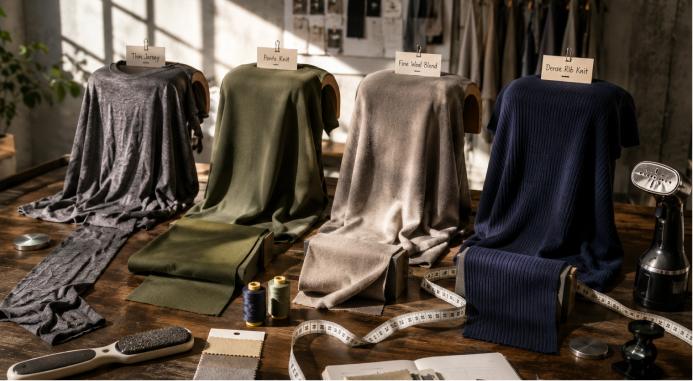
Material with enough weight tends to fall in cleaner vertical lines. Extremely thin material may cling to areas where the wearer expected it to drape. A fabric that has lost its recovery can create stretched knees, sagging elbows, or a collapsing waistband.
Softness therefore should not be confused with lack of structure.
Sitar’s collection reportedly uses a faux-cashmere-style fabric precisely because touch and softness were central to the concept.
For shoppers trying to improve their image while prioritizing comfort, fabric can be evaluated with a few practical questions.
Does it return to shape after stretching?
Does it become transparent under strong light?
Does it wrinkle immediately after sitting?
Does the hem fall cleanly?
Does the surface already show pilling in the store?
Can it support the silhouette of the garment without appearing stiff?
These questions often matter more than whether the retailer has categorized something as lounge, casual, workwear, or elevated basics.
Fit Still Determines Whether Oversized Looks Intentional
Oversized clothing is not simply clothing that is too large.
Good oversized design usually retains specific points of control.
An oversized blazer may have extended shoulders but still close cleanly through the body. Wide trousers may have substantial volume through the leg while fitting securely at the waist. A large sweater may drop below the natural shoulder while maintaining deliberate sleeve and hem proportions.
Problems appear when every part of an outfit becomes uncontrolled at once.
A sweatshirt that is very long, trousers that pool heavily at the ankles, an oversized coat, and bulky shoes can eliminate almost every visible proportion in the outfit.
That does not make the person look bad. It may simply create a different visual effect than intended.
A useful approach is to combine relaxation with one or two anchors.
If the trousers are extremely wide, choose a top that ends at a clearly considered point.
If the sweater is oversized, use trousers with a clean waist or straighter leg.
If both top and bottom are loose, show structure through the outer layer, footwear, neckline, cuff, or bag.
The objective is not to make the body appear thinner.
It is to make the silhouette appear deliberate.
Comfortable Clothes Benefit From Better Proportions
Proportion is one reason some relaxed outfits look sophisticated while others appear unfinished.
A long sweater paired with long, loose trousers can create one uninterrupted block of fabric. Shortening the sweater slightly, adding a partial tuck, or choosing trousers with a higher visible waistband can give the outfit clearer divisions.
Similarly, wide-leg trousers can look very different depending on where their hem meets the shoe.
A hem ending awkwardly several inches above a substantial shoe may make the trousers look unintentionally short. Excess fabric collapsing beneath the heel can make them appear poorly fitted.
Comfort does not require ignoring those relationships.
It simply means the proportions should be created without forcing the body into painful or unnecessarily restrictive garments.
That distinction is central to better self-image.
Instead of asking, “How can this outfit make my body look correct?” ask, “How can these garments work together more effectively?”
The first question makes the body the problem.
The second makes styling the problem.

One Structured Piece Can Change the Entire Outfit
One of the easiest ways to dress up soft clothing is to introduce contrast.
A relaxed knit set under a structured trench coat looks different from the same set worn alone.
Wide lounge trousers with a fitted leather loafer communicate differently from the same trousers with worn house slippers.
A soft crewneck sweater becomes more deliberate when paired with a structured shoulder bag.
You do not need to add all of these elements simultaneously.
In fact, comfortable outfits often look strongest when only one part provides obvious structure.
Possible anchors include a jacket, coat, bag, belt, polished shoe, crisp collar, substantial watch, or clearly shaped neckline.
The contrast works because it prevents softness from dominating every visual element.
This principle also makes comfortable wardrobes easier to reuse. One jacket can shift multiple casual outfits toward a more professional or social setting without requiring an entirely separate collection of uncomfortable clothing.
Shoes Can Make Loungewear Look Like an Outfit
Footwear is often the difference between clothing that appears intentionally casual and clothing that looks as though it never left the house.
A matching knit set with clean sneakers can work for an airport, lunch, shopping, or a casual workplace.
The same set with loafers may look appropriate for a creative meeting.
With sandals, it can move toward vacation clothing.
With house slippers, the message changes again.
None of those interpretations is inherently superior. The context decides which one works.
Condition also matters.
Comfortable shoes that are cleaned and maintained generally support a polished image better than dressier shoes with peeling material, damaged heels, dirty laces, or badly worn soles.
This is why “dress better” should not automatically mean “dress more formally.”
It frequently means choosing the more intentional version of the level of formality you already need.
When Formal Clothing Really Does Help
Comfort should not become another rigid fashion rule.
There are environments where formal clothing still carries meaning, and dressing too casually can create an unnecessary visual mismatch.
Research published in the Italian Journal of Marketing in 2025 illustrates how contextual that relationship can be. Researcher Hao Liu conducted four studies examining clothing type and consumer self-confidence. Formal attire was associated with greater self-confidence and increased shopping engagement in some situations, but the effect depended on the environment. In an upscale retail setting, formal clothing had a stronger effect; in a less upscale setting, the difference between formal and casual dress was not significant. (formal attire and self-confidence research)
That contextual effect is useful far beyond retail.
A soft matching set may look excellent at an airport and inappropriate at a formal wedding.
Relaxed trousers and a knit polo might work beautifully at a design agency but look too informal for a conservative legal interview.
Comfortable clothing improves image when it respects the setting rather than pretending every setting has become casual.
A Practical Comfort-to-Polish Scale
The easiest way to judge a relaxed outfit is to examine whether each detail moves it toward intentional presentation.

| Detail | More Relaxed | More Polished |
|---|---|---|
| Fabric | Thin, stretched, heavily pilled | Soft but substantial, clean surface |
| Fit | Accidental oversizing | Deliberate volume with controlled proportions |
| Color | Several unrelated colors | Coordinated or repeating palette |
| Footwear | House or heavily worn shoes | Clean sneakers, loafers, boots, refined flats |
| Outer Layer | None | Structured jacket, overshirt, coat, or cardigan |
| Condition | Wrinkled, sagging, damaged | Clean, maintained, properly stored |
| Accessories | Random or excessive | One or two deliberate finishing pieces |
| Styling | Garments worn independently | Outfit built as one visual composition |
The point is not to maximize the right-hand column.
A person going to the grocery store may need almost none of it.
A person going from home to a casual client meeting may use several elements.
Image improves when the level of polish corresponds with the activity.
Color Coordination Makes Soft Clothing Look More Sophisticated
Relaxed clothing often benefits from a limited color palette because loose silhouettes already create substantial visual volume.
Using too many competing colors can make the outfit busier.
A simple approach is to build around two or three related tones.
Cream trousers, an oatmeal sweater, and dark brown shoes create one family.
Navy lounge pants, a pale blue knit, and gray sneakers create another.
A deep green matching set can be paired with black or cream accessories rather than introducing four additional accent colors.
Sitar’s collection was reportedly designed around interchangeable colors, including butter yellow, shades of blue, green, and neutrals. That strategy reflects an important wardrobe principle: pieces become easier to style when their color relationships are considered before purchase.
This is one reason building a coherent wardrobe often improves personal image more effectively than accumulating individually impressive garments.
Every new piece has more opportunities to look intentional.
Comfortable Clothing Can Photograph Better Too
Comfort also affects how people behave in photographs.
Someone wearing a jacket that restricts their shoulders may repeatedly pull it into position. A tight waistband can change seated posture. Shoes that hurt can influence stance. A neckline that feels unstable may cause constant adjustment.
A garment that fits comfortably reduces some of those distractions.
That matters for professional headshots, family photographs, travel pictures, social events, and video calls.
The 2025 U.S. consumer study on fit is relevant here because it emphasizes the connection between fit performance, self-evaluation, and confident clothing decisions rather than treating fit as a purely mechanical measurement.
For photographs, comfort should still be paired with visual preparation.
Check whether loose garments collapse when seated.
Look at the outfit from the side and back.
Test the clothing in the lighting where photographs will be taken.
See whether a very soft fabric reflects light differently than expected.
Make sure the neckline and shoulders stay where they were designed to sit.
Comfort helps you stop fighting the clothing.
Good styling helps the clothing photograph clearly.
Avoid Turning “Looking Polished” Into Another Body Standard
There is an important limit to image-improvement advice.
Clothing can influence self-presentation without determining personal worth.
Research on fashion involvement and body image has produced complicated results rather than a simple claim that caring more about clothing improves self-esteem. A 2025 Body Image study examining Brazilian women found relationships between fashion involvement, self-objectification, and mental-health-related measures that differed depending on the analytical pathway. The authors cautioned against overly simple interpretations.
That is useful context for any discussion of dressing better.
The objective should not be to spend every morning evaluating whether clothes hide enough, lengthen enough, slim enough, or make the wearer acceptable enough.
A stronger wardrobe reduces that mental workload.
You know the trousers fit.
You know the sweater feels good.
You know the colors coordinate.
You know the shoes work for the day.
Then you can leave the mirror.
How to Build a Comfortable Outfit That Still Looks Put Together
A practical formula is to begin with the most comfortable garment you genuinely want to wear and build outward from it.
Start with soft wide-leg trousers, for example.
Add a knit top in a coordinated color.
Check whether the proportions need a shorter hem, partial tuck, or cleaner neckline.
Choose footwear appropriate to where you are actually going.
Then decide whether the occasion needs one structured layer or accessory.
That process works better than beginning with the assumption that comfort must be disguised.
For a casual office, that might produce wide trousers, a fine knit, loafers, and an unstructured blazer.
For travel, it might mean a matching knit set, clean sneakers, a structured tote, and a lightweight coat.
For lunch, relaxed jeans, a soft polo sweater, and polished flats may be sufficient.
For a home-based video meeting, comfortable trousers can remain invisible while a well-fitting knit or jacket provides a clear upper-body silhouette.
The formula changes.
The principle does not: softness plus intention.
The Best Comfortable Clothes Make You Forget About Them
Anna Sitar’s new Pacsun collaboration is commercially useful because it captures a larger change in how many people think about dressing. Her collection does not attempt to turn lounge clothing into formalwear. Instead, it treats softness, coordinated colors, interchangeable pieces, and relaxed silhouettes as legitimate components of style. The 24-piece collection launched August 4 after eight to ten months of development, with Sitar describing comfort and confidence as central to how she now approaches her own image.
That does not mean every sweatshirt is suddenly appropriate everywhere.
It means the old equation—uncomfortable equals polished, comfortable equals sloppy—is too simplistic.
A strong image comes from recognizing the occasion and choosing clothing that looks considered within it.
Fit matters.
Fabric matters.
Proportion matters.
Condition matters.
Shoes matter.
Color relationships matter.
And comfort matters because clothing works best when you can stop adjusting it and start paying attention to the life happening while you wear it.
The most successful comfortable outfit is not one that tricks other people into thinking it is formal.
It is one that looks like you chose comfort deliberately.