
For job seekers, a hybrid dress code can feel less predictable than the old office uniform. The challenge is not only deciding what looks professional. It is reading context: the company, the role, the interview format, the client exposure, and the difference between what is written in a policy and what people actually wear.
The practical answer is not to overdress out of fear or underdress to seem relaxed. A stronger approach is to prepare a small range of polished options that can flex between video calls, office visits, team meetings, and client-facing settings. That gives you control without making your clothing the loudest part of the conversation.
Hybrid Dress Code Signals To Read Before Interviews
Build A Hybrid Dress Code Baseline
A useful starting point is to assume that many workplaces have become more flexible, while still caring about professional presentation. A June 2025 survey of 1,000 U.S. hybrid workers reported that 56% said their companies had a clearly defined dress code, and among those workers, 67% said the code had relaxed in recent years, according to the IWG workwear survey analysis. The same survey reported that 92% of hybrid workers wanted clothing that could serve both work and leisure settings.
That does not mean every employer welcomes the same outfits. It does mean versatility has become a sensible wardrobe strategy. For a job seeker, the best baseline is usually refined business casual unless the employer, industry, or role clearly calls for business formal attire.
Check Formality Against The Role
Role matters. A candidate interviewing for a client-facing finance, law, executive, or consulting position may need sharper tailoring than someone interviewing for a creative, technical, or internal operations role. Yet even in relaxed environments, your appearance should communicate that you prepared with care.
The Associated Press reported on August 6, 2026, that some job candidates had encountered interviewers wearing hoodies or jeans, while the article still advised candidates to choose a polished outfit or ask about dress expectations in advance when unsure, as covered in this AP report on interview attire. That is a helpful distinction. The interviewer’s casual clothing does not automatically give a candidate permission to appear careless. It tells you the workplace may be less formal, not that presentation has no meaning.
If you want a related framework for mixed settings, this site also has practical advice on dress code expectations for interviews, office days, client sessions, and video calls.
Ask Direct Questions Without Sounding Unsure
Use Questions That Separate Client Days From Office Days
Asking about clothing can sound professional when the question is tied to performance, preparation, and respect for the environment. You are not asking because you lack judgment. You are asking because hybrid work often creates different standards for different settings.
- “How do people usually dress on office days compared with remote days?”
- “Is the dress code different for client meetings or presentation days?”
- “Are there any clothing guidelines new hires should know before their first week?”
- “Would business casual be appropriate for the interview, or is a more formal look preferred?”
These questions are direct without being awkward. They show that you understand workplace image is situational. They also prevent a common mistake: preparing for the company’s public brand while missing the day-to-day reality of the team you hope to join.
Listen For Rules And Norms
There is a difference between a formal rule and an informal norm. A company may have a written policy, but employees may interpret it through role, seniority, department, and meeting type. Another company may have few written rules, yet still expect restraint around shorts, gym clothing, revealing pieces, or very casual footwear.
Listen for phrases such as “client-ready,” “smart casual,” “relaxed but polished,” or “use your judgment.” Each phrase carries a signal. “Client-ready” usually means cleaner lines, more structure, and less casual styling. “Relaxed but polished” often permits knitwear, dark denim, simple sneakers, or softer jackets, provided the full outfit still looks intentional.
Choose Interview Outfits That Bridge Remote And Office Settings
For Video Interviews
Video interviews compress your image into a small frame. That makes the top half of the outfit especially visible: collar, neckline, jacket shape, color contrast, grooming, and background all interact. Choose a top that separates clearly from your background and avoids distracting patterns. A blazer, structured cardigan, polished knit, collared shirt, or simple blouse can all work, depending on the role.
Comfort still matters. If a collar pulls, a jacket restricts movement, or a fabric rustles, you may appear distracted. The aim is to look composed enough that the interviewer focuses on your answers, not your clothing adjustments.
For Office Or Hybrid Interviews
For an in-person interview in a mixed work environment, dress one level more polished than the everyday baseline you expect. If the company seems casual, that might mean dark denim with a blazer, loafers, and a neat shirt. If the company appears business casual, consider trousers, a jacket or refined knit, and closed-toe shoes. If the role is formal, a suit or equivalent structured outfit remains the safer choice.
A hybrid dress code rewards balance. Too formal can create distance in a casual culture, while too casual can suggest that you missed the professional signal. The middle path is deliberate: clean lines, good fit, limited distractions, and clothing that lets your competence remain central.
For readers preparing written materials alongside interview clothing, Interline Publishing offers resources within the same network to enhance your professional communication skills.
Build A Repeatable Outfit Formula
Start With One Step Above The Everyday Baseline
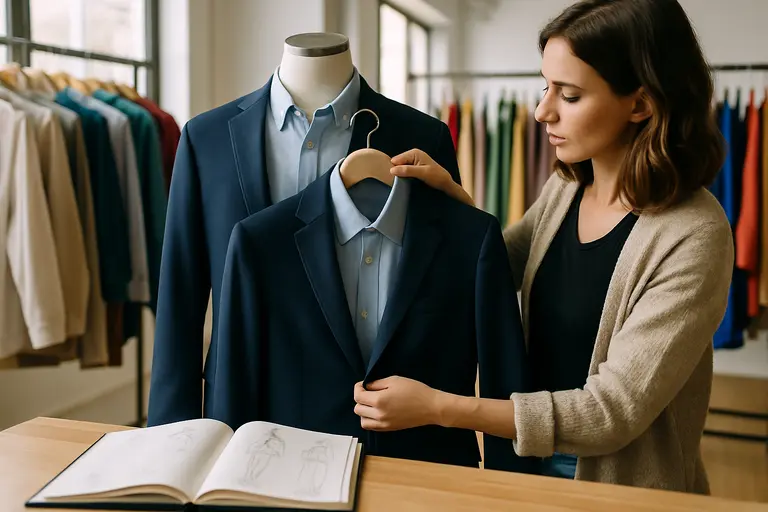
A repeatable outfit formula reduces decision fatigue before interviews and early office days. It also helps you avoid buying items that work for only one meeting. Think in combinations rather than single garments: structured layer plus neat top plus tailored trousers; polished knit plus dark denim plus refined shoes; simple dress plus jacket plus low-profile footwear.
The formula should suit your real calendar. If you expect video calls, office days, and occasional client meetings, build around pieces that can shift with small changes. A blazer can move an outfit from casual to interview-ready. Shoes can shift the message from relaxed to polished. Accessories can add definition without making the look feel overdone.
Use Comfort As A Professional Asset
Comfort is not the opposite of professionalism. In hybrid work, it is part of sustainable presentation. Clothing that fits well, allows natural movement, and suits the temperature of your work setting helps you concentrate. The key is to separate comfort from sloppiness.
Soft fabrics, stretch, knit layers, and practical shoes can still look professional if they are clean, well-fitted, and appropriate for the setting. Wrinkled clothing, visible wear, distracting logos, and pieces that seem better suited to exercise or lounging may send the wrong message, especially before colleagues know your work quality.
Hybrid Dress Code Confidence For Job Seekers
Make Your Image Easy To Interpret
The goal is not to dress like someone else. It is to make your professional image easy to read. A strong interview outfit says: I understand the context, I respect the meeting, and I can represent myself well in this environment.
Before an interview or first office day, check three things. First, does the outfit match the likely formality of the employer? Second, does it support the role you want to be trusted with? Third, can you sit, stand, speak, and move without fussing with the clothing?
If the answer is yes, you are close. A hybrid dress code will keep varying by company and role, so certainty is not always possible. What is possible is preparation: research the employer, ask clear questions, choose business casual when evidence is limited, and adjust once you see the real working culture.
That is how job seekers can use clothing strategically without making it perform more work than it can. Your attire cannot replace experience, preparation, or communication. It can, however, support the first impression those strengths deserve.