
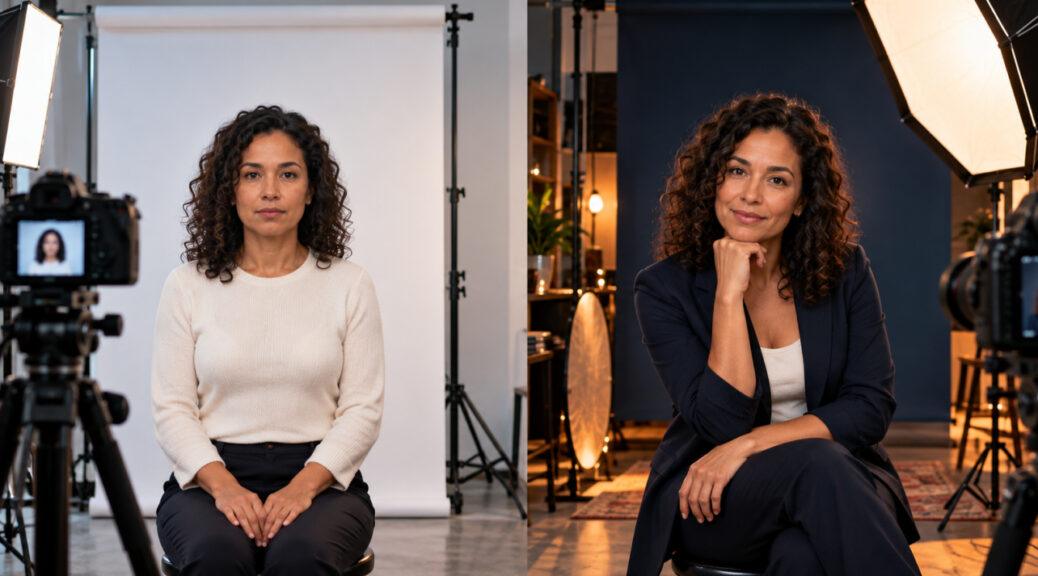
You can take a passport photo and a professional headshot within hours of each other, wearing similar clothes and with exactly the same haircut, and still look surprisingly different in the two images.
That does not necessarily mean one photograph is inaccurate.
A passport photo and a professional headshot are designed to accomplish fundamentally different jobs. One prioritizes identification and standardization. The other can use expression, lighting, camera position, background and photographer direction to communicate personality and professional identity.
That distinction is especially relevant in 2026. On October 1, Associated Press business writer Dee-Ann Durbin examined the changing role of professional headshots, speaking with Houston photographer Chris Gillett, Goodwin Recruiting area director Emily Lauro, marketing director Jenny Battershell and freelance journalist Philip Eil. Their discussion emphasized recognizability and authenticity while also showing how much deliberate communication can happen inside a professional portrait.
At the same time, the U.S. Department of State has increasingly explicit rules for passport photography. Its current passport-photo guidance, updated March 24, 2026, requires an original, unedited photograph and specifically prohibits altering the image with filters, phone apps, computer software or artificial intelligence.
Put the two photographs side by side, then, and the difference makes sense: a passport photo is trying to document you consistently; a professional headshot is trying to present you effectively.
The Two Photos Have Completely Different Jobs
The simplest way to understand the difference is to look at what each photograph is supposed to accomplish.
| Element | U.S. Passport Photo | Professional Headshot |
|---|---|---|
| Primary purpose | Identity documentation | Professional presentation |
| Expression | Controlled, direct expression | Can communicate warmth, confidence or approachability |
| Pose | Face camera directly, head not tilted | Photographer can adjust head and shoulder angles |
| Background | Plain white or off-white | Can vary by profession and intended use |
| Lighting | Even and free of problematic shadows | Can be shaped creatively while remaining natural |
| Editing | Original image; digital alteration prohibited | Careful retouching is possible, but authenticity matters |
| Eyeglasses | Normally must be removed | Can be worn if appropriate to the person’s normal appearance |
| Framing | Strictly regulated | Flexible according to platform and professional purpose |
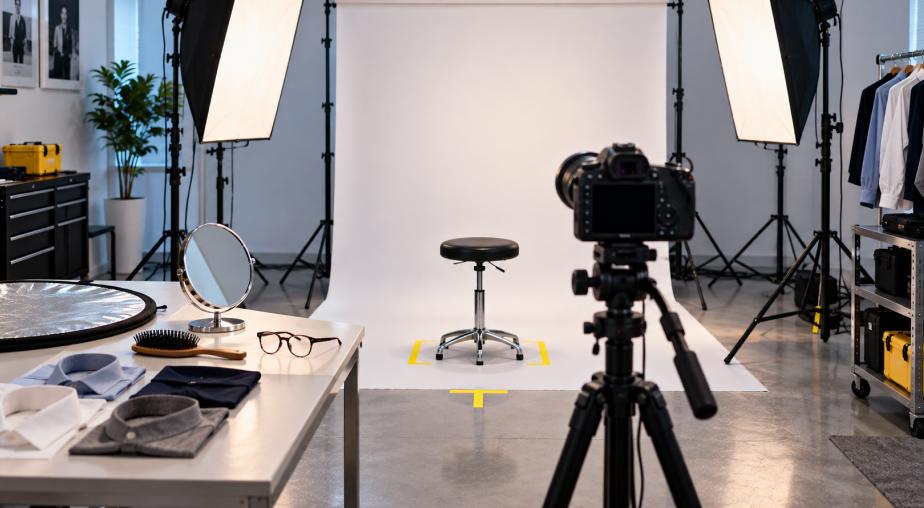
The State Department requires a printed U.S. passport photograph to measure 2 by 2 inches, or 51 by 51 millimeters. The head must measure between 1 and 1 3/8 inches, or 25 to 35 millimeters, from the bottom of the chin to the top of the head. The department also advises positioning the camera several feet away and keeping the head centered.
A professional headshot has no comparable government template.
That freedom changes almost everything.
A photographer can decide how closely to crop, how much of the shoulders to show, whether the subject turns slightly, how bright the background should be, where the light comes from and which expression best supports the person’s professional goals.
The passport photographer is solving a compliance problem. The headshot photographer is solving a communication problem.
A Passport Photo Deliberately Removes Many Portrait Techniques
Professional portrait photography often depends on controlled variation.
The photographer may ask you to move your chin slightly forward, rotate your shoulders, shift your weight or make a tiny adjustment to your expression. Lighting can be moved to emphasize facial structure, soften shadows or create separation between the subject and background.
Passport photography deliberately removes much of that flexibility.
Current State Department instructions say applicants should face the camera directly without tilting the head. The full face must remain visible, the eyes must be open, and the background must be plain white or off-white and free from shadows, textures and objects.
The department’s guidance primarily calls for a neutral expression with the mouth closed, although its detailed examples indicate that a restrained smile can be acceptable when the eyes remain open and the mouth stays closed. Exaggerated expressions and open-mouth smiles are not acceptable.
That can produce a photograph that feels unusually serious compared with the way you normally see yourself.
You are accustomed to seeing your face moving, talking, smiling and reacting. Friends and colleagues usually see you from changing angles rather than perfectly centered against a blank background.
A passport photograph removes much of that familiar context.
It is not trying to capture your personality. It is trying to produce a clear, standardized representation of your current appearance.
A Professional Headshot Is Designed Around Expression
Expression becomes much more important when the photograph is intended for a professional website, biography, speaking profile or social platform.
In the October 1 AP feature, Houston-based headshot photographer Chris Gillett explained that even very small changes around a smile or eyebrow can change the expression a photograph communicates. He favors traditional head-and-shoulders compositions because they keep attention on the face.
That illustrates why the same person can look dramatically more approachable in a headshot.
A professional photographer can work through dozens or hundreds of frames while watching small differences in the eyes, mouth, eyebrows and posture. Instead of simply asking for “a smile,” the photographer can talk with the subject, create a reaction and photograph the expression at the right moment.
A passport-photo station generally has no reason to do that.
The professional headshot therefore has an opportunity to show something a standardized identification photograph intentionally minimizes: personality through expression.
That does not mean a professional photograph should manufacture a personality that is not there. The strongest portrait is usually the one in which the subject remains recognizable when the online image eventually meets the real person.
That principle also applies to preparing for an in-person introduction. Finest Image’s first encounter attire guide examines the same broader issue: presentation works best when clothing and visual choices support the message rather than becoming a disguise.
Camera Distance Can Actually Change How Your Face Looks
Expression is only part of the difference.
Photography itself converts a three-dimensional face into a two-dimensional image, and camera-to-subject distance can change the apparent proportions of facial features.
This is particularly relevant when comparing a carefully produced portrait with a photograph taken quickly on a phone or at an automated photo station.
A 2024 study published in The Laryngoscope examined photographs of 12 subjects using both a smartphone and a full-frame digital camera at multiple distances and focal lengths. Researchers found measurable distortion of midfacial features when photographs were captured at close “selfie” distances. Smartphone photographs taken from eight inches away showed an 18% increase in vertical stretching of the midface, while photographs from 12 inches produced a 12% increase in the study’s measurements.
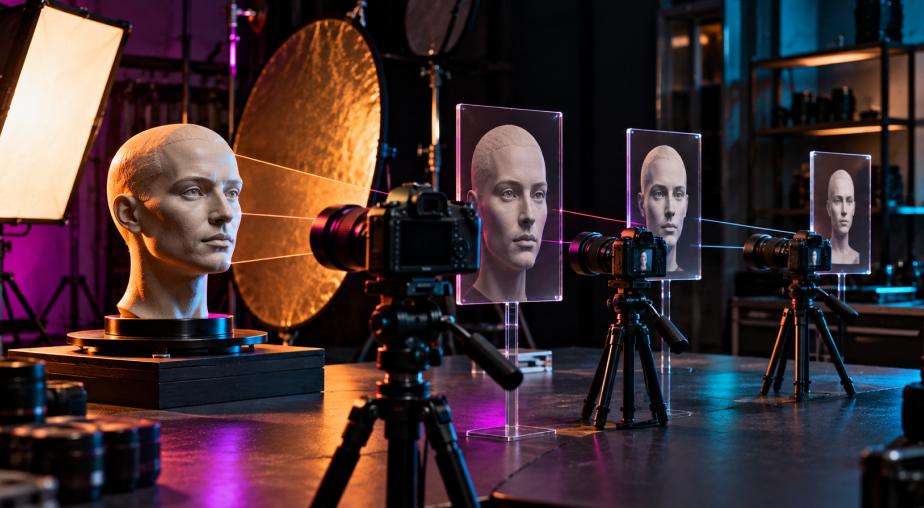
This does not mean a particular lens magically changes your face. Camera position is central to perspective. In practice, however, focal length and camera distance are often changed together because photographers move farther away when using longer portrait focal lengths to maintain similar framing.
Earlier research involving 45 photographed participants and 369 raters also found that portrait acquisition choices affected both depicted facial shape and how faces were perceived.
This helps explain a common experience: “I don’t look like that in the mirror.”
You may look exactly like yourself. The camera may simply be observing your three-dimensional features from a different distance than the one from which you normally see them.
The State Department’s current guidance addresses this practically by advising that the camera should be several feet away; one of its examples specifies about 1.2 meters and warns that a photograph taken too close to the camera is unacceptable.
Lighting Changes the Face Without Changing the Face
Another major difference is lighting.
A passport photograph needs clarity. The State Department requires uniform lighting and warns against shadows on either the face or background. It also says the photograph should reproduce skin tones accurately.
Professional headshot lighting can be far more expressive.
A portrait photographer may use a large soft source close to the subject to create smooth transitions between highlights and shadows. Another light can separate hair or shoulders from the background. A reflector can brighten the shadow side of the face.
None of those techniques need to involve digitally changing someone’s features.
They change how three-dimensional structure is represented by light.
Move the primary light higher and the shadows beneath the cheekbones, nose and jaw change. Move it closer to the camera axis and the face can appear more evenly illuminated. Move the subject relative to the background and the portrait gains depth.
That is one reason a professionally lit portrait can look more dimensional while a passport photograph appears comparatively flat.
The flatter photograph is not necessarily worse photography. For an identification document, predictability is an advantage.
Your Shoulders and Head Position Matter More Than You Think
Look carefully at many passport photos and another difference becomes obvious: symmetry.
The State Department requires applicants to face directly forward. Its examples reject photographs in which the head is tilted or the head and shoulders are rotated away from the camera.
Professional portraiture does not have that restriction.
Turning the shoulders slightly can create depth between the near and far sides of the body. A small change in chin position can alter how the neck and jaw appear. Moving the head slightly toward the camera can change the relationship between the face and shoulders.
These adjustments should remain subtle. Extreme posing can make a business portrait feel theatrical rather than professional.
The objective is not to create an artificial jawline or hide someone’s real proportions. It is to find a comfortable position that photographs naturally.
Passport photography asks, “Are you positioned correctly?”
Professional portrait photography can ask, “Which natural position communicates you most effectively?”
Those are different questions, so they produce different pictures.
Your Glasses May Disappear From One Version of You
Even familiar accessories can make the two photographs feel different.
The State Department currently requires applicants to remove eyeglasses, sunglasses and tinted glasses for passport photos except when glasses cannot be removed for medical reasons and appropriate documentation is supplied. Hats and head coverings are also generally prohibited except under specified religious or medical exceptions, and the full face must remain visible.
For someone who wears glasses every waking hour, removing them can make a passport photograph feel surprisingly unfamiliar.
A professional headshot has more flexibility. If glasses are part of how colleagues, clients and friends recognize you, keeping them on may make the photograph more representative of your everyday professional appearance. A photographer can adjust lighting and camera position to control distracting reflections.
Again, neither image is necessarily more truthful.
They are following different definitions of what the photograph needs to accomplish.
Retouching Creates the Biggest Modern Divide
The difference becomes especially important when editing enters the process.
The State Department’s position is unusually clear. Passport applicants must submit the original, unchanged photograph. Computer software, phone apps, filters and artificial intelligence cannot be used to change the image. Its current examples explicitly reject AI-altered photos and digitally modified backgrounds.
Professional headshots operate under different standards.
Minor adjustments to exposure, color, temporary blemishes or distracting background elements have long been part of professional photographic workflows. The question is how far those changes should go.
The October AP report makes recognizability the practical boundary.
Emily Lauro of Goodwin Recruiting warned that heavily edited photographs can create problems when the person appearing at an interview looks substantially different from the profile image. AP also reported that AI-generated professional headshots have become inexpensive and accessible, while noting concerns that unrealistic results can shift attention away from a candidate’s actual qualifications.
The best professional headshot therefore does not need to reproduce the visual austerity of a passport photograph.
But it should still look like you.
Why You May Prefer Your Headshot
Most people would reasonably expect to prefer a professional headshot.
More time has been spent choosing the lighting, expression, framing, clothing and final image. The photographer can capture multiple versions and select the frame in which those elements work together.
That preference should not automatically be interpreted as evidence that the passport photograph is “bad.”
The passport image has fewer tools available to create a flattering presentation because flattering presentation is not its primary purpose.
Its job is recognition.
The headshot’s job is broader. It may need to introduce a lawyer to potential clients, a founder to investors, an author to readers, a physician to patients or an executive to employees.
Philip Eil’s experience illustrates the difference particularly well. For photographs connected to his first book, the Providence, Rhode Island-based journalist worked with a photographer who created studio close-ups and environmental portraits near the Seekonk River, a location personally meaningful to him.
A passport photograph cannot communicate that kind of context.
A professional portrait can.
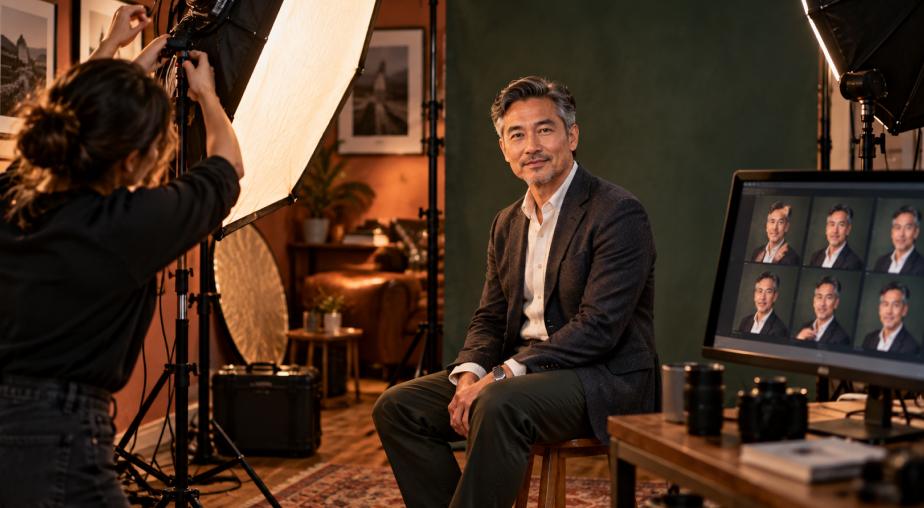
Which Photo Looks More Like the Real You?
The answer may be both.
Your passport photograph shows your face under a narrow set of standardized conditions. Your professional headshot shows the same face under conditions selected to communicate something about you.
Neither photograph captures the full experience of meeting a moving, speaking, expressive person in three dimensions.
That is why comparing them can be misleading.
If you dislike your passport photo, the useful question is not necessarily, “Why do I look so bad?” It may be, “Which photographic conditions are different from the way I normally see myself?”
The answer could include expression, camera distance, lighting, posture, glasses, background, framing or simply the absence of movement.
And if your professional headshot looks so different that people struggle to recognize you, the opposite question becomes important.
The best professional image should benefit from the flexibility that portrait photography provides without crossing the line into creating a different person.
A passport photo has to prove who you are.
A professional headshot has room to communicate how you want to show up.
Understanding that difference makes it much easier to accept why the same face can produce two remarkably different photographs.