
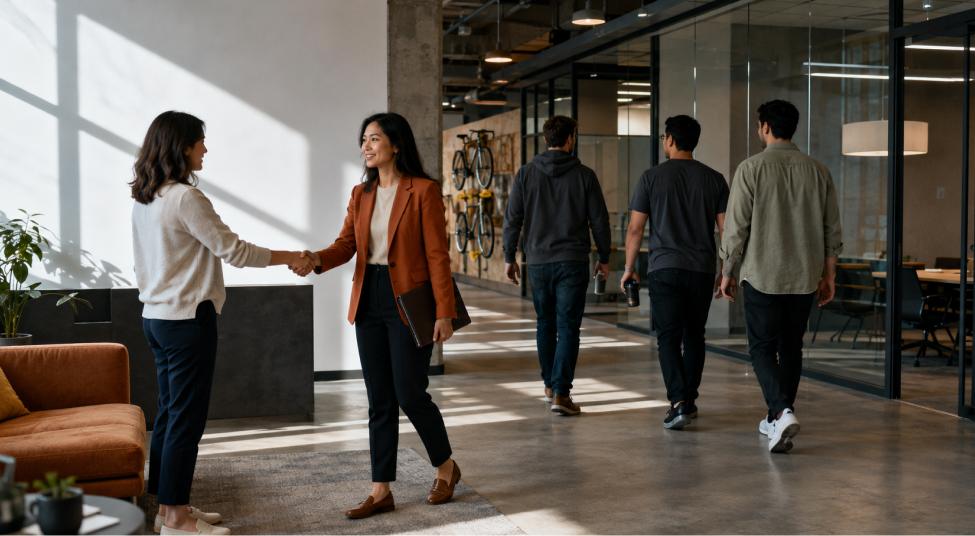
A matching blazer and trousers once seemed like the safest possible outfit for a job interview. For Dani McEwen, a 20-year-old student at Baldwin Wallace University in Berea, Ohio, that choice became a source of doubt when she arrived for an insurance-company interview and saw employees wearing T-shirts and jeans.
McEwen worried that she looked overly formal and possibly out of step with the office. Her experience appeared in an Associated Press report published on August 6, 2026, examining the widening gap between traditional interview clothing and increasingly casual workplaces. (New Grad Headshots and Brand Makeovers That Accelerated Job Offers)
The question facing candidates is no longer simply whether to wear a suit. It is how to demonstrate preparation and judgment when the interviewer may appear in a hoodie, athletic shirt, sneakers, or shorts.
When considering what to wear to a job interview, dress slightly more formally than usual. This approach helps you remain credible within the company’s culture. For a candidate at a conservative law firm, a tailored suit may be required. In contrast, at a software startup, polished business casual works.
Structured trousers, a clean shirt or knit top, and an optional blazer can complete the look. These pieces project professionalism without appearing overdone. Choose fabrics and colors that align with the role and culture. Aim for neat grooming and minimal accessories to keep focus on qualifications.
The purpose is not to imitate employees exactly. It is to show that you understand the workplace while recognizing that an interview is still a more formal interaction than an ordinary workday.
Why Interview Clothing Became More Difficult to Read
Remote work, hybrid schedules, video meetings, and relaxed office policies have weakened many of the visual rules that once made interview dressing predictable.
Christina Adamo, a personal stylist at Neiman Marcus in Paramus, New Jersey, told the Associated Press that companies and employees have become more relaxed during the six years shaped by remote and hybrid work. Polished suits are no longer the automatic default in every field, even though they remain common for executive positions and careers in law, finance, government, and other conservative industries.
The result is an unusual imbalance. Employers may conduct interviews in clothing that reflects their normal workday, while candidates are still expected to signal that they take the opportunity seriously.
Molly Tyndale, 22, told the AP that she wore a blouse and suit jacket to an online interview after the company described its dress code as business professional. One interviewer appeared in an athletic T-shirt. Tyndale believed a candidate who joined the same call dressed that casually would probably have been rejected.
That asymmetry explains why copying the interviewer is not a reliable strategy. Their clothing reflects the position they already hold. Your clothing must communicate readiness for a position you are still seeking.
The August 6 Associated Press report on interview attire recommends researching the organization, assessing its industry, and presenting a slightly more polished version of its everyday visual culture.
Research the Office Before Choosing an Outfit
The strongest interview outfit begins with research rather than shopping.
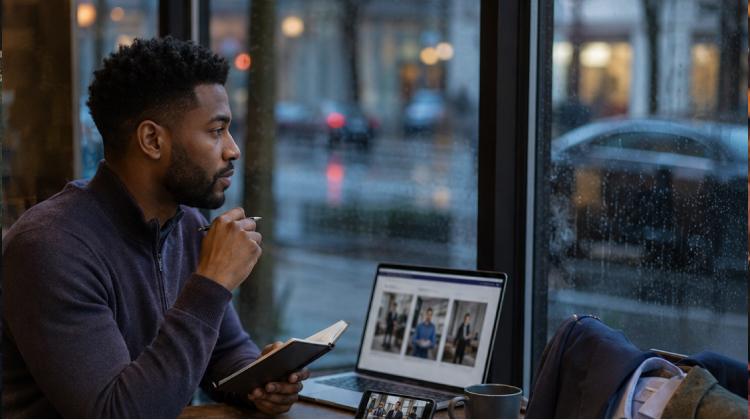
Look at the company’s official website, careers pages, employee profiles, recruiting videos, conference photographs, and verified social-media accounts. Focus on images that show people performing roles similar to the one you want.
A corporate homepage may feature executives in suits even though designers and engineers work in jeans. A recruiting video may reveal that client-facing employees dress more formally than internal teams. Conference photographs may show how senior leaders present themselves when representing the organization publicly.
The language a company uses also provides clues. An organization that emphasizes tradition, discretion, fiduciary responsibility, or institutional trust may expect conservative clothing. A company that describes itself as experimental, disruptive, informal, or creator-led may permit greater flexibility.
The dress standard can also vary within one company. An attorney, maintenance technician, product designer, salesperson, and software engineer may share an employer without sharing a wardrobe.
When online research remains unclear, ask the recruiter or scheduling contact. A straightforward message such as “Could you share the expected dress level for the interview?” demonstrates preparation rather than insecurity.
Texas A&M University’s Career Center advises candidates to check the company website or ask the person arranging the interview about its dress code. Its guidance recommends dressing somewhat more formally and conservatively than employees usually dress, even when a suit is not part of the organization’s normal workwear. (Texas A&M interview-attire guidance)
Use the One-Level-More-Polished Rule
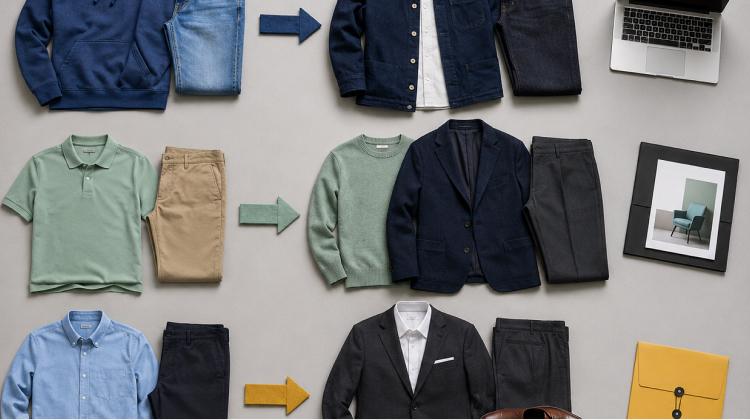
A practical way to choose an outfit is to identify the company’s ordinary dress level and move one step upward.
| Everyday Office Style | Appropriate Interview Direction |
|---|---|
| Hoodies, T-shirts, sneakers, and jeans | Smart casual with dark trousers or clean dark jeans, a polished top, and refined shoes |
| Polos, casual button-downs, knitwear, and chinos | Business casual with structured trousers, a blouse or collared shirt, and an optional blazer |
| Blazers, dresses, tailored separates, and dress shoes | Business professional with a coordinated suit or equally formal separates |
| Traditional suits and conservative accessories | A well-tailored, restrained suit appropriate to the industry |
| Uniforms, technical clothing, or skilled-trade workwear | A clean, interview-ready version suitable for the role, not clothing taken directly from a worksite |
The rule prevents two common mistakes. The first is arriving in clothing that looks indistinguishable from what someone might wear during an ordinary casual shift. The second is choosing an outfit so formal that it makes the candidate appear unfamiliar with the company.
Smart casual does not mean careless. A clean, heavyweight T-shirt under a structured jacket can work in some technology or creative environments. A faded graphic T-shirt, stretched sweatshirt, or visibly worn hoodie usually communicates less intention.
Dark jeans may be acceptable in an exceptionally casual office when they are clean, well fitted, and free from distressing. They remain a risk in finance, law, government, consulting, formal education, and many client-facing positions.
The objective is calibrated effort. You should look like you studied the environment and prepared for an important version of it.
When a Suit Is Still the Safest Choice
The casualization of work has not made suits obsolete.
A suit remains the clearest option for interviews involving executive leadership, law, investment banking, traditional finance, senior consulting, diplomatic work, formal government positions, luxury services, and highly visible corporate representation.
It can also be useful when the interview includes several audiences. A technology company may maintain a relaxed engineering culture but expect a sales director, public-affairs executive, or chief financial officer to represent the business before clients, regulators, investors, or the media.
Samantha Harman, a personal stylist and author interviewed by the AP, noted that hiring managers evaluating senior candidates may consider whether someone appears capable of addressing the media, leading a conference, or representing the organization during a crisis. Clothing becomes part of a larger judgment about public presence.
Los Angeles publicist Dylan Thomas Cotter told the AP that he wears a dark blue tailored suit when interviewing or trying to secure a new client. In public relations, he sees visual composure as part of communicating that he can manage pressure and represent another person or company effectively.
A suit is most persuasive when it appears current, comfortable, and properly fitted. An outdated, oversized, or visibly uncomfortable suit does not automatically create a stronger impression than polished separates.
The jacket should sit cleanly across the shoulders. Sleeves and trousers should be an intentional length. Buttons should close without pulling. The wearer should be able to sit, stand, walk, and reach for documents without constant adjustment.
Formality works only when it supports confidence rather than creating a costume.
What to Wear to a Casual Technology or Creative Interview
Technology, design, media, entertainment, advertising, and creator-focused workplaces often provide the most uncertainty because personal style may be valued alongside professional judgment.
A reliable outfit can combine one structured element with more relaxed pieces. That might mean tailored trousers with a fine-gauge knit, a casual dress with a jacket, dark jeans with a collared shirt, or clean minimalist shoes with an otherwise polished outfit.
The structured element signals that the interview matters. The relaxed pieces show that you understand the environment.
Avoid dressing like a stereotype of the industry. Buying a hoodie because you are interviewing at a startup is not cultural research. It may look less authentic than wearing clothing that already fits your identity and professional experience.
Personal style can appear through color, texture, jewelry, footwear, glasses, a scarf, or one distinctive garment. The choices should reinforce your image rather than become the main subject of the meeting.
Georgia Tech’s Career Center recommends understanding the employer’s dress code and raising the level slightly, such as wearing a blazer and trousers even in a casual environment. It also advises keeping personal style controlled enough that clothing does not distract from skills and personality.
For creative roles, the candidate’s visual judgment may be evaluated more directly. An art director, fashion buyer, photographer, or brand designer may be expected to demonstrate awareness of proportion, color, presentation, and detail. Even then, the strongest outfit usually looks deliberate rather than theatrical.
Fit and Condition Matter More Than Price
Most interviewers cannot determine whether a jacket came from a luxury retailer, an outlet, a thrift store, or a university career closet. They can usually see whether it fits, whether it is wrinkled, and whether the candidate appears uncomfortable.
Jamie Close, a corporate recruiter with HireQuest in Charleston, South Carolina, told the Associated Press that clothing should be clean, presentable, and properly fitted. She advised candidates not to wear a new outfit for the first time during an interview.
An untested garment can create practical problems. Trousers may become uncomfortable when seated. A shirt may pull across the shoulders. Shoes may cause pain during a tour of the office. A jacket may crease or rise unexpectedly when the wearer reaches forward.
Wear the complete outfit before interview day. Sit at a table, walk several blocks, climb stairs, carry a bag, and practice greeting someone. Check the outfit in natural daylight and under indoor lighting.
Close also advised skilled-trade candidates to wear a clean and polished version of their normal work clothing. Clean boots and a collared shirt may communicate greater role awareness than a business suit that bears no relationship to the job.
Candidates who need affordable clothing can use thrift stores, nonprofit career programs, university closets, and community clothing exchanges. UC Davis lists several free and lower-cost resources and emphasizes that clothing should be comfortable, simple, clean, and free from distracting damage or large logos. (UC Davis interview clothing guidance)
Professional image is built through maintenance and selection, not brand prestige.
Choose Colors That Communicate Clearly
Neutral colors remain useful because they coordinate easily and rarely overpower the face. Navy, charcoal, medium gray, deep brown, cream, muted blue, and restrained green can all create a professional foundation.
Black can appear authoritative but may feel severe in some settings. It can also lose detail during a poorly lit virtual interview. Bright white shirts may reflect excessive light on camera, especially when paired with automatic exposure.
Solid colors are generally safer for video. Small checks, tight stripes, and dense patterns can create distracting interference on webcams and compressed video platforms. Adamo recommended solid colors for online interviews because they tend to reproduce more cleanly on camera.
Color can also support the impression appropriate to the role. Dark blue frequently reads as composed and dependable. Softer blues and greens can look approachable. Burgundy, rust, or restrained jewel tones can add personality without becoming visually dominant.
There is no universal psychological formula that guarantees a hiring result. The better approach is visual balance: select a color that works with your complexion, separates from the background, fits the organization, and allows your face to remain the focus.
Avoid clothing covered in slogans, political messages, oversized logos, or imagery that requires explanation. The interview should create conversation about your experience and judgment, not force the employer to interpret your shirt.
Dress Fully for a Virtual Interview
A virtual interview may show only the upper half of the body, but treating it as a waist-up event can weaken preparation.
Harman recommended wearing shoes even when they remain outside the frame because completing the outfit can create a mental transition into interview mode. Adamo similarly advised dressing as though the meeting were taking place in person.
Wearing the full outfit also protects against unexpected moments. You may need to stand to close a door, retrieve a document, adjust a light, or reconnect a cable.
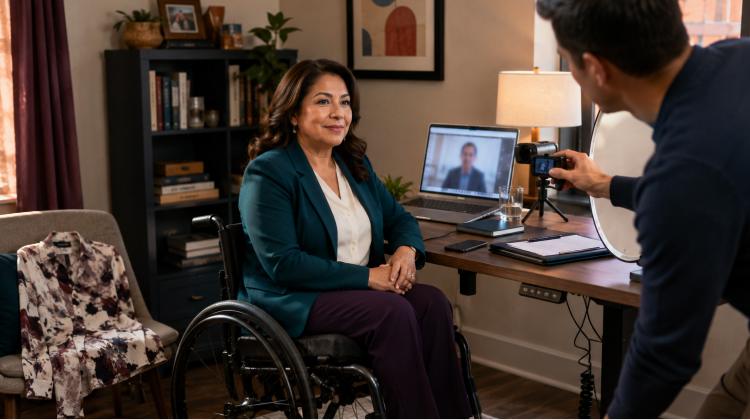
The camera should be at approximately eye level, not looking sharply upward from a desk or downward from a high monitor. UC Davis recommends positioning it about an arm’s length from the face, using clear frontal light, and choosing a plain or neutral background.
Test the complete visual frame in advance. A dark jacket may disappear against a black chair. A white shirt may blend into a pale wall. Reflective jewelry may repeatedly catch a desk lamp. A patterned garment may flicker when the video quality changes.
The interview outfit and the room should work as one image. Clothing, background, camera angle, and lighting all influence whether you appear clear, prepared, and attentive.
Comfort Is Part of Professional Presentation
Interview clothing should support concentration. If an outfit requires continuous adjustment, it competes with the conversation.
Choose waistbands that remain comfortable while seated. Make sure collars do not feel restrictive. Wear shoes that permit natural walking. Avoid fabrics that become excessively warm under studio lights or during a long office tour.
McEwen told the AP that confidence in an outfit can affect the quality of interview answers. Feeling visually out of place may make a candidate second-guess other parts of the interaction.
Comfort does not mean wearing whatever feels most relaxing at home. It means selecting professional clothing that fits the body and the situation without creating a distraction.
This is especially important for candidates who wear adaptive clothing, religious attire, cultural dress, maternity clothing, or garments selected around sensory or mobility needs. Professionalism should not require erasing identity or ignoring physical access.
Texas A&M’s guidance explicitly recognizes that culture, gender, and religious identity can influence professional attire and encourages candidates to include those elements while choosing clothing in which they feel comfortable and confident.
Grooming Should Look Intentional, Not Transformed
Interview grooming is less about meeting a narrow beauty standard than demonstrating care and readiness.
Hair should appear maintained in the way appropriate to its texture and style. Facial hair can be groomed without being removed. Makeup, when worn, should help the candidate feel composed rather than disguise the face. Nails should be clean, and fragrances should be restrained because scent can be distracting or create accessibility problems for others.
Accessories can express personality, but they should not repeatedly make noise, catch on clothing, or require adjustment. A bag should hold documents, identification, and essential items without becoming difficult to manage.
Visible tattoos, piercings, natural hairstyles, religious garments, and culturally specific presentation are treated differently across organizations and industries. Candidates should research the employer without assuming that conformity is the only route to credibility.
The most persuasive professional image is coherent. Clothing, grooming, posture, and communication should appear to belong to the same person.
What to Do When You Still Cannot Decide
When the company’s culture remains unclear, choose polished business casual unless the industry strongly indicates that a suit is required.
A dependable outfit might include structured trousers or a professional skirt, a clean blouse, collared shirt, or fine knit, an optional blazer, and polished closed-toe shoes or restrained clean footwear appropriate to the role.
Select solid or subtle colors. Steam or iron the clothing. Test it while sitting and walking. Prepare an outer layer in case the office is colder or more formal than expected.
For law, traditional finance, executive leadership, formal consulting, and conservative client-facing work, move toward a suit. For creative, technology, media, and informal internal roles, retain one structured piece while allowing the rest of the outfit to feel contemporary.
Do not reduce the decision to “suit or hoodie.” Modern professional dress occupies a much wider range between those extremes.
The Interview Outfit Should Show Judgment
The best interview clothing does not prove that a candidate is talented, ethical, or capable. It does demonstrate how the candidate interprets context.
Arriving at a hoodie-heavy office in a tailored suit is not necessarily a failure. McEwen still chose clothing that showed preparation. The problem arose because she did not know whether the visual distance between herself and the employees would make her seem overly formal.
The solution is not to lower effort until your outfit matches the most casually dressed person in the building. It is to research the organization, understand the role, and raise its normal clothing standard by one deliberate level.
A strong interview outfit says that you recognize the occasion without pretending to be someone else. It fits properly, feels familiar, photographs cleanly, respects the industry, and leaves the interviewer free to concentrate on your experience.
When the office wears hoodies, you rarely need to wear one to the interview. You need to show that you understand why the office wears them—and that you know how to present a more polished version of yourself within that culture.