

At Buc-ee’s, employee clothing is not merely a workplace preference. It is part of a carefully controlled visual system.
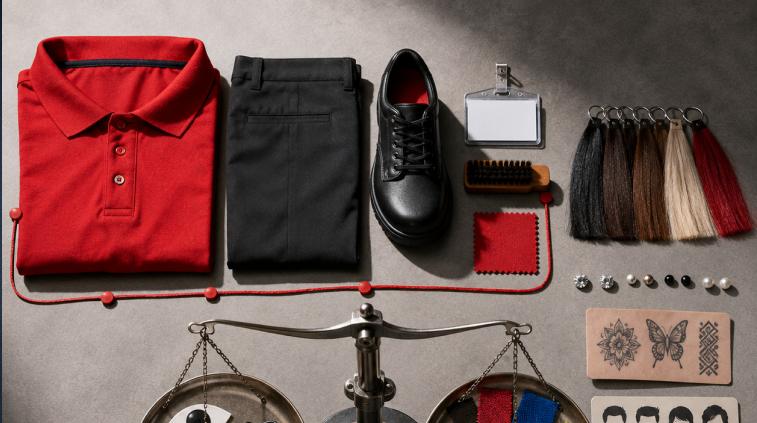
The Texas-based travel-center chain currently instructs store employees to wear tan, khaki, or black pants with a clean, professional, solid-red collared shirt. Red sweaters or coats are permitted during cooler weather. Its published rules also prohibit visible tattoos, body piercings, tongue posts, unnatural hair colors, open-toed shoes, and torn or faded clothing. The requirements are listed directly on the company’s official Buc-ee’s careers page.
Those standards received renewed attention in U.S. coverage in early August 2026, but the timing is particularly interesting because Buc-ee’s is also expanding rapidly. On August 12, 2026, the company plans to open a 74,000-square-foot travel center in San Marcos, Texas, with 128 fueling positions and more than 200 jobs. Buc-ee’s says that opening will bring its U.S. network to 57 stores.
The combination makes the dress-code question larger than whether employees should be allowed to show tattoos or wear brightly colored hair.
Buc-ee’s demonstrates what happens when employee appearance becomes part of corporate image architecture. The red shirt makes staff immediately recognizable inside an enormous store. Repetition creates consistency across locations. Customers encounter a visual language that connects employees, merchandising, bathrooms, food service, signage, and the broader Buc-ee’s brand experience.
But strict appearance controls also raise another question: how much individual expression should workers surrender when their bodies become one of the surfaces on which a company displays its brand?
For businesses thinking about uniforms, corporate fashion, or professional image, Buc-ee’s offers a useful case study in both the power and limits of visual consistency.
The Buc-ee’s Dress Code Is More Specific Than “Look Professional”
Many organizations tell employees to dress professionally and leave the interpretation largely to the individual. Buc-ee’s takes a more standardized approach.
The current company policy specifies three acceptable trouser colors and one employee shirt color: red. The shirt must be solid, collared, clean, and professional. Cooler-weather layers must remain red. The same careers page explicitly lists the appearance elements employees cannot wear while working.
That specificity changes the purpose of the dress code.
A general business-casual policy helps employees determine how formal they should look. A standardized color-and-garment system helps customers identify employees almost instantly.
Imagine entering a 74,000-square-foot travel center during a busy holiday weekend. Hundreds of people may be moving between food counters, refrigerators, restrooms, merchandise displays, checkout lanes, and fueling areas. The ability to find a recognizable red-shirted employee has practical value.
Uniformity can therefore reduce visual uncertainty.
The red shirt operates almost like a moving piece of signage. Wherever an employee walks, part of the visual identity moves with them.
This is important for a brand such as Buc-ee’s because its stores are designed as destinations rather than conventional small convenience stores. The upcoming San Marcos location, for example, will combine 128 fueling positions with an enormous retail floor and food operation. The company says the site will employ more than 200 people.
In that environment, employee visibility is not merely aesthetic.
It can become part of navigation and customer service.
Uniforms Turn Employees Into Recognizable Brand Touchpoints
Corporate image is often discussed in terms of logos, colors, advertising, packaging, and store architecture. Customer-facing employees belong on that list too.
Research on service employee clothing supports the idea that what employees wear can affect how customers interpret a business.
A study by Yao Chin Wang and Chunmin Lang examining service employees in full-service restaurant environments looked at how employee dress influenced employee-customer interaction and the customer-brand relationship. The research focused partly on employee-brand congruence: the degree to which the visual image of an employee seems compatible with the image customers associate with the company. (service employee dress research)
For Buc-ee’s, congruence is unusually easy to see.
The organization repeatedly emphasizes cleanliness, friendly staff, low prices, fresh food, and a highly controlled customer experience. Its careers page literally opens by saying the stores should be clean and staff should be friendly.
The employee uniform visually reinforces that system.
A clean red polo paired with neutral trousers is simple, visible, repeatable, and difficult to confuse with ordinary customer clothing.
That is a different objective from fashionable corporate dress.
The uniform does not appear designed to make each employee look distinctive. Its purpose is almost the reverse: it makes the employee visually understandable as part of the organization.
| Appearance Element | Possible Brand Function | Important Limitation |
|---|---|---|
| Solid-red collared shirt | Immediate employee recognition | Leaves little freedom in daily clothing choice |
| Tan, khaki, or black trousers | Creates a consistent visual base | Defines professionalism narrowly through approved garments |
| Clean, maintained clothing | Reinforces the brand’s cleanliness message | Garment condition still depends on working conditions and support |
| No open-toed shoes | Creates a uniform retail appearance and may suit active work | Practical footwear needs can vary by employee |
| Restrictions on tattoos, piercings, and hair color | Produces a more standardized employee image | Personal expression may be affected even when it does not alter job performance |
The important distinction is that a coherent brand objective does not automatically make every appearance restriction necessary.
A company can have a legitimate reason to want employees easily recognizable without every aspect of individual appearance needing to become standardized.
Why Red Works So Well in a Huge Retail Environment
Buc-ee’s choice of a solid-red employee shirt illustrates one of the simplest principles of visual branding: consistency makes identification easier.
Color can connect objects that otherwise have little in common.
A cashier standing at a register, an employee stocking a shelf, and a food-service worker answering a question perform different tasks. Dress them in the same dominant color and customers can process them as members of the same organization before reading a badge or asking a question.
That efficiency becomes more important as stores become larger.
Buc-ee’s announced on July 29 that its San Marcos location would open August 12 at 3245 N. IH 35. The store will span 74,000 square feet. Once it opens, the company says it will have 57 U.S. stores, including 36 in Texas and locations across 12 other states. (San Marcos opening announcement)
A standardized uniform helps the same customer-service model travel with that expansion.
Someone familiar with Buc-ee’s in Texas can walk into a newer location in Arizona, Ohio, or Virginia and encounter a visually recognizable employee system.
That is the advantage of disciplined brand imagery: customers do not need to relearn the environment completely at each location.
The same principle applies to smaller businesses.
A coffee shop does not need identical uniforms to create visual continuity. It might use aprons in one signature color. A design studio could use consistent staff badges at public events. A hotel might standardize silhouettes while allowing employees to choose among several approved pieces.
The goal is recognition without unnecessary complication.
Employee Appearance Can Make Service More Closely Associated With the Company
Uniforms create one potential disadvantage that receives less attention: when employees look unmistakably connected to an organization, customers may attribute their behavior more strongly to the organization.
Research published in the Journal of Applied Social Psychology examined how uniforms influence judgments about organizations. One finding was particularly relevant for visual branding: organizational attire can strengthen the mental connection between an individual employee and the company.

That connection is beneficial when the service is excellent. It can be damaging when the service is poor. (uniformity and organizational judgments)
This creates an important lesson for corporate-image strategy.
A recognizable uniform is not a substitute for customer service.
It is an amplifier.
When a clearly uniformed employee is attentive, knowledgeable, and efficient, those qualities can reinforce the brand. When that same employee behaves dismissively, the customer may not simply think, “That person was rude.” The visual connection can make the experience feel like evidence about the company itself.
Buc-ee’s appears to understand this relationship at the operational level. Its careers page places friendliness alongside cleanliness as a central company belief, while the company’s San Marcos announcement describes friendly service as part of the experience it wants to deliver.
The uniform makes the promise visible.
Employee behavior has to make it credible.
Corporate Fashion Works Best When It Supports the Service
A corporate dress system should begin with a functional question: what does the customer need to understand when looking at an employee?
In a huge travel center, recognition is valuable. In a hospital, role identification and hygiene may dominate. In a luxury hotel, the clothing may communicate formality and hospitality. In a technology company with almost no public-facing employees, strict visual uniformity might accomplish very little.
This is where companies sometimes confuse branding with control.
A uniform requirement can have a clear customer-facing purpose. Restrictions unrelated to recognition, safety, hygiene, or job performance require a more careful argument.
Buc-ee’s, for example, does not merely specify red shirts and appropriate pants. It also restricts visible tattoos, piercings, tongue posts, and unnatural hair colors.
Those choices create a more homogeneous employee appearance, but they are not necessary for recognizing who works in the store. A person with blue hair can still wear a red polo. An employee with a visible tattoo can still be immediately identifiable as staff.
That does not mean a company cannot establish grooming policies. It means businesses should distinguish between the visual elements that perform a direct branding function and those that mainly enforce a particular conception of professional appearance.
The difference matters as workplace norms continue to evolve.
Professionalism Is Not the Same as Visual Sameness
Buc-ee’s language describes the required shirt as “clean” and “professional.” Those two ideas deserve to be separated from personal traits such as tattoos or hair color.
Cleanliness can be observed through garment condition. Professional behavior can be evaluated through attendance, communication, competence, service, reliability, safety, and performance.
Visual conformity is something different.
A uniform can make a team appear coordinated without proving that the team performs well. An unconventional hairstyle does not establish poor performance any more than a tucked red polo establishes excellent performance.
Modern corporate-image planning is strongest when it understands that distinction.
Businesses still need standards. Customer-facing organizations particularly need employees who are identifiable, presentable, and appropriately equipped for the work.
The challenge is establishing the narrowest visual standard that accomplishes the business objective.
For Buc-ee’s, requiring red collared shirts provides an obvious recognition system. Neutral trousers support it. Clean clothing aligns directly with a brand famous for emphasizing cleanliness.
Rules about personal expression occupy a more debatable category because they go beyond creating that visual identification.
Dress Codes Also Have Legal Boundaries
Employers establishing strict grooming standards must also account for federal employment law.
The U.S. Equal Employment Opportunity Commission explains that Title VII of the Civil Rights Act requires employers to provide reasonable accommodations when a sincerely held religious belief, practice, or observance conflicts with a workplace requirement, unless providing the accommodation would create an undue hardship.
The EEOC specifically identifies exceptions to dress and grooming policies as a possible religious accommodation.
That could include circumstances involving religious garments, head coverings, hair practices, facial hair, or other forms of appearance.
The EEOC has also cautioned that a company cannot rely simply on customer preference or a vague desired “image” when refusing a legally required religious accommodation.
This does not establish that Buc-ee’s published dress code is unlawful. The public careers page lists general rules and does not describe every possible accommodation or individual employment circumstance.
It does show why companies should avoid treating visual branding as absolute.
Brand standards operate within employment law, accommodation requirements, workplace safety, and the realities of individual employees.
A strong corporate image policy anticipates those boundaries rather than assuming uniformity is the highest objective.
Buc-ee’s Is Selling a Complete Visual Experience
The employee dress code becomes more understandable when viewed alongside Buc-ee’s wider branding.
Founder and CEO Arch “Beaver” Aplin III has described the company’s beaver logo as deliberately approachable and playful while emphasizing that the operation, product quality, location development, and customer experience are taken seriously. Texas A&M University profiled that approach while describing Buc-ee’s growth from its 1982 origins in Lake Jackson, Texas.
That contrast is central to the brand.
The mascot is playful. The operating system is tightly controlled.
Store scale, product displays, food presentation, restrooms, merchandise, signage, and employees all contribute to the same customer impression.
Buc-ee’s careers page reinforces this operational discipline through detailed policies, weekly pay, defined career paths, and published compensation ranges. As of August 2026, it lists associate pay at $20–$25 per hour, team-lead pay at $23–$28, department-manager pay at $33 per hour, assistant general manager compensation starting above $125,000, and general manager compensation ranging from $200,000 to $275,000 or more. The company also lists medical, dental, and vision insurance, a 401(k) match of up to 6%, and paid time off.
The appearance rules therefore sit inside a larger employment and operational structure rather than existing as an isolated fashion policy.
That context is important when assessing corporate uniforms fairly.
A Strict Image Can Strengthen a Brand and Narrow Its Talent Pool
Companies should also consider what dress standards communicate to prospective employees.
A candidate reading Buc-ee’s careers page knows exactly what the customer-facing appearance will require before applying. There is value in that clarity.
Someone comfortable with the policy can make an informed choice. Someone strongly committed to visible tattoos, facial piercings, or unconventional hair colors may decide the workplace is not compatible with their preferred self-presentation.
From the employer’s perspective, that creates consistency.
It can also narrow the potential workforce.
The tradeoff becomes especially important during rapid expansion. Buc-ee’s says its San Marcos store alone will create more than 200 jobs, and its careers page notes that frontline positions for new stores are generally posted 90 days before opening.
As companies scale, every additional restriction potentially affects a larger recruiting population.
Brand managers therefore have to ask whether each visual standard creates enough customer or operational value to justify that cost.
There is no universal answer.
The important point is that appearance policy is not free. It shapes employer image as well as consumer image.
The Best Corporate Uniforms Make Employees Easy to Identify
For businesses studying Buc-ee’s, the most transferable lesson is probably not its restrictions on tattoos or hair color.
It is the clarity of its core uniform.
Red shirt. Neutral pants. Clean appearance. Immediate recognition.
That formula is visually simple enough to reproduce across dozens of locations and hundreds of employees while remaining obvious to customers.
Other organizations can apply the same logic without copying the style itself.
A business might use one recognizable jacket color, apron, shirt silhouette, name badge, or accessory. The exact garment matters less than consistency and functional visibility.
Uniform design should also account for movement, climate, body diversity, accessibility, durability, washing requirements, and the actual tasks employees perform. Corporate fashion that looks polished in promotional photography but becomes uncomfortable during an eight-hour shift is poorly designed.
The best image system works from both sides of the counter.
Customers can identify the employee.
Employees can perform comfortably.
The company remains recognizable without requiring every person to look interchangeable.
What Buc-ee’s Reveals About Corporate Brand Image
Buc-ee’s demonstrates how thoroughly a company can integrate employee appearance into its customer experience.
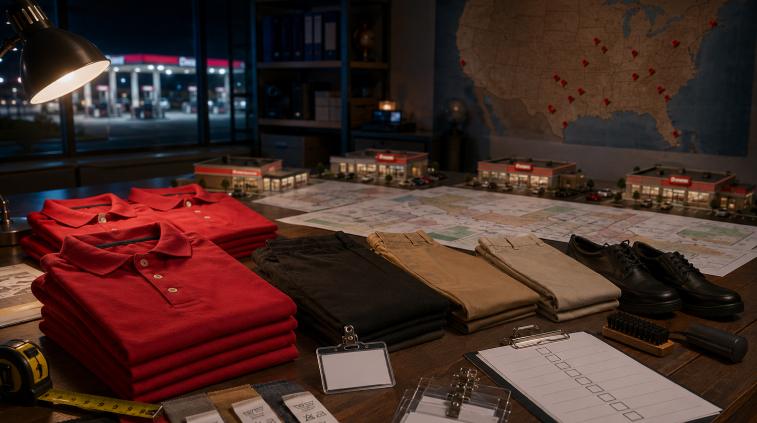
Its solid-red shirts create recognition. Neutral trousers reduce visual variation. Clean clothing supports its stated emphasis on spotless stores. As its footprint expands—with the San Marcos opening scheduled for August 12, 2026, bringing the company to 57 locations—the ability to reproduce that image from one state to another becomes increasingly valuable.
The stricter grooming rules reveal the more complicated side of the strategy.
A company can use clothing to create visual trust without proving that every form of personal expression undermines that trust. Tattoos, piercings, hair color, religious practices, accessibility needs, and cultural expression require more nuanced consideration than shirt color.
For brand managers, the useful question is therefore not simply, “How do we make every employee look consistent?”
It is: Which parts of employee appearance genuinely help customers recognize and trust the brand, and which parts are being controlled mainly because the company has always imagined professionalism that way?
Buc-ee’s makes the power of visual consistency unusually easy to see. Its red-shirt system shows how a uniform can function almost like a living brand asset. (Dressing to Impress)
It also demonstrates why corporate image works best when consistency has a clear purpose.
The strongest brand is not necessarily the one that controls the most details. It is the one that knows exactly which visual details matter.