
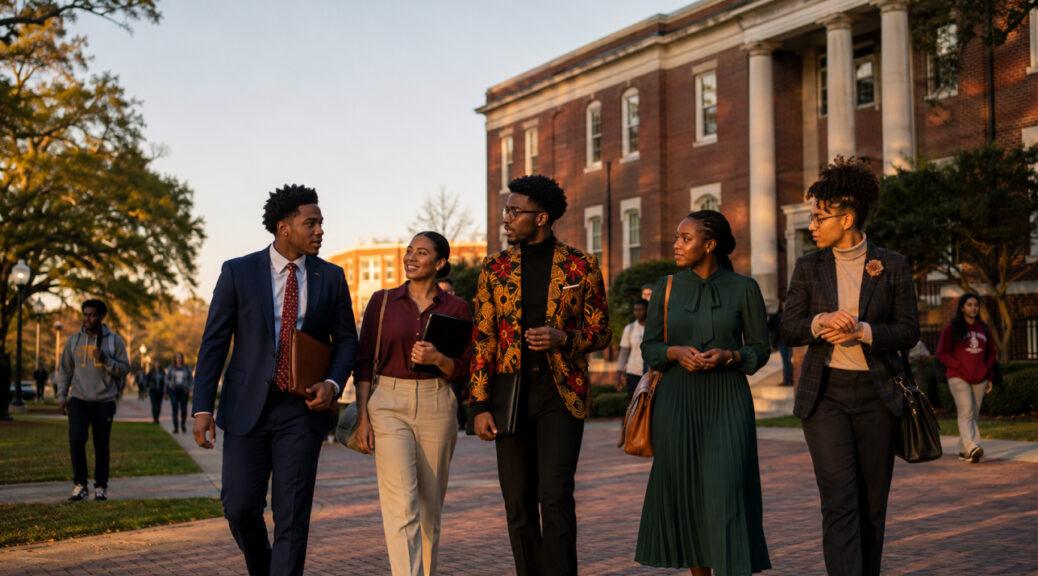
Initially, Tuskegee University’s Fall 2026 attire debate focused on campus conduct and workforce preparation.
However, the discussion broadened into concerns about professional image. It also raised questions of cultural expression, economic access, and who defines dressing to impress.
On July 23, 2026, HBCU Gameday reported that Tuskegee University President Dr. Mark A. Brown had outlined updated expectations in a message to parents of incoming students. The reported guidance asked students to arrive prepared for professional occasions with a business suit and appropriate shoes. It also prohibited revealing clothing in classrooms, dining spaces, and official settings, while barring bedroom shoes, bonnets, and durags from classrooms and the cafeteria. Faculty members would be authorized to address clothing considered inconsistent with the guidelines. (HBCU Gameday)
The controversy intensified when some national headlines characterized the policy as a requirement for students to wear business suits every day. Tuskegee’s publicly available Fall 2026 orientation guidance is more specific. It tells students to bring business attire for career fairs, meetings, interviews, and the Rites of Passage ceremony. It also requires black-and-white business attire for that ceremony on August 16. The university’s New Student Orientation runs from August 11 through August 17 in Tuskegee, Alabama. (Tuskegee University orientation guidance)
That distinction matters. Preparing students to own appropriate clothing for interviews and formal events is not the same as requiring a suit in every classroom. Yet the debate remains important because the restrictions extend beyond formal occasions and address what students can wear in everyday academic and dining environments.
For anyone interested in personal image, the Tuskegee discussion offers a more useful lesson than the familiar slogan “dress for success.” Clothing can influence first impressions and help someone feel prepared, but professional presentation works best when it is tied to context, clearly communicated, affordable, and broad enough to respect cultural identity.
The Policy Behind the Headlines
Tuskegee University was founded on July 4, 1881, under the leadership of Booker T. Washington. Its educational mission has long connected academic learning with employment, leadership, technical skill, and service. The university’s current Career Education and Leadership Development Center supports students through career fairs, internships, résumé assistance, interview workshops, and employer seminars. (Tuskegee University Career Center)
Dr. Mark A. Brown, Tuskegee’s tenth president and its first alumnus to serve as president and CEO, has framed his administration around professional preparation and measurable outcomes. Brown began his presidency on July 1, 2024, after a career that included service as a U.S. Air Force major general. (Tuskegee University president profile)
The reported attire message was part of a broader set of expectations covering classroom attendance and cellphone use. Brown described the changes as preparation for the workforce rather than an attempt to prevent students from enjoying college life. HBCU Gameday also reported that Tuskegee expected its largest new-student enrollment in 32 years, giving the policy heightened visibility as a new cohort prepared to arrive on campus.
The official orientation page reinforces the career-readiness component without describing business suits as daily classroom uniforms. Incoming students are told to pack business attire for interviews, meetings, career fairs, and formal university activities, as well as at least two formal outfits.
The most accurate interpretation is therefore more nuanced than either side of the viral debate. Tuskegee is emphasizing professional clothing for specific occasions while also establishing everyday boundaries around attire in classrooms, dining areas, and official settings. The argument is not only about suits. It is about how far an institution should go when teaching students to manage their public image.
Why Clothing Can Affect First Impressions
Clothing communicates before a person begins speaking. It can suggest whether someone recognized the formality of an event, considered the expectations of an audience, or prepared carefully for an important interaction.
That does not mean clothing accurately reveals intelligence, discipline, reliability, or competence. It means observers frequently use appearance as a shortcut when they have limited information.
A 2024 review published in the Journal of Applied Psychology described workplace clothing as a complex social signal influenced by situation, culture, time, and individual interpretation. The researchers identified formality, provocativeness, and fashionability as recurring characteristics that can affect perceived warmth and competence. They also emphasized that clothing-based judgments can contribute to biased evaluations rather than simply reflecting a worker’s actual performance. (workplace clothing review)
Earlier research by Joy V. Peluchette and Katherine Karl found that respondents reported feeling most authoritative, competent, and trustworthy in formal business attire, while casual or business-casual clothing was associated more strongly with friendliness. The study concerned self-perception rather than an objective measure of job performance, but it helps explain why some people feel more focused when they dress deliberately. (workplace attire study)
The practical takeaway is not that a suit makes someone competent. A better interpretation is that clothing can support a mental transition into a particular role. Putting on interview clothing may help a student rehearse professional behavior, just as athletic clothing can signal that it is time to train.
The effect depends heavily on context. A structured suit may appear prepared at a banking interview but unnecessarily formal at a small design studio. A creative outfit may communicate confidence in fashion, media, or advertising while appearing distracting in a conservative legal setting. Dressing to impress is therefore less about maximizing formality than correctly reading the room.
What “Professional” Actually Means Changes by Setting
One weakness in broad dress-code debates is the assumption that every workplace expects the same visual identity. Professional clothing varies across industries, regions, organizations, job levels, and daily responsibilities.
A nursing student may need clean clinical attire and secure footwear. An engineering intern visiting a manufacturing floor may need protective equipment rather than a jacket and tie. A photographer meeting an art director may need clothing that is polished but still practical enough to handle equipment. A student attending a traditional corporate career fair may benefit from a conservative suit.
The most useful question is not “Does this look formal?” It is “Does this look intentional and appropriate for the work, audience, and setting?”
| Setting | Useful Visual Goal | Typical Approach |
|---|---|---|
| Career fair | Prepared and approachable | Suit, coordinated separates, or polished business attire |
| Job interview | Credible and attentive to industry norms | One level more formal than ordinary workplace clothing |
| Classroom presentation | Organized and audience-aware | Business casual or field-appropriate attire |
| Creative portfolio review | Distinctive but controlled | Personal style with clean fit and one clear focal point |
| Laboratory or technical site | Safe and functional | Required protective clothing and practical footwear |
| Formal university ceremony | Respectful of institutional tradition | Specified colors, formal clothing, and appropriate shoes |
A 2026 study in BMC Psychology examined 303 students in professional programs and identified substantial differences in how they perceived dress-code flexibility, professional preparedness, and sector-specific attire. The authors warned that the findings were cross-sectional and based on perception rather than proof of causation. Their broader point was still relevant: students respond more positively when professional clothing is connected to recognizable industry expectations rather than imposed as an unexplained symbol of compliance. (higher-education dress-code study)
Tuskegee’s official orientation instructions are strongest where they provide that context. Career fairs, interviews, meetings, and Rites of Passage are situations with understandable expectations. The more controversial parts are the restrictions affecting ordinary classrooms and dining spaces, where the relationship between a specific garment and educational performance is less direct.
Why Bonnets and Durags Changed the Conversation
The restrictions involving bonnets and durags made the Tuskegee debate culturally specific. These items cannot be discussed as though they are visually identical to bedroom slippers or any other casual garment.
Bonnets and durags have practical functions in Black hair care. They can protect hairstyles, preserve moisture, maintain waves, and reduce friction. They also carry cultural meanings shaped by race, gender, style, public visibility, and generations of judgment about Black appearance.
A policy can describe certain items as inappropriate for a classroom while still producing a larger message about whose grooming practices are considered acceptable in public. That is why critics framed the issue as respectability politics: the expectation that Black people must modify culturally recognizable forms of presentation to receive institutional or professional acceptance.
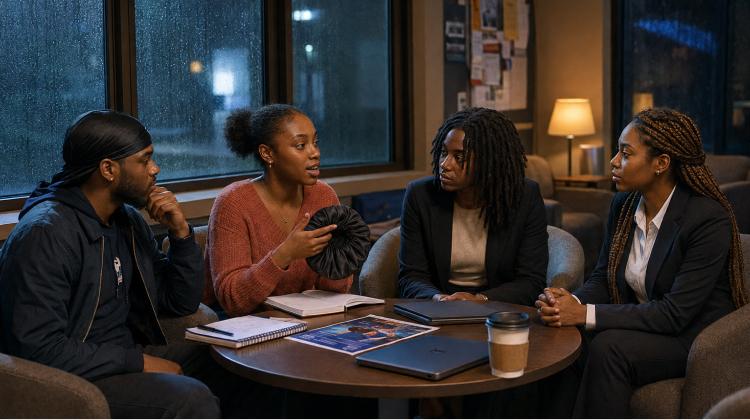
Supporters of Tuskegee’s rules argue that classrooms and dining facilities are public environments and that students should distinguish between clothing intended for private grooming and clothing selected for academic participation. Some alumni have also described formal presentation as part of Tuskegee’s established campus culture rather than a sudden rejection of student identity.
Both positions contain a real concern. Institutions can teach students how appearance is interpreted in workplaces, but they can also reinforce biased standards if professionalism is treated as a narrow visual code with no room for cultural difference.
The 2024 workplace-clothing review noted that attire tied to religion, uniforms, culture, and group identity requires different analysis from ordinary choices about formality or fashionability. Professional standards are not interpreted in a social vacuum.
A productive dress policy should therefore explain its purpose, define its settings precisely, provide cultural and religious accommodations, and avoid language that assumes one group’s habits are naturally more professional than another’s.
Dressing to Impress Should Not Mean Dressing Expensively
A requirement to own suits, formal wear, and appropriate shoes carries a financial cost. That cost matters for students already managing tuition, housing, books, transportation, food, and technology.
Professional image advice often focuses on what to buy rather than how to use a small wardrobe effectively. In practice, fit, condition, coordination, and context usually matter more than labels.
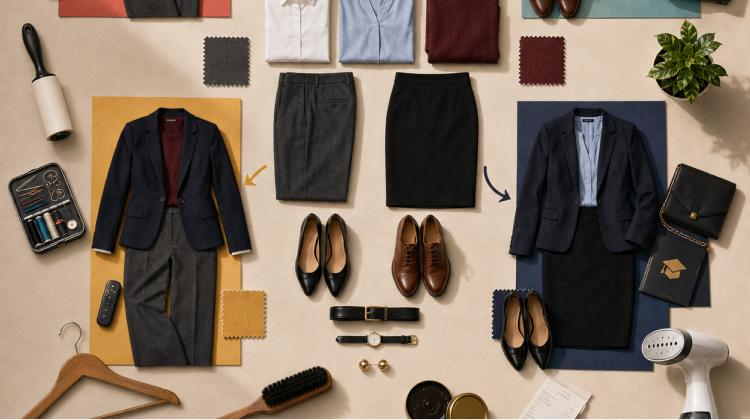
A student does not need a closet full of expensive clothing. One dark suit or coordinated jacket-and-trouser combination can cover interviews, career fairs, ceremonies, professional photographs, and formal meetings. Two shirts or blouses, one pair of polished shoes, and a few restrained accessories can create several distinct combinations.
The garment should fit through the shoulders, close without pulling, allow comfortable movement, and sit at an appropriate length. Clothing that is visibly too tight, excessively loose, wrinkled, stained, or damaged may attract more attention than an inexpensive but properly maintained outfit.
Color also changes the impression. Navy, charcoal, deep brown, and other dark neutrals are versatile because they photograph cleanly, combine easily, and work across many formal settings. Softer colors can make an outfit more approachable, while one brighter accent can communicate personality without dominating the presentation.
Shoes should be clean, stable, and suited to the amount of walking or standing required. A student attending a multi-hour career fair may appear more confident in comfortable polished flats or low-heeled shoes than in footwear that makes movement difficult.
Universities that require professional clothing can make those expectations more equitable through clothing closets, tailoring support, alumni donations, emergency grants, and workshops that teach garment care. A rule is easier to internalize when students are given the resources to meet it.
The Best Professional Image Is Deliberate, Not Generic
The phrase “dress to impress” can encourage people to focus too heavily on approval. A more useful goal is to dress with a clear intention.
Someone preparing for an interview might want to appear dependable, attentive, and ready to work. A creative professional may want to communicate originality and visual judgment. A student representative may need to appear approachable while still respecting a formal ceremony.
Those goals can be expressed through fit, proportion, color, grooming, posture, and consistency.
A carefully fitted shirt with clean trousers may look more professional than an oversized suit worn only because it is technically formal. A well-maintained natural hairstyle can appear more intentional than a rushed style chosen to conform. A modest, coordinated outfit can project greater confidence than an expensive ensemble the wearer does not feel comfortable inhabiting.
Professional presentation also extends beyond clothing. Arriving on time, silencing a phone, listening carefully, preparing questions, maintaining documents, and following through after a meeting usually create a stronger impression than any jacket or pair of shoes.
Tuskegee’s policy announcement placed dress alongside attendance and classroom cellphone restrictions. That combination reveals the university’s broader argument: professionalism is a pattern of preparation, presence, and behavior, not a fashion category alone.
The clothing component is useful when it helps students practice that broader pattern. It becomes less useful when appearance is treated as proof of character.
Professional Clothing Must Work in Photographs Too
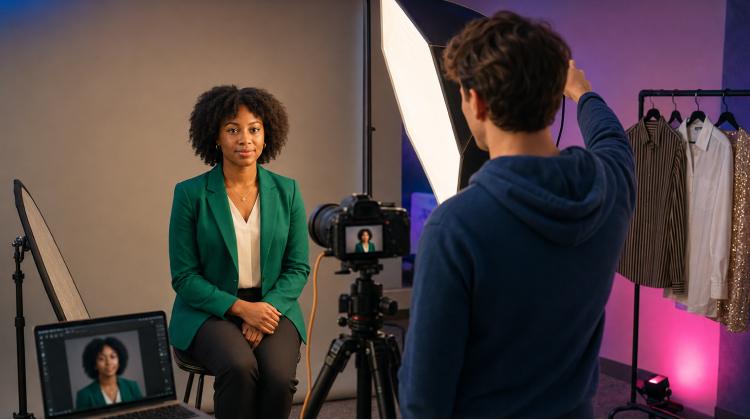
Students increasingly encounter employers through profile photographs, virtual interviews, internship portals, portfolio sites, and recorded introductions before meeting anyone in person. The outfit must therefore work both in a room and through a camera. (Real Entrepreneur Headshot Transformations That Revolutionized Their Business)
Small patterns can create distracting visual effects on video. Bright white clothing may lose detail under strong lighting, while very dark clothing can blend into a poorly lit background. Reflective jewelry can catch light, and oversized accessories can compete with the face.
For a professional headshot or virtual interview, medium and dark solid colors usually create reliable separation from neutral backgrounds. The neckline should sit neatly, the collar should remain symmetrical, and the visible portion of a jacket should lie flat. The camera should be positioned at eye level, with soft light directed toward the face.
The aim is not to erase personality. A textured fabric, distinctive color, cultural accessory, or carefully chosen piece of jewelry can make an image memorable. The strongest presentation keeps the face and communication central while allowing style to support the message.
This is another reason a single universal dress code is limited. Clothing that works in an in-person laboratory may not work in a televised presentation. Clothing suitable for a creative portfolio portrait may not be appropriate around machinery. Professional image is situational.
What Universities Can Learn From the Debate
Tuskegee’s career-centered reasoning fits the institution’s long-standing emphasis on connecting education with employment and leadership. The debate shows, however, that professional-development goals require more than a list of permitted and prohibited garments.
Students need clear definitions of where rules apply. They need to know whether business attire is expected every day, only for formal meetings, or for specific academic programs. Ambiguous language allows social media headlines to replace the institution’s own explanation.
They also need a reason for each standard. A ban on unsafe footwear in a laboratory is easy to connect with risk. A requirement for formal attire at a ceremony is tied to the character of the event. Rules affecting cultural grooming items require a more careful justification because they carry meanings beyond casualness.
The 2026 BMC Psychology study found that student perceptions varied substantially and suggested that clarity, flexibility, mentoring, and sector-specific guidance may help students connect dress expectations with professional development. It did not establish that dress codes cause readiness, and its authors explicitly cautioned against that interpretation.
A stronger institutional approach would combine practical workshops, mock interviews, photographs of several acceptable outfit styles, cultural consultation, financial assistance, and direct student feedback. That teaches judgment rather than simple obedience.
The Better Lesson Is Context, Not Conformity
Tuskegee University’s attire debate demonstrates why appearance still matters and why it cannot be separated from culture, money, identity, and power.
Students benefit from knowing how to dress for an interview, career fair, presentation, ceremony, and professional photograph. They should understand that clothing can affect first impressions and their own sense of preparedness. They should also know that every industry has different expectations and that formal clothing does not create competence on its own.
The useful form of “dressing to impress” is not copying one approved image of success. It is learning to identify the audience, understand the setting, choose clothing intentionally, maintain it well, and present yourself without losing the qualities that make you recognizable.
Tuskegee’s Fall 2026 guidance will continue to draw attention as students arrive for orientation from August 11 through August 17. Its lasting value may depend less on whether students own a business suit than on whether the university can turn a contested appearance policy into clear, inclusive, and practical education about professional life.