
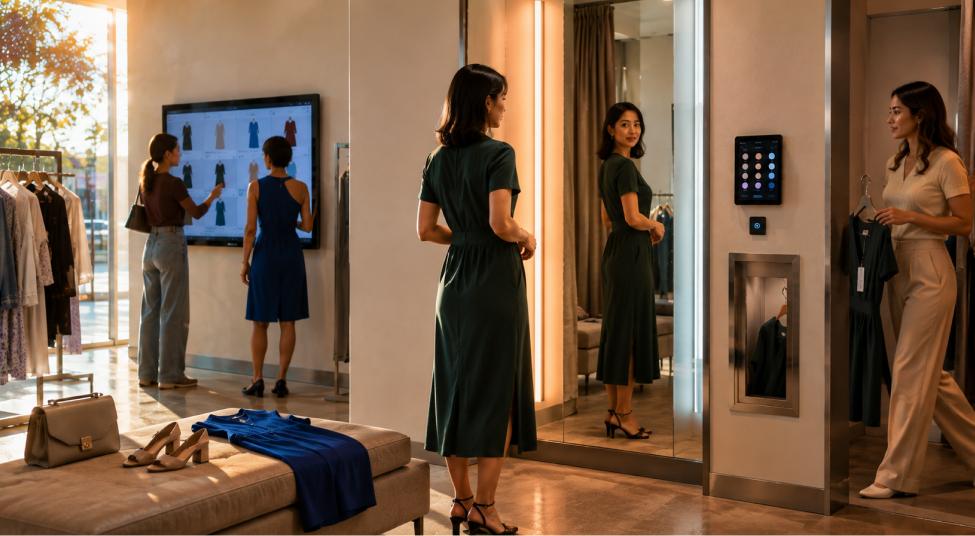
The fitting room has always been where fashion meets reality. A dress can look perfect on a model, appealing on a hanger, and completely different once it is on your body under fluorescent lights.
Reformation has spent nearly a decade trying to redesign that moment.
The Los Angeles-founded womenswear company launched its Retail X concept in 2017, combining digital product selection with what Reformation describes as “magic wardrobes” and customizable dressing-room lighting. By the first quarter of 2026, Retail X operated in 49 stores, representing about 75% of the company’s retail locations at the time. (Reformation timeline)
The system has become more relevant since Reformation entered the public markets. The company priced its initial public offering at $15 per share on July 29, 2026, and began trading on the New York Stock Exchange under the ticker REF on July 30. Reformation offered 14,062,500 shares in the IPO, which raised about $210.9 million in total proceeds for Reformation and selling stockholders and initially valued the company at roughly $886 million.
Behind those financial numbers is an interesting claim about how people shop for clothes. Reformation told investors that its Retail X stores generated approximately 8.5% higher average order value and 270 basis points higher conversion in 2025 than its traditional stores.
That does not prove smart dressing rooms make customers look better. It does show that changing the environment in which people evaluate clothing can change what they buy.
For shoppers, the more useful question is what Reformation’s experiment reveals about finding clothing that actually flatters you.
How Reformation’s Smart Dressing Rooms Work
Reformation describes Retail X as an attempt to bring the convenience of online shopping into a physical store.
Instead of searching through densely packed racks for every available size and color, shoppers can use digital screens or mobile devices to select pieces and build a dressing room much like they would build an online shopping cart. The selected garments are then prepared for try-on. Reformation’s dressing-room concept also includes customizable lighting and its so-called magic wardrobes, allowing additional items to be delivered to the fitting-room area without requiring the shopper to get completely dressed and return to the sales floor. (Reformation Retail X history)
The concept dates to December 2017, but it is now a major part of the company’s business rather than a novelty experiment.
As of June 22, 2026, Reformation reported 70 stores across four countries. The company generated $507.1 million in net revenue during 2025, while first-quarter 2026 revenue reached $112.3 million, up 30.4% from $86.1 million during the comparable quarter of 2025.
Retail X matters because fitting rooms sit at the exact point where customers answer a difficult question: Does this garment actually work for me?
Technology can remove some of the distractions surrounding that decision.
Instead of wondering whether another size exists somewhere on the sales floor, shoppers can request it. Instead of judging one dress under one fixed light source, they can alter the lighting. Instead of carrying 12 garments around the store, they can build a more controlled selection.
Those conveniences can make shopping easier.
They can also make it easier to evaluate the clothes themselves.
Lighting Changes How Clothes Look More Than Most Shoppers Realize
One of the most interesting elements of Reformation’s fitting rooms is not the touchscreen.
It is the lighting.
Reformation specifically promotes customizable lighting as part of Retail X. That makes sense because the lighting surrounding a fitting-room mirror can influence how people perceive color, texture, contrast, and even their own complexion.
Retail research has long established that illumination affects how customers experience merchandise and commercial environments. Studies of fitting rooms have also identified inadequate lighting as one of the recurring complaints shoppers have about changing-room design.
That does not mean there is one magical light setting that makes everyone more attractive.

Quite the opposite.
A garment that looks beautiful under extremely warm, flattering illumination may appear very different outside at noon. A cool light can change the apparent relationship between a shirt and skin tone. Strong overhead lighting may create facial and body shadows that do not exist in ordinary environments.
The smartest way to use adjustable fitting-room lighting is therefore not to find the setting that makes you look best.
It is to test the garment under multiple conditions.
If a fitting room offers warm, cool, and neutral settings, examine the clothing under all three. Pay attention to whether the color still works, whether the fabric becomes transparent, whether the texture changes visually, and whether details such as seams or wrinkles become more obvious.
Then, whenever possible, check the garment in another part of the store with different lighting.
Clothing does not live inside fitting rooms.
A Better Mirror Cannot Fix the Wrong Size
Smart retail technology can simplify shopping, but fit remains physical.
The most flattering garment is usually not the one with the most fashionable label or the smallest size number. It is the one whose proportions correspond most effectively with your body and the look you are trying to create.
That means evaluating more than whether a zipper closes.
Check the shoulders first on structured garments. A jacket whose shoulder seam sits significantly beyond or inside your natural shoulder line may never hang correctly, even if the waist fits.
Look for unwanted pulling across the chest, hips, buttons, or pockets. Horizontal tension lines can indicate that the garment needs more room in that area.
Then look for the opposite problem: excess fabric. Large folds beneath the arms, sagging waistbands, collapsing shoulder lines, and unnecessary volume through the back can make clothing appear less intentional.
Reformation’s digital fitting-room system is useful here because requesting another size does not require restarting the entire shopping process. Removing that inconvenience encourages a comparison between sizes rather than treating the first wearable option as the final answer. The company’s SEC filing says Retail X generates product-level and fitting-room conversion data in addition to its higher average order value and store conversion.
For shoppers, the lesson is straightforward: try the adjacent size even when the first one technically fits.
Sizing labels are inconsistent across brands, categories, and garments. The visual result matters more than the number sewn inside the waistband.
Photograph the Outfit Instead of Trusting One Mirror Angle
A fitting-room mirror gives one perspective. Other people will see the outfit from many.
Taking a simple photograph can therefore reveal things a mirror does not.
Stand several feet from the phone rather than holding it close to the body. A close, wide-angle selfie can distort proportions by enlarging whatever is nearest the lens.
Photograph the outfit from the front, side, and back. If someone is shopping with you, ask them to take the pictures from roughly waist or chest height rather than from an extreme high or low angle.
The goal is not to produce a social-media image.
It is to evaluate the clothing.
Check whether trouser legs fall cleanly. Look at the back of the jacket. See whether the waistline sits where you thought it did. Examine the proportion between the top and bottom halves of the outfit.
A photograph can also make color relationships easier to notice. A jacket that appears neutral in the mirror may dominate the entire outfit once seen in a smaller frame.
This approach is particularly useful when deciding whether a garment photographs well for professional headshots, weddings, conferences, dates, presentations, or other situations where images will become part of the experience.
The camera should be treated as an additional viewpoint, not as a judge of your body.
Move Before Deciding That an Outfit Looks Good
Many garments look excellent while the wearer stands motionless in front of a mirror.
That is a very low standard.
Sit down.
Walk across the fitting area.
Raise your arms.
Reach forward.
Cross your legs.
Put your phone in the pocket if the garment has one.
Pretend to pick something up from the floor.
The purpose is to see what happens when clothing is used as clothing.
A skirt that looks elegant while standing may ride upward when seated. Trousers may pull sharply across the hips. A blazer may become restrictive when the arms move forward. A neckline may shift dramatically when bending.

Comfort also affects appearance.
People tend to adjust clothing that feels unstable, restrictive, or exposed. Constantly tugging a hem, repositioning a neckline, or pulling at a waistband can make an otherwise polished outfit feel less confident.
Recent body-image research examining athletic clothing has specifically looked at relationships between clothing comfort, appearance-monitoring behavior such as mirror checking and garment adjustment, and task concentration. The findings reinforce the broader point that clothing is experienced through movement and attention, not merely through a static reflection.
A fitting room should therefore function as a small movement test, not a photo booth.
Compare the Garment With Your Actual Wardrobe
Smart dressing rooms are designed to make it easier to add more products.
That does not necessarily mean you need more products.
Before buying something because it looks good in isolation, mentally place it beside the clothing you already own.
Can the trousers work with three tops at home?
Do you already own shoes appropriate for the hem length?
Does the jacket fit over the sweaters you actually wear?
Would the dress require a bra, shapewear, jacket, or shoe style you do not currently own?
Reformation’s Retail X performance illustrates why retailers value frictionless fitting rooms. In 2025, Retail X locations produced an average order value about 8.5% higher than non-Retail X stores. For the retailer, that is a positive business result.
For the shopper, it is also a reminder to maintain a separate objective.
The store wants to make purchasing easier.
You want to make choosing well easier.
Those goals can overlap, but they are not identical.
A flattering garment that works with five things you already own may improve your wardrobe more than three individually attractive pieces that require entirely new outfits.

Hemming Can Matter More Than Changing Sizes
Sometimes the right garment is already in the fitting room but needs a small alteration.
Trouser length is one of the clearest examples.
A well-cut pair of pants can look sloppy if several inches of fabric collapse around the shoe. The same trousers can appear dramatically cleaner after hemming.
Sleeves can create a similar effect. A jacket or blouse may fit through the body but look oversized because the sleeves extend too far over the hands.
Reformation currently offers hemming through its U.S. stores, excluding pop-ups and outlets, for members of its Friends with Benefits loyalty program. Eligible adjustments include garment length, sleeve hemming, and strap adjustments. (Reformation hemming information)
The existence of that service highlights something technology cannot solve.
No touchscreen can determine whether you personally prefer trousers with a full break, slight break, cropped ankle, or floor-skimming silhouette.
Those are aesthetic decisions involving shoes, body proportions, styling, and personal taste.
A fitting room can help you reach the decision faster.
Tailoring may still create the final result.
Smart Fitting Rooms Can Improve the Experience Without Knowing Your Body Better Than You Do
The broader smart-fitting-room industry often promotes personalization, recommendations, augmented reality, sensors, and artificial intelligence.
A 2024 study in Procedia Computer Science used a conjoint experiment with 122 participants to examine smart fitting-room features. Personalized recommendations, offers, sustainability information, useful visualizations, and a comfortable environment contributed to the customer experience, although the researchers also noted that smart fitting rooms can make shopping less social.
That tradeoff is important.
A digital system can quickly show another color.
A knowledgeable friend may tell you that the color you originally chose looks more like you.
A touchscreen can recommend a complementary skirt.
A stylist may notice that the jacket would work better with trousers you already own.
Technology is good at removing friction and organizing options. Personal judgment remains necessary because flattering clothing is contextual.
It depends on where you are going, how you want to present yourself, how the garment moves, what you already own, and whether you actually enjoy wearing it.
“Looking Better” Should Mean Improving the Garment Decision
There is an unhealthy version of fitting-room advice that assumes the objective is to make the body look smaller, taller, younger, or closer to one predetermined silhouette.
Reformation’s smart-store model points toward a more practical interpretation.
The dressing room can be improved instead.
Better lighting can reveal color more accurately.
More accessible size requests can help shoppers compare fit.
Multiple mirrors and photographs can reveal different angles.
Movement can expose practical problems.
Alterations can correct proportions.
Existing wardrobe pieces can determine whether a purchase is useful.
Under that model, the problem is not automatically the person standing in front of the mirror.
Sometimes the garment simply does not work.
That distinction matters because shopping for clothing has long been connected with appearance management and body satisfaction. Research published in Body Image has found that clothing plays a meaningful role in how people manage and experience appearance across age groups.
A productive fitting-room mindset therefore asks, “Does this clothing serve me?” rather than “How do I make myself serve this clothing?”
Reformation’s Retail X Numbers Reveal What Retailers Already Understand
Reformation’s IPO has turned its smart dressing rooms from an interesting store feature into a measurable business asset.
The company reported more than one million active direct-to-consumer customers in 2025 and approximately 1.14 million active customers by March 28, 2026. Customers who used both e-commerce and physical retail generated 3.1 times more net revenue per customer in 2025 than customers who used only one channel.
Reformation also reported that 90% of its 2025 net revenue came directly through e-commerce and retail rather than wholesale. That gives the company a strong incentive to make physical stores feel as convenient and measurable as digital commerce.
Retail X does exactly that.
The customer gets convenience.
The company gets data.
The fitting room becomes both a private styling space and a measurable stage in the sales funnel.
That does not make the experience inherently manipulative. It means shoppers benefit from understanding what the environment is designed to accomplish.
If adjustable lighting makes an outfit easier to evaluate, use it.
If instant size requests save time, use them.
If the touchscreen suggests another $250 garment simply because the system is optimized to encourage additional shopping, remember that saying no remains part of good styling.
The Best Fitting Room Is the One That Helps You See the Clothes Clearly
Reformation’s smart dressing rooms reveal something surprisingly traditional about looking better in clothes.
Technology helps most when it removes obstacles between the shopper and an honest evaluation of the garment.
The ideal fitting room gives you enough space to move, lighting that can be tested rather than blindly trusted, a useful mirror, quick access to other sizes, and enough time to compare options.
The rest is judgment.
A flattering outfit should fit through the places that matter, move comfortably, coordinate with your existing wardrobe, work under more than one type of lighting, and make sense for the situations in which you intend to wear it.
Reformation’s Retail X stores have shown that making the fitting-room process easier can produce measurable commercial results: approximately 8.5% higher average order value and 270 basis points higher conversion than the company’s traditional stores in 2025.
For consumers, the useful lesson is not to buy more because the fitting room is smarter.
It is to become smarter about what happens inside the fitting room.
Change the light. Try another size. Sit down. Walk around. Take a photograph. Check the back. Think about your existing closet. Consider alterations. (Proven Tips to Look Your Best in Passport Photos)
Then buy the clothes that work for you—not merely the clothes the room makes easiest to buy.