
Interview body language is not about performing a false version of yourself. It is about helping your preparation show clearly through posture, expression, clothing, camera setup, and the way you listen. In remote, hybrid, and in-person hiring conversations, those signals can either support your message or distract from it.
As a personal image consultant, I encourage clients to treat appearance and body language as communication tools, not as a substitute for skill. Your experience, judgment, and answers still carry the real weight. The goal is to make sure your visual presence does not work against the substance you bring.
Why Interview Body Language Still Matters
Interview Body Language Starts Before You Speak
Hiring conversations begin before the first answer. In person, that may mean how you enter the room, greet people, sit, place your hands, and settle your materials. On video, it may mean lighting, camera height, framing, and whether your face and upper body can be seen clearly.
That first visual impression should suggest readiness rather than tension. Sit or stand with the spine upright but not rigid. Let the shoulders release downward. Keep hands visible when possible, either resting lightly on the table or moving naturally as you explain a point. If your hands disappear below the frame during a video call, your delivery can feel less open.
Research also supports the value employers place on communication. The GMAC 2026 Corporate Recruiters Survey, conducted from January through May 2026, reported that 64% of global employers cited communication skills as the most important skill for current hires, according to GMAC’s recruiter findings. Communication is broader than posture or facial expression, but those visual cues can affect how clearly your message is received.
Static And Dynamic Cues Work Together
It helps to separate two categories of presence. Static cues are the things visible before you begin speaking: dress, grooming, background, lighting, and general presentation. Dynamic cues are the signals that change as the conversation develops: eye contact, nodding, gestures, posture shifts, facial expression, and pace.
A 2026 study on technology-mediated selection interviews found that perceived body-related nonverbal information in video interviews was associated with interview performance ratings through social presence; the study also examined how larger video frames may show more of the body than a narrow head-and-shoulders view, according to the Wiley interview study. The practical takeaway is not that you need to show your full body. It is that framing, visibility, and movement can shape how present you seem on camera.
Dress Choices That Support Interview Body Language
Choose Clothes That Let You Move Naturally
Your outfit should help your body language, not fight it. A jacket that pulls across the shoulders may make you sit stiffly. A neckline that needs constant adjustment can draw attention away from your answers. Shoes that feel unstable can affect how you stand or walk into the room.
Before an interview, sit, stand, gesture, and turn in the outfit you plan to wear. Check whether sleeves restrict hand movement. Notice whether trousers or skirts stay comfortable while seated. If you will be on camera, test the clothing under the same lighting you plan to use. Some fabrics glare, ripple, or distract on video even if they look polished in person.
Interview dress does not need to be severe. It does need to fit the role, organization, and setting. A finance interview, a design studio conversation, a nonprofit leadership meeting, and a software team call may all call for different levels of formality. If you are uncertain, aim one step more polished than the daily dress norm you can reasonably infer.
Use Color And Fit With Intention
Color affects visual focus. Mid-tone solids often read well on camera because they do not overpower the face. Very busy prints, high-contrast stripes, and shiny fabrics may pull attention toward the garment instead of the speaker. In person, texture and fit can matter more because the interviewer sees your full presence rather than a cropped image.
Fit is just as relevant as formality. Clothing that is too tight can restrict breathing and gestures. Clothing that is much too loose can make posture appear less defined on screen. A well-fitting blazer, knit jacket, structured shirt, or polished top can frame the face and shoulders without making you look overdone.
If you want a focused prep piece on clothing and posture together, this site’s article on professional image for job interviews connects attire, eye contact, and culture-aware presentation in a practical way.
Preparing For Remote And Hybrid Interviews
Frame Your Presence Before The Call
Remote interviews compress your image into a small rectangle, so small choices carry more weight. Place the camera near eye level. Sit far enough back that your face, shoulders, and some upper torso are visible. This gives space for natural gestures without making you appear distant.
Lighting should come from in front of you rather than behind. A bright window at your back can leave your face in shadow. A cluttered background can make the setting feel unprepared, even if your answers are strong. You do not need a perfect room; you need a clear, quiet, stable setup.
- Test your camera, microphone, and internet connection before the interview time.
- Place notes near the camera so your gaze does not drop for long stretches.
- Keep water nearby, but avoid unnecessary objects in the frame.
- Use a chair that supports upright posture without forcing stiffness.
- Silence notifications and remove likely distractions from the room.
Adapt Eye Contact For Screens
In person, eye contact usually means looking at the interviewer while also glancing away naturally as you think. On video, eye contact feels different because looking at the person’s face on screen may not align with the camera lens. A useful rhythm is to look at the interviewer’s face while listening, then glance toward the camera for key points in your answer.
Do not stare into the lens without pause. That can feel unnatural and tiring. Instead, use the camera as a point of emphasis. When you share a main point, a result, or a concise answer, look toward the lens briefly so the listener feels addressed.
Practice Cues Without Sounding Rehearsed
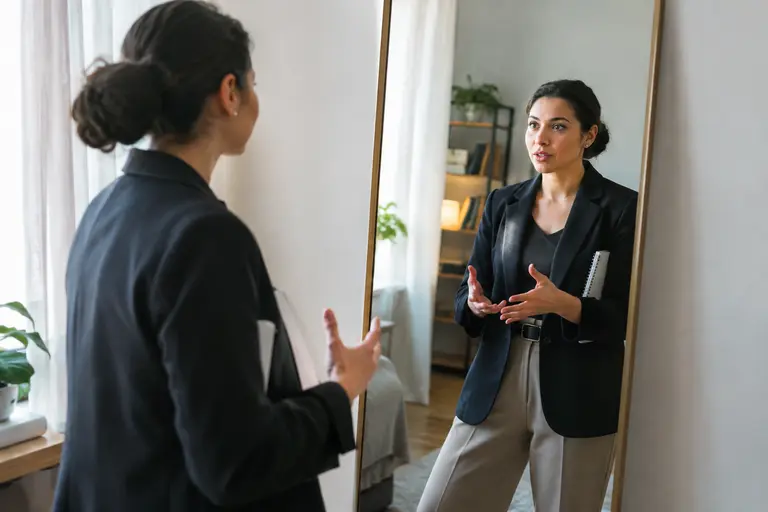
Record One Short Answer
Practice is most helpful when it shows you what the interviewer may see. Record a one-minute answer to a common question, then watch it without judging your appearance harshly. Look for patterns: Are your shoulders rising? Are your hands frozen? Do you nod too often? Do you look away during every main point?
Adjust one cue at a time. If you try to fix posture, gestures, eye contact, smiling, pace, and clothing all at once, you may appear controlled rather than present. A better plan is to choose two priorities. For example: keep hands visible and pause before answering. Or: sit farther from the camera and slow your opening sentence.
Keep Gestures Purposeful
Good gestures support meaning. They can show contrast, sequence, scale, and emphasis. They should not compete with the words. If you tend to over-gesture, rest your hands lightly between points. If you tend to freeze, practice using one hand movement to mark a list or explain a shift.
Interview body language should feel like a clearer version of your normal communication style. A quiet person does not need to become theatrical. An expressive person does not need to become still. The aim is alignment: your voice, posture, clothing, and gestures should all suggest that you are prepared and engaged.
For additional information on community, career, and presentation resources, AGHEIRO offers a wealth of insights as part of a broader network of practical information.
Interview Body Language For Your Next Interview
The strongest preparation joins the practical with the personal. Choose clothing that suits the setting and lets you breathe, sit, gesture, and think comfortably. Set up your video frame so your face and upper body are visible. Practice enough to notice distracting habits, but not so much that your answers sound memorized.
Interview body language cannot guarantee an offer, and it should never be used to cover weak preparation. It can, however, reduce visual friction. When posture, dress, gestures, and facial expression support your message, the interviewer has fewer reasons to question your readiness and more room to hear what you can contribute.
Before your next conversation, ask three simple questions: Does my outfit match the role and allow natural movement? Does my setup help me appear present and easy to hear? Does my body language show attention, steadiness, and respect? If the answer is yes, your image is doing its proper job: supporting the substance of your interview.