
The first impression young professionals make on employers is becoming increasingly important, but new research suggests that many hiring managers remain unconvinced about Generation Z’s workplace readiness.
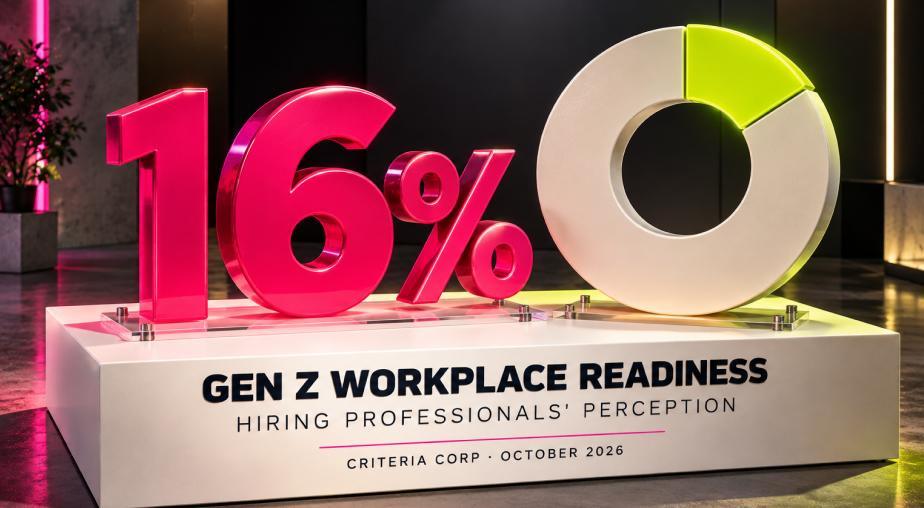
On October 6, 2026, Los Angeles-based hiring technology company Criteria Corp released its ninth annual Hiring Benchmark Report, revealing that only 16% of surveyed U.S. hiring professionals believe Gen Z is well-prepared for the workplace.
The findings come from a survey of 1,027 U.S.-based hiring professionals across different industries, company sizes, and professional roles. According to the official Criteria Corp announcement, 52% of respondents said hiring had become more difficult in 2026, while 55% identified finding qualified candidates with the right skills as their biggest challenge.
Criteria Corp co-founder and CEO Josh Millet connected these challenges to changes in artificial intelligence, candidate evaluation, and the difficulty of identifying reliable indicators of professional ability.
For Gen Z job seekers, the findings raise an uncomfortable question: How can young professionals establish credibility when employers may already question their readiness before an interview begins?
The answer involves more than dressing professionally or creating an attractive LinkedIn profile. It requires demonstrating relevant skills, communicating experience clearly, and developing a professional identity supported by genuine accomplishments.
For HR departments, the report also highlights the risks of allowing broad generational assumptions to influence individual hiring decisions.
What The 16% Gen Z Workplace Readiness Statistic Really Means
The most important distinction in Criteria Corp’s findings is that the 16% figure measures employer perceptions rather than independently verified workplace performance.
The company’s 2026–2027 Hiring Benchmark Report found that approximately half of surveyed hiring professionals considered Gen Z only somewhat prepared for the workplace, while roughly one-third considered the generation unprepared.
Only 16% viewed Gen Z as well-prepared.
The report also found that just 22% of Gen Z respondents within its hiring-professional sample considered their own generation prepared for work.
These findings suggest uncertainty about workplace readiness, but they do not establish that most young workers lack the abilities required for employment.
Generation Z includes individuals at different stages of their careers. Some are recent college graduates entering their first full-time positions, while others already have several years of experience managing projects, working with clients, or supervising colleagues.
A survey asking employers to evaluate an entire generation cannot capture those individual differences.
The results also reflect the expectations of hiring professionals operating in a changing labor market. When employers introduce new technologies, adjust staffing plans, or revise entry-level responsibilities, their definitions of workplace readiness may change.
For young professionals, the practical challenge is therefore not to disprove a generational stereotype through appearance alone. It is to make relevant qualifications visible and understandable.
Why Employers Are Questioning Gen Z’s Professional Readiness
Criteria Corp’s research suggests that concerns about younger workers extend beyond technical qualifications.
According to the report, approximately four in five hiring professionals perceived a mismatch between the skills new graduates possess and the abilities employers need.
Work ethic emerged as the most frequently identified concern, appearing at 67% in the report’s breakdown of perceived skills gaps. Communication, professionalism, and technical or digital skills were also identified as areas of concern.
These categories deserve careful interpretation.
Work ethic is not a single technical competency that can be measured through a resume. Employers may associate it with reliability, initiative, persistence, time management, or willingness to complete unfamiliar assignments.
Professionalism can be equally difficult to define consistently.
In one workplace, professionalism may involve formal communication, conservative clothing, and established reporting procedures. In another, employees may communicate informally, work remotely, and collaborate through digital platforms.
Neither environment automatically produces more capable workers.
The challenge arises when expectations remain unclear or employers interpret differences in communication style as evidence of poor performance.
A young employee who prefers written project updates, for example, may be communicating effectively even if a manager prefers face-to-face conversations.
Similarly, a candidate with limited formal employment history may have developed valuable organizational skills through internships, volunteer projects, academic research, or community leadership.
Hiring managers need evidence of actual behavior rather than assumptions based on age or presentation style.
For Gen Z applicants, this means translating experience into specific examples that demonstrate dependability, communication, problem-solving, and professional judgment.
A Different U.S. Hiring Study Offers A More Nuanced Picture
Criteria Corp’s findings are significant, but they are not the only evidence available about early-career workplace readiness.
On May 28, 2026, the Bethlehem, Pennsylvania-based National Association of Colleges and Employers (NACE) released findings from its Job Outlook 2026 Spring Update.
According to the NACE employer readiness report, more than 70% of participating employers considered new college graduates somewhat well-prepared for employment, while slightly more than 20% considered them very well-prepared.
NACE President and CEO Shawn VanDerziel emphasized the importance of students connecting their educational experiences and developed skills to the industries and positions they were pursuing.
The NACE spring survey included 185 employer responses collected between February 12 and March 17, 2026.
These results differ substantially in tone from Criteria Corp’s findings.
However, the two studies should not be treated as directly contradictory measurements.
Criteria Corp surveyed hiring professionals about Generation Z as a broad demographic group. NACE focused on employers’ assessments of new college graduates entering the workforce. The studies also used different samples, questions, and response categories.
The distinction matters because new college graduates and Gen Z workers are not interchangeable populations.
Together, the studies suggest that workplace readiness is more complicated than a single percentage can explain.
Employers may perceive broad generational shortcomings while still recognizing that individual graduates possess valuable abilities.
For recruiters, the strongest approach is to evaluate candidates against clearly defined job requirements rather than relying on general impressions about their generation.
Why Gen Z’s First Impression Now Begins Before The Interview
Professional first impressions were traditionally associated with introductions, clothing, body language, and interview communication.
Those elements remain relevant, but employers often encounter a candidate’s professional information before any direct conversation occurs.
A resume may be reviewed by a recruiter or processed through an applicant tracking system. A hiring manager may examine a portfolio, professional biography, or work sample before deciding whether to schedule an interview.
LinkedIn profiles can also provide additional context about a person’s experience, projects, and professional interests.
For Gen Z applicants, this creates both opportunities and challenges.
Digital platforms allow early-career professionals to present evidence of their abilities even when their employment histories are relatively short.
A recent graduate in graphic design can share completed projects. A marketing applicant can explain an internship campaign. An aspiring software developer can document technical work through an appropriate portfolio.
These materials provide more context than generic statements about being hardworking or motivated.
However, digital visibility does not guarantee that an employer will review every profile or portfolio.
Some recruitment processes prioritize information submitted through formal application systems. Others rely on structured screening criteria before candidates reach a human reviewer.
A strong first impression therefore begins with accurate, relevant application information.
Personal branding can complement that information, but it should not replace it.
How Gen Z Can Demonstrate Professional Skills Without Years Of Experience
One of the most common challenges facing early-career applicants is the expectation that they demonstrate workplace abilities before accumulating extensive employment experience.
Fortunately, professional experience is not limited to full-time positions.
Internships, apprenticeships, research assignments, student organizations, volunteer responsibilities, and substantial academic projects can provide useful evidence of transferable skills.
The key is explaining what the candidate actually did.
For example, a student who helped organize a university event could describe coordinating schedules, communicating with participants, managing deadlines, and resolving unexpected logistical problems.
A graduate who completed a collaborative research project could explain how responsibilities were divided, how disagreements were handled, and what the team ultimately produced.
These examples are more informative than unsupported claims about leadership or communication ability.
NACE’s 2026 research on skills-based hiring found that approximately 70% of participating employers used skills-based hiring practices, up from 65% the previous year.
The organization also reported that employers increasingly wanted candidates to demonstrate competencies through specific situations and examples.
This creates an opportunity for Gen Z applicants to emphasize evidence rather than seniority.
A professional portfolio does not need to contain dozens of projects. A smaller selection of relevant work, accompanied by clear explanations of responsibilities and outcomes, can communicate more than a collection of disconnected achievements.
Candidates should also distinguish individual contributions from team accomplishments.
Describing a group project’s success is appropriate, but claiming sole responsibility for work completed by several people can damage credibility.
The strongest presentation is both specific and accurate.
Why LinkedIn Personal Branding Matters For Young Professionals
LinkedIn can serve as an extension of a resume by providing context about professional interests, experience, and completed work.
For Gen Z professionals, this can be particularly useful when traditional employment history does not fully communicate their capabilities.
A well-developed profile should make it easy for readers to understand the candidate’s field, relevant skills, educational background, and professional direction.
The headline can identify an area of specialization rather than relying exclusively on a generic description such as recent graduate or aspiring professional.
The profile summary can explain the type of work the individual has completed, the problems they are interested in solving, and the opportunities they are pursuing.
Experience descriptions should prioritize responsibilities and evidence.
For example, an early-career communications professional might describe preparing campaign materials, conducting audience research, or supporting event promotion.
Where appropriate, project samples and published work can reinforce these descriptions.
Consistency is equally important.
Employment dates, academic credentials, project ownership, and professional claims should align across LinkedIn, resumes, personal websites, and other public-facing materials.
An attractive profile cannot compensate for inaccurate information.
There is also no reliable basis for assuming that posting frequently, using a particular headline formula, or maintaining a specific follower count guarantees better recruitment outcomes.
For young professionals, LinkedIn is most valuable when it functions as a credible record of experience and an accessible introduction to their professional interests.
How Professional Headshots Influence First Impressions
Professional photography can support a recognizable personal identity, particularly on LinkedIn, company websites, professional directories, and portfolio pages.
A clear headshot allows colleagues, recruiters, and potential collaborators to recognize the person associated with a professional profile.
However, a photograph should not be interpreted as proof of competence, reliability, or workplace readiness.
On October 1, 2026, Associated Press business writer Dee-Ann Durbin examined how professionals can create authentic headshots that reflect their intended public image.
The Associated Press headshot report included guidance from Houston-based photographer Chris Gillett, who emphasized natural expressions and portraits that keep attention on the subject’s face.
The article also explored concerns about excessive retouching and AI-generated images that substantially change a person’s appearance.

For Gen Z professionals, these considerations are especially relevant when creating an initial LinkedIn presence.
A successful headshot does not require expensive clothing, dramatic studio lighting, or an artificial expression.
Natural facial detail, balanced lighting, an appropriate background, and a recognizable appearance can support a clear professional presentation.
The photograph should also reflect the context in which it will appear.
A young attorney may choose a different visual style from an independent designer, healthcare professional, or creative entrepreneur.
Neither approach is automatically more credible.
The goal is to create a photograph that feels consistent with the person’s actual identity and professional environment.
Importantly, Criteria Corp’s survey did not measure headshot quality or establish that professional photographs improve Gen Z hiring outcomes.
Photography is one component of personal branding, not a solution to the skills concerns identified in the report.
What Gen Z Should Wear For Professional Headshots And Job Interviews
Clothing remains part of professional presentation, but workplace dress expectations have become increasingly dependent on industry, organizational culture, and the responsibilities of a particular position.
A candidate interviewing at a financial services organization may encounter different expectations from someone pursuing a role in game development, marketing, or digital media.
The appropriate choice is not necessarily the most formal outfit.
It is clothing that fits the professional context, allows comfortable movement, and does not distract the wearer from communicating effectively.
For professional headshots, well-fitting clothing and thoughtful color choices can help create a coherent image without requiring an expensive wardrobe.
For interviews, candidates should research the employer’s public-facing materials and follow any instructions provided by the recruitment team.
Finest Image’s guide to company culture attire for job seekers explains how applicants can interpret workplace clothing expectations and prepare outfits that respect organizational norms without sacrificing personal identity.
This is particularly useful for Gen Z candidates who may be entering unfamiliar professional environments.
A creative workplace may allow expressive clothing, while a client-facing position may require a more structured appearance.
Professional presentation should also account for video interviews.
Camera framing, lighting, fabric contrast, background distractions, and posture can influence how clearly someone appears on screen.
Candidates can test these practical details before an interview without attempting to change their identity or conform to unrealistic appearance standards.
Ultimately, clothing and grooming should support communication rather than serve as substitutes for qualifications.
Should Gen Z Applicants Include A Photo On Their Resume?
A professional headshot may be appropriate for LinkedIn or a personal portfolio, but that does not mean it belongs on a conventional U.S. resume.
The U.S. Equal Employment Opportunity Commission (EEOC) advises employers against requesting applicant photographs during the pre-employment process.
According to the agency’s employment policies and practices guidance, information collected during recruitment should generally be limited to what is necessary to determine whether an applicant is qualified for the job.
The EEOC also explains that photographs needed for identification can be obtained after an employment offer has been made and accepted.
The distinction reflects concerns about appearance-related assumptions and discriminatory hiring decisions.
A photograph can reveal or suggest characteristics that are unrelated to someone’s ability to perform a job.
For most conventional U.S. employment applications, Gen Z candidates should therefore prioritize a clear, well-organized resume containing relevant experience, qualifications, and skills.
Professional photographs can remain part of public-facing branding where they serve a legitimate communication purpose.
Candidates applying for specialized creative or performance roles should follow the actual requirements of those applications rather than assuming one rule applies to every profession.
How AI Is Changing Entry-Level Hiring Opportunities
The challenge facing young professionals is not limited to employer perceptions of workplace readiness.
Artificial intelligence is also influencing how organizations evaluate applicants and distribute work.
Criteria Corp’s October 2026 report found that 56% of surveyed hiring professionals had adopted AI in at least part of their recruitment processes.
The research also found that 37% believed AI might be reducing their organizations’ need for entry-level employees.
Within the technology industry, that figure increased to 65%.
These findings describe employers’ reported perceptions. They do not establish that AI directly eliminated a corresponding percentage of entry-level jobs.
Nevertheless, they suggest that organizations are reconsidering how junior positions fit into their staffing plans.
Tasks previously assigned to new employees may increasingly involve AI-supported drafting, research, data organization, or administrative workflows.
That shift could change the skills employers expect candidates to demonstrate.
For Gen Z job seekers, familiarity with AI tools may be useful, but tool familiarity alone is unlikely to establish professional readiness.
Employers still need people who can evaluate information, recognize errors, communicate findings, protect confidential material, and exercise appropriate judgment.
Candidates should therefore explain not only which technologies they have used but also how they applied those technologies responsibly.
An applicant who used AI to organize research could describe how the information was verified and how the final decisions were made.
Someone who used automation during an internship could explain the workflow, the limits of the technology, and the human responsibilities that remained.
This approach demonstrates practical judgment rather than treating AI proficiency as an isolated credential.
What HR Teams Should Change About Evaluating Gen Z Candidates
The 16% workplace readiness finding creates an important responsibility for recruiters and hiring managers.
Employers should avoid turning survey-level perceptions into assumptions about individual candidates.
A person’s generation does not establish whether they communicate effectively, complete assignments reliably, or possess the skills required for a position.
Structured recruitment processes can help reduce that uncertainty.
Hiring teams can identify essential competencies before reviewing applications, use consistent interview questions, and assess candidates against job-related criteria.
Relevant work samples can also provide useful evidence, particularly when applicants have limited formal employment histories.
For example, a candidate pursuing an entry-level marketing position might complete a realistic exercise involving audience analysis or campaign planning.
A prospective administrative employee might explain how they would prioritize competing deadlines.
These activities should be proportionate to the position, clearly explained, accessible to candidates, and designed to evaluate genuine job requirements rather than demand extensive unpaid work.
Employers should also examine how they define professionalism.
Communication style, clothing preferences, and familiarity with traditional office conventions do not always predict performance.
An unfamiliarity with a particular workplace norm may indicate a need for orientation or mentoring rather than a lack of potential.
HR teams can improve hiring decisions by separating trainable expectations from essential qualifications.
How Colleges And Employers Can Narrow The Readiness Gap
Workplace readiness is developed through experience, feedback, and opportunities to apply knowledge.
Educational institutions can support that development by connecting academic work with practical responsibilities.
Internships, apprenticeships, industry projects, student employment, and supervised professional experiences can help students understand how their skills translate into workplace expectations.
Employers also play an important role.
Clear onboarding, realistic performance expectations, mentoring, and constructive feedback can help early-career employees adapt to unfamiliar environments.
This is particularly important when new workers are expected to understand unwritten workplace rules without receiving guidance.
NACE’s August 21, 2026, analysis of its Student Survey on skills-based hiring provides additional context.
The survey included more than 17,000 students from 258 U.S. colleges and universities.
Among graduating seniors, 47.8% reported being familiar with the term skills-based hiring, compared with 39.6% the previous year.
Students who understood the concept were also more likely to report including skills developed through coursework, internships, and extracurricular activities on their resumes.
These findings suggest that career preparation involves more than developing abilities. Students also need to recognize those abilities and explain them to employers.
A graduate may already possess useful communication or leadership experience but struggle to describe it in language relevant to a job opening.
Career services departments, educators, and employers can help bridge that gap by providing practical examples of how competencies appear in real workplace situations.
What A Strong Gen Z Professional First Impression Should Communicate In 2026
Criteria Corp’s October 2026 research reveals a substantial gap between how many hiring professionals perceive Generation Z and the level of workplace readiness employers want to see.
However, the report should not be interpreted as evidence that an entire generation is incapable of meeting professional expectations.
The findings reflect employer concerns during a period of technological change, evolving recruitment practices, and uncertainty about the skills required for entry-level work.
For young professionals, the most effective response is to build a credible record of experience.
That means presenting accurate qualifications, explaining meaningful projects, demonstrating relevant competencies, and maintaining consistency across resumes, LinkedIn profiles, portfolios, and professional biographies.
A recognizable professional headshot and appropriate interview clothing can complement that presentation, but they cannot replace evidence of ability.
For HR teams, the responsibility is to assess individual candidates fairly, explain expectations, and provide opportunities for applicants to demonstrate what they can contribute.
The larger lesson of the 2026 hiring research is that professional first impressions should be grounded in substance rather than generational assumptions.
As AI changes recruitment and early-career responsibilities, the ability to communicate real skills clearly may become one of the most valuable elements of a young professional’s personal brand.