
Professional image is no longer only a question of polish, taste, or brand consistency. For employers and employees, clothing, hair, uniforms, and grooming rules can also become evidence of how fairly a workplace applies its standards. As a brand enhancement coach, I see the practical lesson clearly: image choices should support credibility without forcing people to erase identity, culture, or protected practices.
The recent research record points to a simple but demanding standard. Appearance rules need to be clear, consistent, and connected to real job needs. If a rule is vague, unevenly enforced, or aimed at a style linked with race, ethnicity, religion, or national origin, it can create risk and damage trust. This article is not legal advice. It is a practical image-use framework for reviewing how clothing and grooming decisions affect workplace presence.
Professional Image Rules Are Now Evidence
Dress codes and grooming expectations often begin with reasonable goals: safety, customer recognition, brand consistency, and role clarity. The problem starts when the rule reaches beyond the work need and begins judging identity-linked expression. A professional image policy should answer one question before it restricts clothing or hair: what job-related purpose does this standard serve?
That question matters because appearance rules are not experienced as abstract documents. They are experienced at the mirror, at the locker, at the front desk, and during the first conversation with a supervisor. A hairstyle restriction, head covering rule, uniform fit requirement, or “neatness” standard can affect whether a person feels respected before the workday begins.
What Image Rules Communicate
Clothing choices send signals, but policies send signals too. A well-written rule says, “Here is how we present ourselves to clients and co-workers.” A poorly written rule may say, “Only one version of professionalism is acceptable here.” Those are very different messages.
For image selection, this means employers should separate role-based presentation from personal preference. A security officer may need a visible uniform. A food service worker may need hair secured for hygiene. A client-facing employee may need clothing that is safe and appropriate for the setting. Those needs can often be stated without banning culturally significant hairstyles or singling out attire associated with a protected group.
What The Key Case Shows About Grooming Standards
On August 5, 2026, the 11th U.S. Circuit Court of Appeals vacated an $811,264 verdict in favor of Davita Key, a Black woman who said she was sent home under a grooming policy that banned locs and similar hairstyles for uniformed security officers. Bloomberg Law reported that the court ordered a new trial because the jury instructions did not properly ask whether she brought the race complaint to the relevant employer, leaving the case unresolved as of October 17, 2026: Bloomberg Law report.
The case is useful for image professionals because it shows how a grooming rule can move from a workplace handbook into litigation. The issue was not whether an employer may ever set grooming standards. The issue centered on how a specific rule affected a worker and how the legal questions were presented at trial.
Case Status Matters
Because the verdict was vacated and the matter was sent back for a new trial, the case should not be treated as a final worker victory or final employer victory. It is better read as a warning about precision. If a workplace rule names a hairstyle associated with race or culture, the business reason and enforcement pattern will likely receive close attention.
For managers, the practical move is to review the exact words used in handbooks. For employees, the practical move is to ask for written clarification if a rule appears to restrict hair, clothing, or grooming in a way that conflicts with identity, faith, or cultural practice. Keeping the discussion specific helps everyone avoid turning style concerns into personal criticism.
How EEOC Activity Changes Image Decisions
The EEOC’s Fiscal Year 2025 litigation record shows that workplace discrimination enforcement remained active. The agency said it filed 94 merits lawsuits, resolved 120 merits cases, and secured nearly $27 million in monetary relief. It also reported that, of 180 active merits cases on its district court docket at the end of FY 2025, 81 were class or systemic cases and 37 were systemic discrimination cases: EEOC FY 2025 report.
Those figures do not prove that every appearance policy is problematic. They do show why image standards deserve careful review. Workplace rules can affect one person at a time, but they can also reflect a broader pattern if the same restriction applies across a group.
Professional Image Questions To Ask
Before changing a dress code or grooming rule, leaders can use a short image review. The aim is not to weaken standards. The aim is to make standards easier to explain and fairer to apply.
- What specific job need does the clothing, hair, or grooming rule support?
- Is the rule written in neutral language, or does it name a protected or culturally linked trait?
- Would the same standard be applied to every employee in the same role?
- Is there a clear process for religious, medical, cultural, or disability-related requests?
- Could the same business goal be met with a narrower rule?
This type of review also supports brand clarity. A company that explains its standards calmly and consistently appears more credible than one that relies on subjective words such as “unprofessional” without defining the work-related concern.
Practical Clothing Choices For Employees And Managers
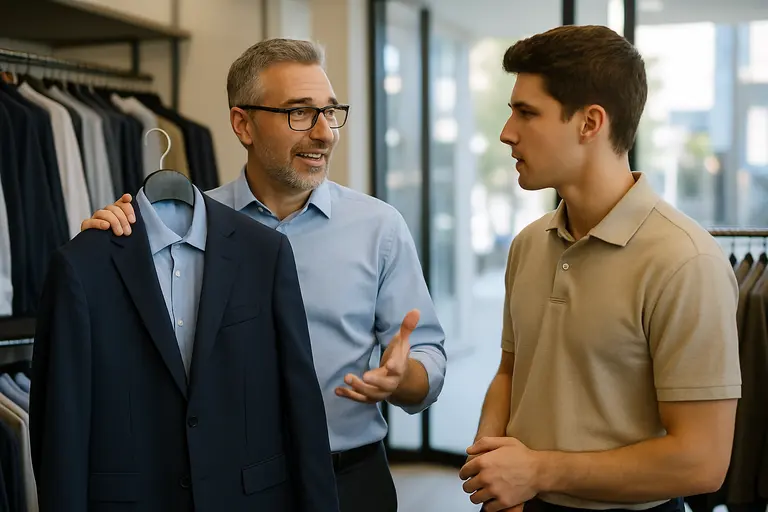
For employees, professional image should begin with the role, not with fear. Look at the work setting, the safety needs, the level of client contact, and the written policy. Then choose clothing that helps you do the work and feel steady in the room. If a rule seems unclear, ask for the policy language rather than relying only on hallway comments.
For managers, the strongest appearance standards are usually the plainest. Instead of saying “hair must be businesslike,” describe the actual requirement: hair must not block vision, interfere with required equipment, or create a stated safety concern. Instead of saying “dress professionally,” define the practical categories that fit the role, such as closed-toe footwear, visible identification, or clean uniform pieces.
Separate Brand Signals From Protected Traits
Good image selection focuses on signals that can be changed without asking someone to suppress identity. Color coordination, garment condition, fit, cleanliness, and role-appropriate layers are usually safer and clearer than rules about natural hair texture, traditional attire, or religious dress.
For a related workplace policy discussion, Finest Image has also covered dress code law for professional branding. For a creative take on image cues, a site like The Sketchbook Project can spark ideas before rigid policies are established.
Professional Image After Recent EEOC Cases
A useful professional image standard should make work easier to perform, not identity harder to carry. Recent EEOC-related developments show that appearance rules are strongest when they are specific, role-based, evenly applied, and open to reasonable requests for adjustment.
For employees, the practical path is to choose clothing and grooming details that support the job while asking clear questions when a standard feels inconsistent or identity-related. For employers, the practical path is to remove unnecessary bans, define real work needs, train supervisors to apply rules evenly, and keep accommodation conversations respectful.
Clothing choices still shape credibility. Grooming still affects first impressions. Uniforms still help people understand roles. But the standard of professionalism is becoming more precise: the image should serve the work without turning culture, race, religion, disability, or national origin into a workplace disadvantage.