
Starting a new job involves more than learning responsibilities, meeting coworkers, and understanding company expectations. It also means figuring out how to present yourself in an unfamiliar professional environment.
One of the first questions many new employees ask is simple: What should I wear on my first day at work?
The answer is not always a formal suit, a business-casual outfit, or whatever appeared appropriate during the job interview. Workplace dress codes vary across industries, organizations, geographic locations, and individual teams. An outfit that communicates professionalism in one setting may appear unnecessarily formal in another.
On October 17, 2026, Business Insider published an interview with Laura Massetti, founder of the career-coaching company Real Work Ready, examining the unwritten workplace expectations that can challenge employees beginning their careers.
Massetti spent 15 years leading corporate sales and marketing teams before developing a coaching program focused on workplace communication, professional judgment, and organizational awareness.
Among the lessons she discussed was an experience involving her own clothing choices. Early in her corporate career, she arrived at a meeting in Miami wearing a full black business suit, only to discover that her outfit was considerably more formal than the environment required.
Her experience illustrates an important distinction: dressing professionally is not necessarily the same as dressing formally.
For employees preparing for their first day, the goal is to understand the workplace, select clothing that supports their responsibilities, and create a professional impression without sacrificing comfort or personal identity.
What Did Laura Massetti Say About the Unwritten Rules of Professional Appearance?
In her October 17 interview with Business Insider, Massetti explained that employees are frequently evaluated on expectations that are never formally included in their job descriptions.
These expectations can involve communication, reliability, judgment, meeting preparation, organizational awareness, and professional presence.
Massetti argued that early-career employees are sometimes expected to understand workplace conventions without receiving clear instruction.
Her observations focused particularly on younger professionals entering organizations where established employees may have developed their workplace habits through years of experience.
However, these challenges are not exclusive to Generation Z. Someone changing industries, returning to office-based work, or joining a company with a different organizational culture can face similar uncertainty.
Massetti’s personal experience with clothing demonstrates why workplace expectations cannot always be reduced to a universal set of rules.
Approximately six months into one of her jobs, she wore a formal black suit to a meeting in Miami. The outfit was professionally appropriate in isolation, but it did not match the atmosphere of the meeting.
The problem was not the quality or formality of the clothing. It was the difference between the outfit and the setting.
Massetti’s broader advice emphasizes understanding the environment and the people with whom an employee will be working.
For someone starting a new job, that means researching the workplace before selecting an outfit rather than assuming that more formal clothing automatically creates a stronger impression.
Why Your First-Day Outfit Matters for Professional First Impressions
Clothing is one of several visible elements that contribute to an initial professional impression.
Before a new employee has an opportunity to demonstrate their technical abilities, coworkers may notice their clothing, posture, communication style, and overall preparation.
These observations do not reliably measure competence, character, or future job performance. Nevertheless, appearance can influence how people initially interpret an unfamiliar colleague.
A carefully chosen outfit can help communicate that someone has considered the setting and prepared for the occasion.
It can also make the employee feel more comfortable during introductions, meetings, and orientation activities.
The University of California, Davis Career Center emphasizes the relationship between appropriate professional clothing, preparation, and confidence in its professional attire guidance.
The university recommends choosing comfortable clothing suited to the weather and occasion, while avoiding unnecessary distractions such as poorly fitting garments or neglected clothing maintenance.
Although its guidance primarily addresses interviews and career fairs, several principles also apply to an employee’s first day.
The important difference is that an interview and an ordinary workday serve different purposes.
During an interview, candidates may choose slightly more formal clothing to reflect the significance of the occasion. Once employment begins, the more useful standard is the organization’s actual dress code and the practical demands of the role.
A successful first-day outfit should therefore balance three considerations: workplace expectations, personal comfort, and the employee’s professional identity.
How Can You Find Out the Dress Code Before Your First Day?
The most reliable way to choose appropriate clothing is to obtain information directly from the employer.
New employees often receive onboarding documents covering arrival times, required identification, parking, technology access, and workplace procedures.
Dress expectations may be included in those materials, particularly when uniforms, protective equipment, or client-facing standards apply.
If the information is missing, asking a recruiter, hiring manager, or human resources representative is reasonable.
A straightforward question such as, “Is there a recommended dress code for my first day or orientation?” can prevent unnecessary uncertainty.
Employees can also ask whether their first day involves meeting clients, visiting operational facilities, attending formal presentations, or participating in activities that require specific footwear.
These details matter because a normal office outfit may not be appropriate for every task.
For example, an employee joining a manufacturing company might spend part of orientation in an administrative office and another part touring a production facility.
In that situation, footwear and safety requirements may be more important than conventional business styling.
Company websites and employee photographs can provide additional context, but they should not be treated as definitive evidence of everyday dress standards.
Corporate photographs are often produced for marketing purposes. Employees may wear more formal clothing for professional headshots or company events than they do during ordinary workdays.
Direct guidance from the employer should take priority over assumptions based on promotional imagery.
Business Professional, Business Casual, and Smart Casual: What Is the Difference?
One reason first-day clothing decisions can be confusing is that workplace dress codes use terminology that is not always defined consistently.
A company describing its environment as business casual may have different expectations from another organization using the same phrase.
The Texas A&M University Career Center’s dress-for-success guide distinguishes among business professional, business casual, and smart casual clothing.
Its examples provide a useful starting point, although employees should always follow their own employer’s requirements.
| Dress Code | Typical Clothing Examples | Appropriate Context |
|---|---|---|
| Business Professional | Tailored suit or coordinated formal separates, dress shirt or blouse, polished shoes | Formal business settings, executive meetings, certain client-facing roles |
| Business Casual | Chinos or dress trousers, blouse, collared shirt, sweater, optional blazer, loafers or appropriate flats | Many office environments and professional workplaces |
| Smart Casual | Dark, neat jeans where permitted, simple shirt or sweater, casual blazer, clean appropriate shoes | Less formal offices and some creative or technology workplaces |
| Uniform or Role-Specific Attire | Employer-issued clothing, approved footwear, protective equipment, or occupation-specific garments | Healthcare, hospitality, manufacturing, laboratories, and other operational settings |
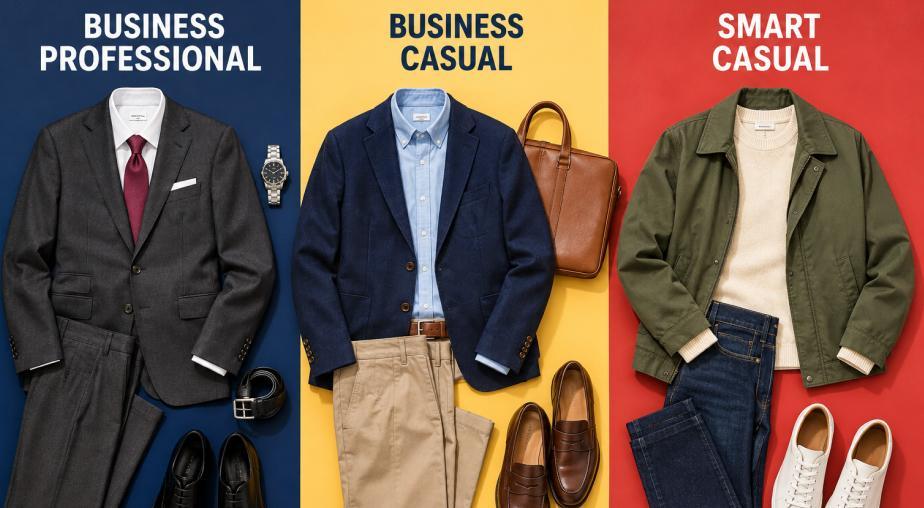
These examples are illustrative rather than universal.
A blazer may be unnecessary in one office but expected in another. Jeans may be accepted in a technology company while remaining inappropriate for certain client meetings.
Some workplaces also distinguish between ordinary office days and occasions requiring more formal clothing.
For new employees, the objective is not to memorize every possible dress-code category. It is to identify which expectations apply to their actual responsibilities.
Should You Dress More Formally Than Your Coworkers on the First Day?
The familiar advice to dress more formally than the people around you can be useful in some situations, particularly job interviews.
However, Massetti’s experience suggests that the principle has limitations once someone enters the workplace.
A full business suit may create an unnecessarily formal impression in an organization where employees regularly wear chinos, sweaters, and casual jackets.
Similarly, arriving in jeans and sneakers may be inappropriate when the employer expects traditional business attire.
The better approach is to select an outfit near the more polished end of the organization’s normal dress range.
If the workplace is business casual, for example, neatly fitted trousers, a simple shirt, and an optional blazer may provide flexibility.
The blazer can be removed if the environment proves more relaxed than expected.
For a smart-casual office, dark trousers and a clean, well-fitting top may be a safer starting point than distressed denim or highly informal clothing.
The important consideration is adaptability.
New employees should not feel obligated to purchase expensive formal clothing simply because they want to demonstrate ambition.
An appropriate, clean, comfortable outfit generally communicates preparation more effectively than an expensive ensemble that feels disconnected from the workplace.
What Should You Wear on Your First Day in Different Industries?
Industry expectations influence workplace clothing, but individual employers may establish standards that differ from general conventions.
In finance, law, and formal corporate environments, tailored clothing may remain common, particularly for client-facing employees.
A coordinated suit or professional separates may be appropriate when the employer identifies business professional as its standard.
In technology and creative industries, clothing expectations may be more relaxed. Employees may wear chinos, sweaters, casual shirts, or clean jeans when permitted.
However, creative workplaces can still have specific expectations for presentations, client meetings, and public events.
In education and nonprofit organizations, clothing often needs to balance professional presentation with practical movement and daily responsibilities.
An employee who spends much of the day interacting with students or participating in community activities may prioritize comfortable, durable clothing.
In hospitality, healthcare, laboratories, and manufacturing, workplace requirements can involve uniforms, hygiene procedures, protective equipment, or approved footwear.
In those settings, safety and job-specific rules take precedence over general fashion recommendations.
These distinctions also explain why observing the workplace is useful.
The first few days can reveal differences between the company’s official policy and the practical clothing choices associated with particular responsibilities.
However, observation should supplement rather than replace written requirements, especially where safety is involved.
Why Clothing Fit and Comfort Matter More Than Expensive Brands
Professional appearance is frequently discussed in terms of clothing categories, but fit and comfort can have a greater practical influence on how someone experiences their first day.
A costly jacket that restricts movement may be less suitable than an affordable, well-fitting alternative.
Shoes that cause discomfort can become distracting during a day involving building tours, introductions, or extended periods of standing.
Clothing that requires constant adjustment may also make an unfamiliar environment feel more stressful.
The UC Davis Career Center specifically recommends selecting clothing that fits comfortably and is appropriate for seasonal conditions.
This is particularly relevant for employees commuting in warm weather, working in heavily air-conditioned offices, or moving between indoor and outdoor locations.
A practical first-day outfit should allow someone to sit, stand, walk, and perform expected tasks without unnecessary discomfort.
Fabric also matters.
Breathable materials can be useful in warmer climates, while a removable layer may help employees adjust to changing temperatures.
Before the first day, trying on the complete outfit is more useful than evaluating each garment separately.
Shoes, accessories, outerwear, and bags should work together as a practical combination.
The objective is not perfection. It is reducing avoidable distractions so attention can remain on the work and people involved.
How Do Colors, Accessories, and Grooming Affect Professional Appearance?
Color can contribute to the overall impression created by an outfit, but there is no scientifically established workplace rule that one particular color guarantees confidence, trust, or career success.
Neutral colors such as navy, charcoal, cream, gray, and brown are often practical because they can be combined easily.
However, a professional wardrobe does not need to exclude brighter colors.
A colorful blouse, patterned scarf, distinctive tie, or carefully selected accessory can express individuality while remaining appropriate to the setting.
The balance depends on the workplace and the person wearing the clothing.
Accessories should also be practical.
A bag that comfortably carries a laptop, notebook, identification, and other required items may be more useful than one selected primarily for its appearance.
Jewelry, watches, and other accessories should not interfere with work responsibilities or safety requirements.
Basic clothing maintenance is another consideration.
Checking for stains, wrinkles, damaged fasteners, and worn footwear before leaving home can prevent last-minute problems.
Grooming should support personal comfort, hygiene, and workplace requirements without demanding that everyone adopt the same hairstyle, facial-hair preferences, or beauty standards.
Professionalism is not defined by a single cultural or aesthetic appearance.
Can You Express Your Personal Style While Following a Workplace Dress Code?
Workplace dress codes can help organizations communicate expectations, but they also raise questions about individuality, fairness, and cultural identity.
Employees may express personal or cultural identity through clothing, hairstyles, religious garments, accessories, or grooming practices.
A workplace’s preference for a particular appearance does not automatically override applicable employment protections.
The U.S. Equal Employment Opportunity Commission (EEOC) explains that Title VII of the Civil Rights Act of 1964 may require covered employers to make reasonable accommodations for sincerely held religious practices that conflict with workplace requirements, unless doing so would create an undue hardship.
Its religious accommodation guidance identifies religious clothing, head coverings, facial hair, and other grooming practices among the issues that can require accommodation.
Whether an accommodation is required depends on the circumstances, including applicable law and workplace requirements.
This is different from ordinary personal fashion preferences, which do not necessarily receive the same legal protections.
For employees, the practical lesson is that professional appearance should not be confused with abandoning personal identity.
For employers, clearly communicating expectations can reduce uncertainty and help prevent inconsistent or unfair enforcement.
A workplace can maintain legitimate professional and safety standards while recognizing that employees have different cultural backgrounds, religious practices, physical needs, and forms of self-expression.
What If Your First Day at Work Is Remote or Hybrid?
Remote employees face a different version of the first-day clothing question.
A new hire working from home may not need the same outfit they would wear to a corporate office, but virtual introductions still create professional expectations.
The appropriate clothing depends on whether the day includes video meetings, onboarding presentations, client conversations, or independent administrative work.
For a scheduled video introduction, a clean shirt, blouse, sweater, or other appropriate top can provide a polished appearance without requiring unnecessary formality.
Employees should also consider the relationship between their clothing and the camera setup.
A dark outfit against a dark background may make the image appear visually flat. A highly patterned garment can become distracting on a small video screen.
The UC Davis Career Center’s virtual interview recommendations emphasize appropriate lighting, camera positioning, and an uncluttered background.
Although those recommendations address interviews, the same visual principles can improve the clarity of a remote employee’s first-day introduction.
Positioning the camera near eye level, checking facial lighting, and ensuring that the background is not distracting can make communication easier.
Employees should also test their microphone, internet connection, and meeting software before scheduled introductions.
Professional presence on video is a combination of preparation, communication, and visual clarity—not simply the formality of someone’s clothing.
Does Your Professional Headshot Need to Match Your Workplace Style?
For many employees, their first professional introduction happens before they enter the office.
A company directory, LinkedIn profile, employee announcement, or internal communication platform may display their photograph to colleagues who have not yet met them.
That creates an additional question: should the clothing in a professional headshot match what someone normally wears to work?
In most cases, the photograph should present a recognizable and appropriate version of the person’s professional identity.
Someone working in a formal business environment may choose a tailored jacket or suit for a headshot.
An employee in a creative field may prefer clothing that reflects a more expressive professional style.
The photograph does not need to reproduce an ordinary workday exactly, but it should not create a completely different impression from the person colleagues will eventually meet.
Lighting, expression, posture, and background selection also contribute to that impression.
A natural expression and clear facial lighting may communicate more effectively than an elaborate outfit or highly stylized setting.
For readers exploring the relationship between appearance, photography, and professional identity, Finest Image’s first-impression resources provide additional context on personal branding and visual presentation.
The larger principle is consistency.
Clothing, professional photographs, communication style, and workplace behavior should support a coherent presentation rather than competing with one another.
Why Professional Presence Is About More Than What You Wear
Massetti’s October 17 interview addressed clothing as one example of a much broader workplace challenge.
She emphasized that employees are also evaluated on their ability to communicate clearly, understand organizational expectations, prepare for meetings, and follow through on responsibilities.
In one example, she described hearing about a new employee who contacted the chief executive of a very large company directly through Slack to request a meeting.
The employee apparently did not understand the organization’s communication conventions.
Massetti used the situation to illustrate how employees can make mistakes when important expectations are never explained.
The same principle applies to clothing.
A new hire cannot be expected to understand every workplace convention immediately, especially when different employers use different standards.
Managers and human resources teams have a responsibility to communicate expectations clearly.
For employees, professional presence can be demonstrated through punctuality, attentive listening, appropriate questions, and reliable follow-through.
Someone wearing an excellent outfit but arriving unprepared may create a less favorable impression than someone dressed simply who demonstrates engagement and good judgment.
This is why first-day preparation should extend beyond wardrobe selection.
Knowing where to report, what documents to bring, whom to contact, and how the onboarding schedule works can be just as important.
A Practical First-Day Wardrobe Checklist
Preparing clothing the evening before work can reduce unnecessary decisions on the morning of an important transition.
A useful checklist includes:
- Confirm the dress code. Review onboarding materials or ask the employer about clothing expectations and any safety requirements.
- Choose comfortable, appropriate clothing. Select an outfit that fits well and supports the activities planned for the day.
- Check the complete outfit. Look for wrinkles, stains, damaged fasteners, and footwear that may need cleaning.
- Prepare practical accessories. Organize a work bag, identification, notebook, and other requested materials.
- Consider the environment. Account for weather, commuting conditions, office temperature, and walking requirements.
- Have an alternative ready. A removable jacket or backup clothing option can help if conditions differ from expectations.
This preparation does not require an extensive wardrobe.
For many employees, a small selection of versatile clothing is sufficient until they understand the organization’s everyday standards.
It is generally more practical to observe the workplace before purchasing additional work outfits than to build an entire wardrobe around assumptions.
What Should You Do If You Misjudge the Dress Code?
Even careful preparation cannot eliminate every uncertainty.
An employee may arrive wearing a blazer and discover that most colleagues are dressed casually.
Another may realize that the workplace expects more formal clothing than the onboarding materials suggested.
Neither situation necessarily creates a lasting professional problem.
If the difference is minor, there may be no need to address it immediately.
The employee can observe how coworkers dress, ask questions when appropriate, and adjust future clothing choices.
If the outfit conflicts with an explicit requirement or creates a safety concern, the employee should speak with the appropriate supervisor and follow workplace instructions.
The important response is adaptability rather than embarrassment.
Massetti’s Miami experience demonstrates that even experienced professionals can misread a workplace’s visual expectations.
The useful lesson is not that formal clothing is wrong or that casual clothing is always better.
It is that professional judgment improves when people pay attention to context.
A first-day outfit is one early decision in a longer process of understanding the organization.
The First-Day Impression That Matters After the Clothes Are Forgotten
Choosing what to wear on your first day at work is ultimately an exercise in preparation and professional awareness.
Laura Massetti’s October 17, 2026, observations highlight how easily employees can encounter expectations that were never clearly communicated.
Her experience wearing a formal black suit to a comparatively relaxed meeting in Miami demonstrates that professional clothing must be evaluated in context.
A strong first-day outfit should match the workplace’s actual requirements, support the employee’s responsibilities, and allow the person wearing it to feel comfortable and recognizable.
That might mean a tailored suit, business-casual separates, smart-casual clothing, or an employer-required uniform.
There is no single outfit that works for every employee or organization.
More importantly, clothing represents only one part of professional presence.
The impressions that develop over the following days and weeks will also depend on communication, preparation, reliability, collaboration, and the willingness to learn.
The best first-day outfit is not necessarily the most formal or expensive. It is the one that helps you arrive prepared, participate comfortably, and begin understanding the workplace around you.